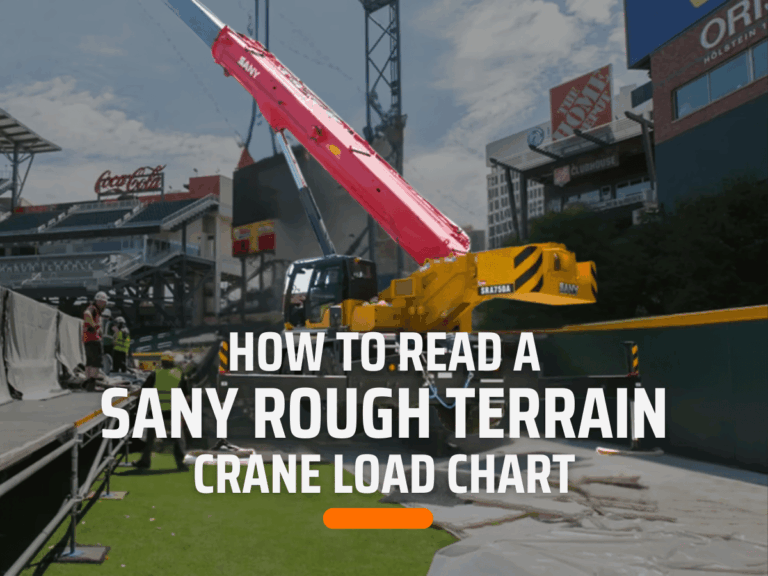
In crane operations, the load chart is the most critical technical document connecting the machine’s design capability with real lifting operations on site. Regardless of crane size or manufacturer, every lifting task must ultimately be validated against the load chart before execution.
For SANY rough terrain cranes, the load chart defines the crane’s allowable lifting capacity under specific operating configurations, including boom length, working radius, outrigger position, and counterweight installation.
Unlike fixed capacity ratings often quoted in brochures, the lifting capacity shown in a load chart is dynamic and configuration-dependent. It changes continuously based on the crane’s geometry and stability conditions.
For operators, supervisors, and lift planners, understanding how to interpret the load chart correctly is essential for preventing overload conditions, avoiding crane instability, and ensuring safe lifting operations.
This article explains how to read a SANY rough terrain crane load chart, focusing on the key technical parameters, interpretation procedures, and common mistakes that should be avoided during crane operations.
What Is a SANY Rough Terrain Crane Load Chart?
A SANY rough terrain crane load chart is a manufacturer-provided technical reference that defines the maximum safe lifting capacity under specific operating conditions.
These values are determined through engineering calculations and physical load testing based on three fundamental constraints:
• Structural strength of the boom and lifting components
• Hydraulic system performance
• Stability limits related to crane tipping
In most lifting configurations, the crane capacity is governed by stability rather than structural strength. To maintain safety, the rated load is typically limited to approximately 75% of the tipping load, providing an additional safety margin.
Because the overturning moment acting on the crane changes with crane geometry, the allowable lifting capacity varies depending on several operating parameters such as boom length, lifting radius, and outrigger configuration.
Understanding how these parameters interact is the key to interpreting the load chart correctly.
Key Elements of a SANY Rough Terrain Crane Load Chart
To read a SANY crane load chart accurately, operators must understand the parameters that determine lifting capacity. These parameters form the basis of load moment calculations used by crane manufacturers.
The following are the most critical elements found in a typical SANY RT crane load chart.
1. Maximum Lifting Capacity
Maximum lifting capacity refers to the maximum total weight the crane can safely lift under a specific configuration.
It is important to understand that this value represents the total suspended load, not only the weight of the object being lifted.
The total suspended load includes:
• Hook block
• Slings and shackles
• Lifting beams or spreaders
• The actual load
The rated capacity shown in the chart represents the upper limit that must never be exceeded during crane operation.
2. Working Radius
The working radius, also known as lifting radius, is the horizontal distance from the center of crane rotation to the vertical centerline of the hook.
This parameter is the most important factor affecting crane capacity.
The overturning moment acting on the crane is determined by the relationship:
Load Moment = Load Weight × Working Radius
As the working radius increases, the overturning moment acting on the crane also increases. To maintain stability, the allowable lifting capacity must decrease.
This is why crane capacity reduces significantly as the load moves further away from the crane.
For accurate load chart interpretation, the working radius should always be measured or calculated precisely before the lift begins.
3. Boom Length and Boom Angle
SANY rough terrain cranes use multi-section telescopic booms, allowing operators to adjust boom length depending on the required reach.
Boom length directly influences crane capacity for two main reasons.
First, extending the boom increases the distance between the load and the crane’s center of rotation, increasing the load moment.
Second, longer boom configurations introduce higher structural stresses and deflection within the boom sections.
Boom angle also affects crane capacity. A higher boom angle reduces the working radius and increases lifting capacity, while a lower boom angle increases the radius and reduces allowable load.
Most modern load charts use working radius as the primary reference parameter, while boom angle serves as a geometric reference for crane positioning.
4. Counterweight Configuration
Counterweight configuration plays a critical role in determining crane stability.
SANY rough terrain cranes may operate with different counterweight configurations depending on the crane model.
A larger counterweight increases the crane’s resistance to overturning by balancing the load moment generated during lifting operations.
Load charts are therefore often divided according to counterweight configuration.
Using the load chart corresponding to full counterweight when the crane is operating without it can significantly overestimate lifting capacity, creating a serious safety risk.
Operators must always verify the installed counterweight before referencing the load chart.
5. Outrigger Configuration
Rough terrain cranes rely heavily on outrigger deployment to maintain stability during lifting operations.
The position and extension length of the outriggers directly influence the crane’s support base and overall stability.
Typical configurations include:
• Fully extended outriggers
• Intermediate outrigger extension
• Minimum extension
Step-by-Step Method to Read a SANY Rough Terrain Crane Load Chart
Interpreting a crane load chart should follow a logical process.
The correct approach is to identify the crane configuration first, determine the lifting geometry, and finally verify the allowable lifting capacity.
The crane achieves its highest lifting capacity when outriggers are fully extended and properly supported.
If the outriggers are only partially extended, the crane’s stability decreases, and the allowable lifting capacity must be reduced accordingly.
This is why load charts provide separate capacity tables for different outrigger configurations.
Step 1: Confirm Crane Configuration
Before consulting the load chart, confirm the crane’s operating configuration.
This includes:
• Outrigger extension status
• Counterweight installation
• Boom configuration
• Jib installation (if applicable)
Each configuration corresponds to a different section of the load chart. Using the incorrect chart can lead to major errors in capacity calculations.
Step 2: Determine Boom Length and Boom Angle
Next, determine the boom configuration required for the lift.
Operators should confirm the actual boom length and elevation angle using the crane’s onboard indicators.
These values help determine the crane’s geometry and allow operators to estimate the working radius of the load.
Step 3: Measure the Working Radius
Measure the horizontal distance between the crane’s slewing center and the hook position.
This measurement is typically performed using a laser rangefinder or site measurement tools.
Once the working radius is known, locate the corresponding row or coordinate in the load chart.
Step 4: Identify the Maximum Rated Capacity
Locate the intersection between the boom length column and the working radius row in the load chart table.
The value at this intersection represents the maximum allowable total suspended load for that configuration.
Step 5: Calculate the Net Allowable Load
Finally, subtract the weight of lifting accessories to determine the allowable weight of the actual load.
Net allowable load = Rated capacity − rigging weight
For example:
Rated capacity from chart: 30 tons
Hook block: 0.5 tons
Rigging gear: 1.1 tons
Net allowable load:
30 − 1.6 = 28.4 tons
If the load exceeds this value, the crane configuration must be adjusted.
Possible adjustments include:
• reducing working radius
• shortening boom length
• repositioning the crane closer to the load
Common Mistakes When Reading Rough Terrain Crane Load Charts
Even experienced operators sometimes misinterpret load charts during lifting operations.
One common mistake is referencing the wrong configuration chart, especially when outriggers are partially deployed.
Another frequent error is estimating the working radius visually instead of measuring it accurately.
Operators may also forget to account for the weight of rigging equipment, which can result in exceeding the crane’s rated lifting capacity.
Ground conditions also play an important role. Load charts assume the crane is operating on level, stable ground. Uneven terrain or inadequate outrigger support can reduce actual crane capacity significantly.
Conclusion
For operators and lift planners, understanding how to read a SANY rough terrain crane load chart is a fundamental technical skill.
The load chart defines the crane’s operating limits based on stability analysis, structural strength, and hydraulic performance.
By correctly interpreting key parameters such as working radius, boom length, counterweight configuration, and outrigger position, operators can determine whether a lift can be performed safely before the crane begins operation.
Proper use of the load chart ensures that the crane operates within its design limits, protecting both personnel and equipment while maintaining efficient lifting operations.