In crane operations, the load chart is the primary technical reference that defines the lifting capability of the crane under specific configurations. Every lift must be verified against the load chart to ensure the crane operates within its structural and stability limits.
For UNIC truck-mounted cranes, the load chart typically consists of two main components:
- The working range chart, which illustrates the geometric relationship between boom length, boom angle, lifting height, and working radius.
- The rated capacity table, which shows the maximum allowable lifting capacity corresponding to a specific boom length and working radius.
By combining these two charts, operators can determine whether a load can be safely lifted at a given position.
Understanding how these charts interact is essential for safe crane operation.
Understanding the Three Key Elements of the UNIC Load Chart
The UNIC load chart is primarily based on three operational parameters.
These parameters determine the load moment acting on the crane, which ultimately defines the allowable lifting capacity.
1. Boom Length
Boom length represents the actual extension length of the crane boom, measured from the boom foot pin to the boom head.
On UNIC cranes, boom length corresponds directly to the number of telescopic sections extended.
For example:
- 3.17 m boom length – first section only
- 5.10 m boom length – two sections extended
- 7.00 m boom length – three sections extended
- 8.90 m boom length – four sections fully extended
As the boom extends further, the load is positioned farther away from the crane’s slewing center. This increases the load moment acting on the crane structure, which reduces the allowable lifting capacity.
This is why the rated lifting capacity decreases significantly as the boom length increases.
2. Working Radius
The working radius is defined as the horizontal distance between the crane’s slewing center and the vertical centerline of the hook.
It is important to note that the working radius is not the boom length.
Instead, it is determined by both:
- boom length
- boom angle
When the boom is lowered, the working radius increases. When the boom is raised, the working radius decreases.
In the working range chart shown above, the working radius is represented along the horizontal axis at ground level.
For example, the diagram indicates a working radius of 3 meters, measured from the crane’s slewing center to the hook position.
Because the overturning moment acting on the crane is calculated as:
Load Moment = Load Weight × Working Radius
the working radius becomes the most critical factor affecting lifting capacity.
As the radius increases, the crane’s allowable lifting capacity decreases rapidly.
3. Maximum Lifting Capacity Table
The rated capacity table provides the maximum allowable lifting capacity corresponding to specific combinations of:
- boom length
- working radius
The values shown in the table represent the maximum total suspended load, including the hook and lifting accessories.
Each row in the table corresponds to a working radius, while each column corresponds to a boom length configuration.
By locating the intersection of these two parameters, the operator can determine the crane’s maximum rated lifting capacity.
Example: Interpreting the UNIC Load Chart
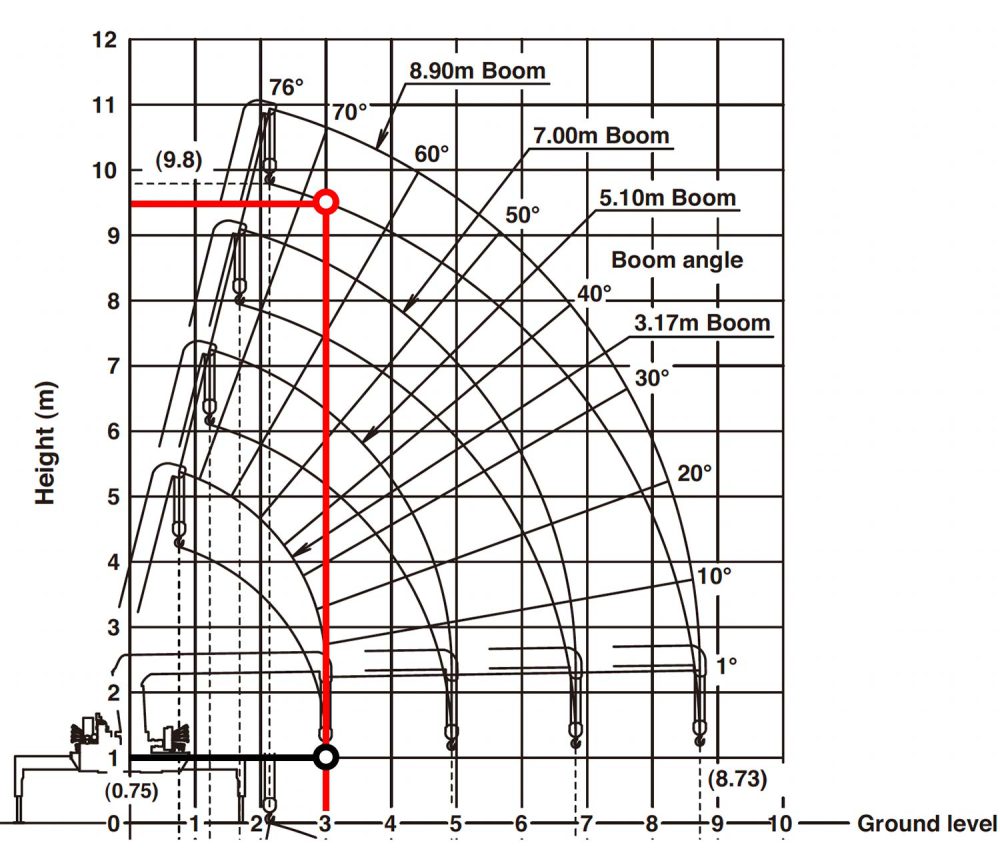
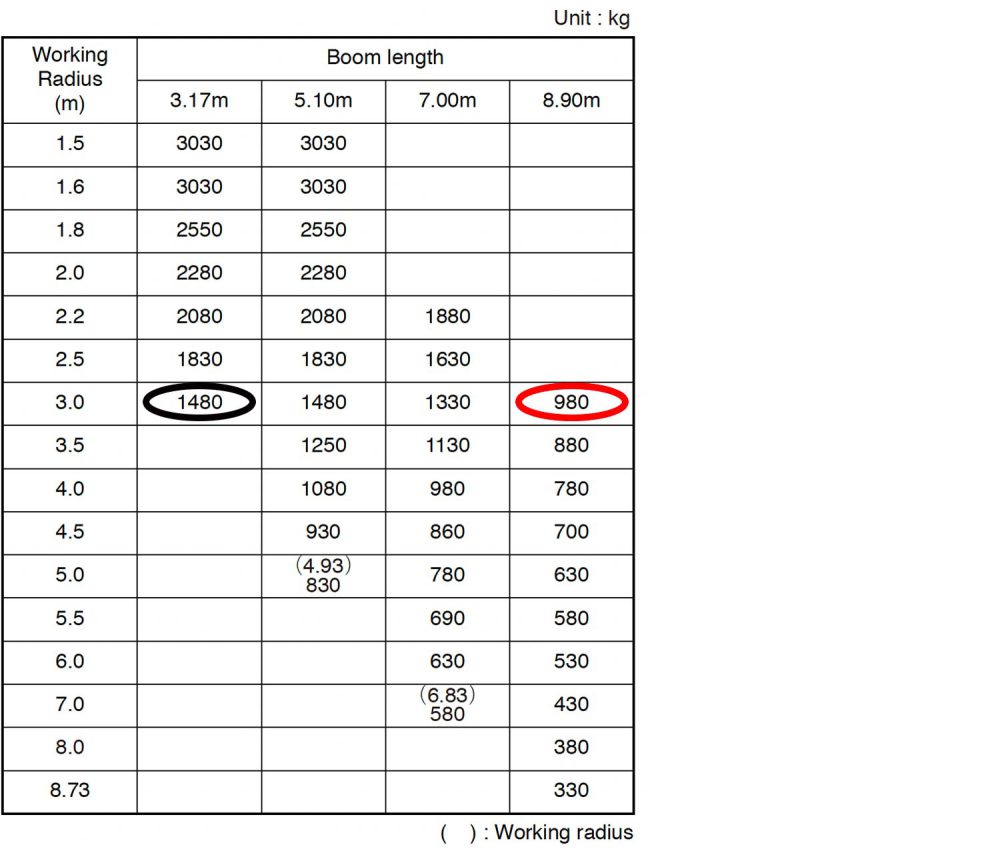
Using the example shown in the chart, we can interpret the lifting capacity under two different boom configurations.
Example 1 — Short Boom Configuration
From the working range chart, the hook position corresponds to a working radius of 3 meters.
If the crane is operating with a boom length of 3.17 m (single boom section), we locate:
Working Radius = 3.0 m
Boom Length = 3.17 m
From the load chart table, the intersection of these two parameters gives a rated lifting capacity of:
1480 kg
This means the crane can safely lift a maximum total load of 1480 kg at this configuration.
Example 2 — Fully Extended Boom
Now consider the same working radius of 3 meters, but with the boom fully extended to 8.90 m.
From the capacity table:
Working Radius = 3.0 m
Boom Length = 8.90 m
The rated lifting capacity becomes:
980 kg
Although the load position remains the same, extending the boom increases the load moment acting on the crane, which reduces the allowable lifting capacity.
This example clearly illustrates a fundamental principle of crane operation:
As boom length increases, lifting capacity decreases even at the same working radius.
Engineering Reason Behind Capacity Reduction
The reduction in lifting capacity is governed by the crane’s moment balance.
When the boom extends further, the structural load path becomes longer and the overturning moment acting on the crane base increases.
Even if the working radius remains constant, the longer boom introduces additional:
- structural stress in the boom sections
- hydraulic cylinder loading
- deflection of the boom
For this reason, the manufacturer reduces the allowable lifting capacity to maintain structural integrity and operational safety.
Practical Use of the Load Chart
Before performing a lift, the operator should always perform a quick feasibility check using the load chart.
The procedure generally follows three steps:
First, estimate the working radius based on the load position.
Second, determine the boom length required to reach the load.
Finally, reference the load chart table to confirm that the maximum lifting capacity exceeds the total suspended load, including rigging equipment.
If the load exceeds the rated capacity, the lift must be adjusted by:
- reducing the working radius
- shortening the boom length
- repositioning the crane closer to the load
Final Thoughts
The UNIC crane load chart is not simply a table of lifting weights. It represents the engineering limitations of the crane based on stability and structural design.
Understanding how boom length and working radius interact allows operators to quickly determine whether a lift is feasible before operation begins.
By correctly interpreting these parameters, operators can ensure that the crane remains within its designed operating limits, maintaining both equipment safety and operational efficiency.