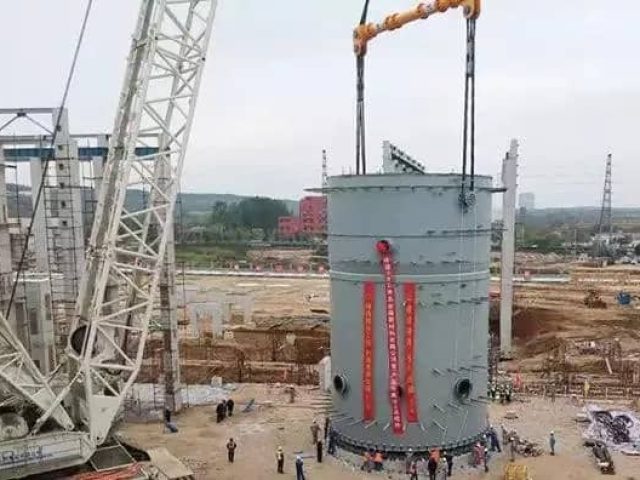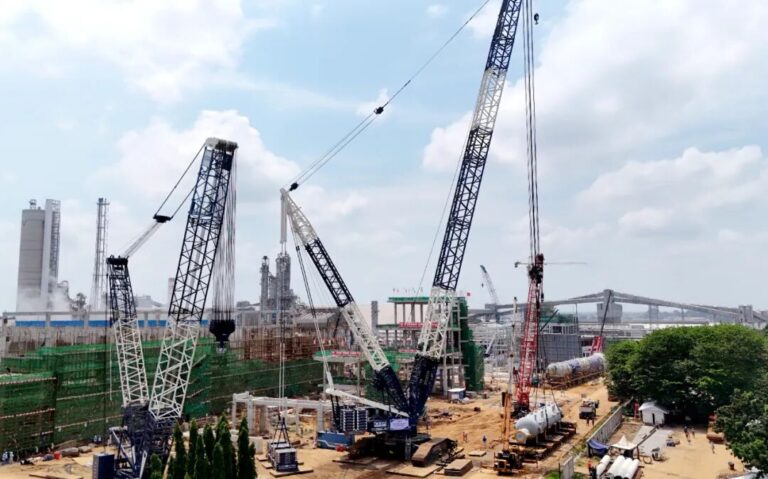
On October 9, the first major lift at the PUSRI-IIIB fertilizer project in Palembang, Indonesia, was successfully carried out. The project, undertaken by China Engineering Co., Ltd 5th Group. under China National Chemical Engineering Group, has now officially begun its heavy equipment hoisting phase.
The milestone involved the installation of an ammonia condenser—an essential piece of static equipment in the process unit. Weighing 216 tons and measuring 3.56 meters in diameter by 25.58 meters in length, the condenser was lifted using a 1350-ton crawler crane. The lift began at 10:50 a.m. local time and involved a sequence of precision manoeuvres including upending, lifting, rotating, and placing the equipment into its foundation. The entire operation proceeded in a controlled and steady manner, with no reported safety incidents.
This particular lift was technically complex and logistically challenging for several reasons. The site conditions were tight, with limited space and ongoing parallel construction activities. In addition, the lifting schedule was tight, with heavy workloads concentrated into short timeframes. From a technical standpoint, ammonia condensers are considered high-risk, high-value static equipment, forming a key part of the project’s critical path. This raised the bar for both technical execution and project coordination, with added emphasis on safety.
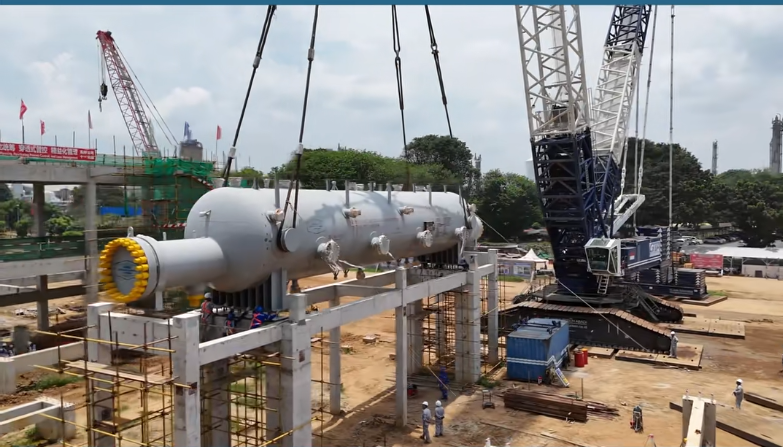
To manage these risks, the project team conducted several rounds of technical reviews and safety briefings. Third-party specialists were brought in to assess key components including the crawler crane itself, rigging equipment, and ground-bearing capacity. Preparations included site improvement works, lifting simulations, and emergency response drills—all completed ahead of the actual lift.
The PUSRI-IIIB project is part of Indonesia’s national strategy to modernize its fertilizer production capacity. Once operational, the facility is expected to significantly increase local output of synthetic ammonia and urea, contributing to a more stable agricultural supply chain and supporting broader industrial transformation efforts in the region.
This initial lift marks a critical transition point. It not only demonstrates site readiness for large-scale installation work but also sets a baseline for upcoming equipment lifts—including towers, reactors, and heat exchangers—scheduled in the next phase of the project.