We use cookies to improve your experience. By using this site, you agree to our Cookie Policy and Privacy Policy.
The SANY SAC12000 is a 1,200-tonne class all-terrain crane developed for ultra-heavy lifting in wind energy, infrastructure, petrochemical and industrial construction. The crane was completed in 2010 and made its global public debut on 23 November 2010 at Bauma China in Shanghai, where it appeared alongside the XCMG QAY1200 as part of China’s push into the 1,000-tonne-plus all-terrain crane sector. The SAC12000 was originally developed under the SAC303 designation before the production model adopted the SAC12000 name. It features an eight-section telescopic boom extending to 102 m, with lattice attachments allowing a maximum jib system of up to approximately 126 m, and a maximum rated lifting capacity of 1,200 tonnes. Mounted on a purpose-built nine-axle all-terrain carrier, the crane combines high-capacity lifting with road mobility, a superlift system and advanced single-cylinder pinning technology.
*Crane Specifications, Load Charts, and Crane Manuals are for reference only.
Contact the crane manufacturer for manuals to operate the crane properly.
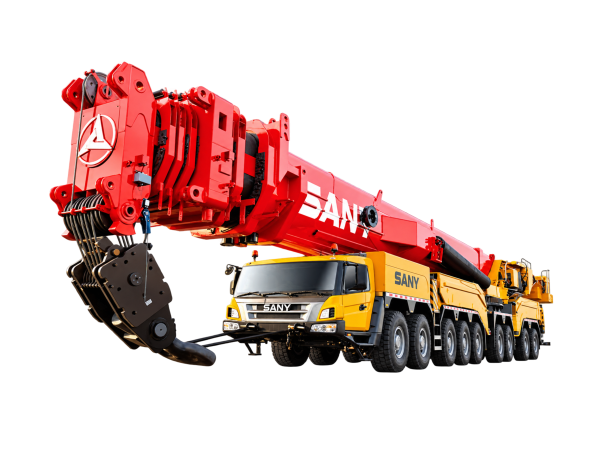
The SANY SAC12000 is a 1,200-tonne all-terrain crane developed as one of the most significant Chinese ultra-heavy mobile cranes of its generation. SANY completed the machine in 2010, after a development programme lasting several years, and presented it internationally on 23 November 2010 at Bauma China in Shanghai. At the exhibition, the crane was shown alongside the XCMG QAY1200, signalling the entry of Chinese manufacturers into a capacity class that had previously been dominated by European machines such as the Liebherr LTM 11200-9.1. The project was therefore important not only as a new crane model, but also as a demonstration of China’s growing ability to design and manufacture kilotonne-class all-terrain cranes.
Before adopting the SAC12000 production designation, the crane was developed and promoted under the SAC303 model name. SANY used the project to develop several technologies required for very large all-terrain cranes, including superlift systems, multi-axle steering, tower-jib systems, single-cylinder pinning for telescopic booms and variable-angle lattice attachments. By March 2010, SANY had completed the first machine, and the project subsequently became the foundation for the company’s expansion into the highest-capacity wheeled crane segment.
The SAC12000 has a maximum rated lifting capacity of 1,200 tonnes and was originally publicised with a maximum lifting moment of around 3,400 tonne-metres. Its main boom consists of eight telescopic sections and reaches a maximum length of 102 m. This exceptionally long telescopic boom was a major part of the crane’s appeal because it allowed substantial lifting height to be achieved without immediately requiring a lattice extension.
For additional reach and hook height, the crane can be configured with lattice boom and jib systems extending the overall attachment length substantially beyond the main boom. Published specifications identify jib configurations extending from approximately 18 m up to around 126 m, depending on the selected arrangement. This gives the SAC12000 a wide operating envelope for wind turbine erection, high industrial structures and other projects where both height and working radius are critical.
The telescopic boom uses a single-cylinder pinning system, allowing one hydraulic cylinder to extend and lock the individual boom sections automatically. This technology reduces the number of large internal telescoping cylinders required and helps control boom weight in an extremely large crane. A superlift system is also used to improve boom stiffness and lifting performance, particularly when the long main boom is operating at large radii.
The crane is mounted on a purpose-built nine-axle all-terrain carrier. The multi-axle chassis incorporates extensive steering capability to maintain manoeuvrability despite the crane’s considerable overall length and mass. Multiple axles are driven, while several steering modes help the machine negotiate restricted access routes and large construction sites. The carrier was specifically engineered for the SAC12000 rather than adapted from a conventional commercial truck chassis.
Power is provided by separate diesel engines for the carrier and crane upperstructure. The carrier engine is rated at approximately 480 kW at 1,800 rpm, while the superstructure uses a separate engine rated at around 290 kW at 1,800 rpm. Maximum road speed is approximately 75 km/h, giving the crane comparatively rapid site-to-site mobility for a machine in the 1,200-tonne class.
Four large X-type telescopic outriggers provide the support base for lifting operations. The system combines swing-out and telescoping movements, producing a broad stabilizing footprint while allowing the outriggers to be folded compactly against the carrier for transport. Automatic levelling assists with setup and helps establish the crane within the allowable working inclination before lifting begins.
The main and auxiliary winches provide line speeds of approximately 130 m/min, while maximum slewing speed is around 0.8 rpm. These operating speeds are relatively conservative compared with smaller mobile cranes, reflecting the need for smooth and controlled load movement when handling extremely heavy components.
Wind Power Applications
Wind turbine installation was one of the principal applications for which the SAC12000 was developed. The combination of a 102 m telescopic boom, long lattice attachments and high-capacity superlift system made the crane particularly suitable for erecting the increasingly large wind turbines appearing in China during the early 2010s.
The SAC12000 underwent a major proof test on 17 July 2011, lifting 850 tonnes at a 4.2 m working radius with a 32.1 m boom. The test was witnessed and documented as a verification of the crane’s structural, hydraulic and electrical systems. SANY reported that the boom, slewing platform and carrier frame showed no structural damage or abnormal deformation during the test.
Following testing, the first commercial SAC12000 was delivered in September 2011 and entered the wind-energy market. SANY subsequently reported the machine being used for wind turbine erection, including installation of a 2 MW wind turbine using the main boom. The crane’s ability to reach substantial hub heights without relying entirely on a long lattice boom made it attractive for wind farm construction, where frequent relocation between turbine positions can make assembly time an important consideration.
The SAC12000 was also designed with transport and assembly efficiency in mind. Major crane components, including the boom and counterweight system, were arranged to simplify mobilisation and reduce dependence on large auxiliary cranes during assembly. This was particularly useful on wind farms, where the crane may need to move repeatedly between turbine foundations during a single project.
From a historical perspective, the SAC12000 represented an important milestone for SANY and for the Chinese crane industry. Its appearance at Bauma China 2010 demonstrated that domestic manufacturers were no longer concentrating only on conventional truck cranes and medium-capacity all-terrain machines, but were moving directly into a segment previously associated mainly with established European manufacturers. SANY itself described the SAC12000 as Asia’s first 1,000-tonne-class all-terrain crane, and the successful 850-tonne test lift in 2011 helped demonstrate that the project had progressed beyond a show prototype into an operational heavy-lifting machine.
Overall, the SANY SAC12000 is best described as a 1,200-tonne, nine-axle ultra-heavy all-terrain crane with a 102 m eight-section telescopic boom, lattice attachments extending to approximately 126 m, superlift capability and 75 km/h road speed. Its development from the original SAC303 project, public debut at Bauma China 2010 and subsequent deployment in wind turbine erection established the SAC12000 as one of the landmark Chinese heavy-lift cranes of the early 2010s.