Heerema Thialf Load Chart PDF + Specifications
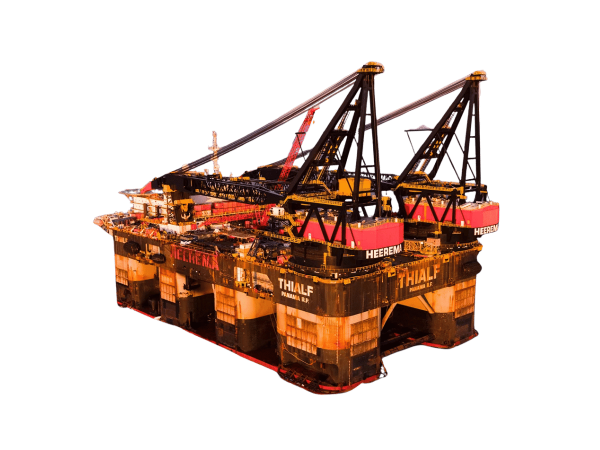
The SSCV Thialf is one of the largest and most powerful semi-submersible crane vessels in the world, owned and operated by Heerema Marine Contractors. Originally built in the mid-1980s and extensively upgraded during the 1990s and 2000s, the vessel is equipped with two giant revolving cranes each rated at 7,100 tonnes, giving a combined lifting capacity of 14,200 tonnes. Designed for heavy offshore construction, platform installation, and decommissioning work, Thialf has been a key vessel in the global offshore oil and gas industry for several decades.
Download Load Chart Here
somdn_product_page
*Crane Specifications, Load Charts, and Crane Manuals are for reference only.
Contact the crane manufacturer for manuals to operate the crane properly.
Key Features & Benefits
The SSCV Thialf (Semi-Submersible Crane Vessel Thialf) is one of the most famous heavy-lift ships ever built for offshore construction. Operated by Heerema Marine Contractors, the vessel has played a major role in installing and removing some of the largest offshore oil and gas structures around the world.
The vessel was originally constructed in 1985 in Japan by Mitsui Engineering & Shipbuilding. At the time of its launch, it was named DB-102 and served as a heavy-lift crane barge. Recognizing the growing demand for larger offshore installation vessels, Heerema acquired the ship and initiated a major conversion project. During the early 1990s, the vessel underwent a significant redesign and upgrade in which it was converted into a self-propelled semi-submersible crane vessel, receiving the name Thialf, derived from a figure in Norse mythology.
The defining feature of Thialf is its two massive revolving lattice boom cranes, each with a lifting capacity of 7,100 tonnes. These cranes are mounted on the port and starboard sides of the vessel’s deck and can operate independently or in tandem. When used together, they provide a combined lifting capacity of 14,200 tonnes, allowing the vessel to install extremely large offshore modules and structures in a single lift.
Each crane features a large lattice boom structure designed to handle enormous loads while maintaining structural efficiency. The cranes are capable of lifting massive topside modules, offshore jackets, subsea structures, and bridge sections used in offshore platforms. Their ability to perform tandem lifts makes Thialf particularly effective for installing very large integrated topsides that would otherwise require multiple installation steps.
The vessel operates using a semi-submersible hull design, which provides excellent stability during lifting operations. When the vessel arrives at a job site, ballast tanks are flooded to lower the hull deeper into the water. This reduces the effects of waves and increases stability, allowing the cranes to handle extremely heavy loads safely in offshore environments.
Thialf measures approximately 201.6 meters in length and about 88 meters in width, making it one of the largest crane vessels ever built. The vessel uses a dynamic positioning system combined with mooring anchors to maintain precise position during offshore lifting operations. This capability is critical when installing structures that must be positioned with extreme accuracy.
In addition to its heavy lifting capability, Thialf also serves as a construction platform equipped with large deck space for transporting offshore modules and equipment. The vessel can accommodate hundreds of crew members and project personnel, allowing large offshore installation campaigns to be carried out directly from the ship.
Throughout its operational history, Thialf has been involved in many major offshore construction projects worldwide. The vessel has installed large platform topsides, removed decommissioned offshore structures, and carried out heavy lifting operations for both oil and gas and renewable energy projects. Because of its exceptional lifting capacity and stability, it became one of the preferred vessels for installing large integrated topsides weighing thousands of tonnes.
Over time, Thialf has undergone multiple upgrades to maintain its position as one of the leading heavy-lift vessels in the offshore industry. Improvements to its cranes, ballast systems, and positioning systems have ensured that the vessel continues to operate effectively even as offshore structures become larger and heavier.
Today, the SSCV Thialf remains one of the most powerful crane vessels in operation. Its twin 7,100-ton cranes, semi-submersible stability, and massive deck space make it an essential asset for offshore construction and heavy lifting projects around the world. The vessel stands as a landmark achievement in offshore engineering and continues to demonstrate the capabilities of large-scale marine heavy-lift technology.