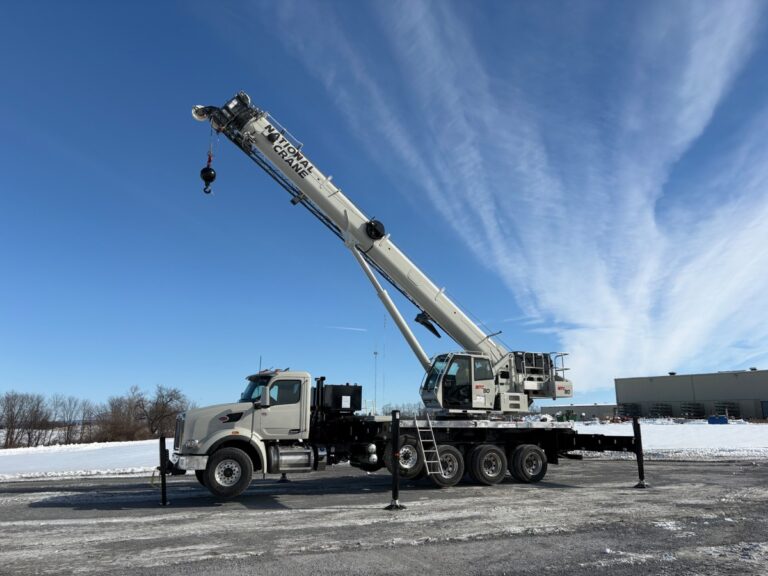
The launch of a new crane at CONEXPO-CON/AGG always attracts attention, but when it comes from National Crane, contractors and rental companies tend to pay even closer attention. At CONEXPO 2026, National Crane introduced the NTC80 boom truck, a new 80-ton class crane designed to deliver higher lifting capacity while still remaining fully roadable on a commercial truck chassis.
From my experience working with contractors and crane rental companies, this combination is something many operators have been asking for. They want more lifting power and longer reach, but they also want cranes that can easily drive between multiple jobs in the same day. No one wants a crane that becomes too large or complicated to move around the city.
That is exactly the gap the NTC80 aims to fill.
National Crane developed this model under Manitowoc’s “Big and Bold” product strategy. Instead of simply increasing size, the company focused on building a crane that delivers greater capability without sacrificing mobility, setup speed, or productivity.
And in today’s market, where crews often perform several lifts across different sites in a single shift, that balance matters more than ever.
A Roadable Boom Truck with 80-Ton Capacity
The headline feature of the NTC80 is its 80 USt lifting capacity, making it one of the more powerful cranes in the roadable boom truck category.
To support that capacity, the crane is equipped with a 156-ft five-section main boom, allowing operators to reach higher and farther without the need for additional equipment. For utility contractors, steel erection crews, and oil and gas maintenance teams, this extra reach can make a big difference when working around obstacles or tight spaces.
From a practical standpoint, this means crews can often complete lifts without mobilizing a larger all-terrain crane, saving both time and transportation cost.
Bob Ritter, Director of Product Management at Manitowoc, explained that the NTC80 was developed directly from conversations with customers.
Contractors across the utility, construction, and energy sectors were asking for cranes that could lift heavier loads but still maintain the mobility of a commercial boom truck. Many operators need cranes that can move frequently between job sites and be set up multiple times throughout the day.
According to Ritter, the message from customers was very clear.
They needed more capability — but not at the expense of maneuverability.
The NTC80 was designed to strike that balance.
Flexible Counterweight System for Different Jobs
One of the most interesting design features of the NTC80 is its trayless modular counterweight system.
Instead of traditional counterweight trays that require specific stacking order, the NTC80 allows slabs to be stacked in any order and hydraulically removed. This may sound like a small change, but on real jobsites, it can make crane setup faster and more flexible.
Operators can configure the crane with different counterweight packages depending on the job and the truck chassis specification.
The crane offers a 12,000 lb standard package, an 18,000 lb heavy roadable package, and a 24,000 lb maximum configuration for higher lifting performance.
Why does this matter?
Because not every lift requires maximum counterweight. Sometimes crews want to stay within road regulations and axle limits while still having enough capacity to complete the job safely.
By allowing different counterweight setups, the NTC80 lets operators match crane performance to the task at hand while keeping transportation simple.
Designed for Frequent Setup and Jobsite Versatility
Boom trucks are often used in environments where space is limited — think urban construction, roadside utility work, or congested industrial sites.
To help operators handle these conditions, the NTC80 comes with four-position outriggers that allow a 24-ft full-span setup.
For tighter locations, customers can also choose an optional single front outrigger configuration, giving the crane additional flexibility when space is restricted.
The crane also features a 37-ft to 61-ft bi-fold swing-away jib, extending the crane’s reach even further when required. The jib can be configured at 0°, 15°, or 30° offsets, making it easier to adapt to different lifting angles.
Another small but useful feature is electric pinning, which speeds up the process of deploying or stowing the jib. Anyone who has worked around cranes knows that small improvements like this can save valuable time during setup.
The crane is also capable of lifting over both the fixed and swing-away jib sections, giving operators more flexibility when adjusting lift geometry during a job.
For hoisting performance, the NTC80 includes a 22,500 lb hoist drum capacity, 19 mm wire rope, and a single-line pull of 17,160 lb, ensuring the crane can handle demanding lifting operations.
New Operator Cab for Comfort and Visibility
Operator comfort is another area where crane manufacturers have been investing heavily in recent years, and the NTC80 reflects that trend.
The crane features an all-new operator cab with increased interior space and improved legroom. Anyone who has spent long hours inside a crane cab knows how important this can be.
Better visibility is also part of the design. The cab layout allows operators to maintain clearer sightlines around the crane and jobsite.
Controls and key features are positioned within easy reach, helping reduce operator fatigue during long shifts.
At the boom tip, the crane includes standard external A2B cable protection, along with optional features such as electric-positioned boom lights and an aircraft warning beacon. These additions improve jobsite visibility and safety, particularly during night work or in busy construction zones.
Serviceability Built into the Design
One area that often gets overlooked when new cranes are launched is serviceability.
But from my experience in the crane rental industry, this is actually one of the most important factors for fleet owners. A crane that is difficult to maintain can quickly become expensive.
Manitowoc clearly considered this when designing the NTC80.
The crane includes lockable ladder storage on both sides, along with multiple access points that allow technicians to reach different parts of the crane easily.
There is also a pull-out catwalk accessible from the operator cab, as well as an integrated hoist access platform, making daily inspections and maintenance tasks easier for technicians.
This design helps reduce downtime and allows service teams to perform routine checks quickly during the workday.
Manitowoc’s “Big and Bold” Strategy
The introduction of the NTC80 is part of Manitowoc’s broader strategy to deliver stronger products and improved customer support.
According to Ritter, the company’s “Big and Bold” approach is not just about building larger cranes. It also means investing in better engineering, smarter design, and stronger support networks.
For crane owners and operators, this includes faster parts availability, access to technical support, and a global dealer network capable of keeping machines running throughout their lifecycle.
Launching the NTC80 at CONEXPO 2026 was a clear signal of Manitowoc’s commitment to supporting contractors working on critical infrastructure projects.
And judging by the increasing demand for high-capacity boom trucks, this is likely a segment we will see continue to grow in the coming years.