

We use cookies to improve your experience. By using this site, you agree to our Cookie Policy and Privacy Policy.
The Gottwald AK 680-3 is one of two AK 680 cranes constructed by Gottwald and represents the conventionally configured version of the type. The crane was originally built in 1980 as the AK 680-1 for Scott Greenham and was broadly similar in concept to the larger Gottwald AK 850. After Grayston, White & Sparrow took over Scott Greenham, the crane became part of the GWS fleet. When Rentokil Initial later acquired GWS, the heavy cranes were sold to Sarens, while a number of the smaller cranes were transferred to Ainscough. Sarens subsequently carried out an extensive rebuild and refurbishment of the machine in 2001, including the fitting of a newer-style Demag driver’s cab. Following this work, Sarens referred to the crane internally as the AK 680-3.
The second AK 680 followed a very different design philosophy. It was supplied to Stanley Davies in 1979 as a semitrailer-mounted crane and was equipped with Maxilift equipment. Owing to the close working relationship between Stanley Davies and Hewden Stuart, the crane often operated in Hewden Stuart colours. After an accident involving the Maxilift equipment during a lifting operation, the insurer sold the crane to Schmidbauer. Schmidbauer retained the Maxilift equipment for use with its AK 850 and subsequently sold the crane itself to Tecmaco in Argentina. Tecmaco, a Sarens subsidiary, later transferred the machine to Sarens, where it became known internally as the AK 680-4. Unlike the conventional AK 680-3, the AK 680-4 uses a 6-axle Gottwald tractor combined with a four-axle bogie, giving the crane its distinctive semitrailer configuration.
The AK 680-3 is identified in the Sarens technical documentation as the Gottwald AK 680-3 650/1200 TON. It is a very large lattice-boom mobile crane intended for heavy industrial erection, power-generation work, infrastructure projects and other lifts requiring both high capacity and long boom configurations. Rather than using a telescopic boom, the crane relies on modular lattice sections that can be assembled in several distinct configurations, allowing the machine to be adapted for heavy short-radius work, long main-boom duties and high-reach luffing-jib operations.
The crane is mounted on a substantial 10-axle mobile carrier. The transport drawings in the Sarens specification show an overall carrier length of approximately 22.2 m. The document gives axle loading of about 12 tonnes on axles 1 to 6 and approximately 10 tonnes on axles 7 to 10, while the illustrated carrier/crane-base transport weight is approximately 112 tonnes. The dimensional drawing also shows a maximum outrigger footprint of about 14.5 m, providing the large support base necessary for the crane’s heavy-lift duties.
For lifting operations, the AK 680-3 can operate with up to 195 tonnes of counterweight. The specification illustrates the counterweight system and crane components as separate transportable items, reflecting the logistical requirements of assembling a crane of this size. Boom sections, ballast, hook blocks and other heavy components are transported separately and assembled at the jobsite. The weight drawing also shows individual boom and ballast components with their respective dimensions and transport weights.
In the standard MB main-boom configuration, the AK 680-3 can be assembled with boom lengths ranging from approximately 17 m to 113 m. The working-range chart and load tables cover a broad selection of boom lengths, including 17, 23, 29, 35, 41, 47, 53, 59, 65, 71, 77, 83, 89, 95, 101, 107 and 113 m. The corresponding load charts are based on a 14.5 m outrigger spread, 195 tonnes of counterweight and 360-degree operation under the conditions stated by Sarens.
The crane can also be rigged in the ML heavy-lift arrangement, which incorporates an additional 23.4 m lattice structure to create a different structural geometry from the conventional MB setup. In this configuration, the available main-boom combinations extend approximately from 35 m to 107 m according to the Sarens documentation. The ML arrangement is intended to provide additional support for heavy lifting at greater boom lengths and represents one of the distinctive heavy-lift configurations available on the AK 680-3.
For high-reach work, the AK 680-3 can be configured with the LJ luffing-jib system. The official Sarens specification shows tower or main-boom sections ranging from approximately 23.75 m to 83.75 m, combined with luffing-jib lengths from 29 m to 95 m. The configuration drawing indicates a maximum working height approaching 170 m in the longest documented arrangement, with the working envelope extending to around 88 m horizontally in the illustrated geometry. Separate load charts are provided for the various tower lengths and luffing-jib combinations.
There is also evidence that the crane was occasionally operated beyond the standard catalogued luffing-jib arrangement. On at least one Hewden Stuart job, the crane is reported to have been rigged with a 107 m luffing jib, exceeding the official 95 m maximum shown in the Sarens specification. This should be regarded as a special operating configuration rather than a standard published specification, but it demonstrates that the machine was at times adapted for unusually demanding high-reach work.
Both known AK 680 cranes were also modified over their working lives with reinforced 18 m boom sections. These stronger sections appear to have supplemented the original boom equipment rather than necessarily replacing all of it, although the precise combination retained on each machine is not fully documented. Such modifications were consistent with the long service lives of these heavy-lift cranes, where structural upgrades and revised boom components were often introduced to extend operating capability or support later configurations.
The AK 680-3 uses several winches and rope systems for the main hoist, auxiliary hoist, boom and jib functions. The working-speed table lists continuously variable main hoist rope speeds of up to approximately 55 m/min, while another heavy-hoist system is shown with a maximum rope speed of around 37 m/min. Additional winches used for boom and jib operation work at lower speeds appropriate to their functions. Several of the principal systems are listed with single-line rope pulls exceeding 215 kN, reflecting the substantial line forces required by a crane in this capacity class.
The crane’s maximum travelling speed is stated as approximately 63 km/h. This road-going capability distinguishes the conventional AK 680-3 from crawler cranes of comparable heavy-lift scale, although its boom sections, counterweights and lifting equipment still require separate transport. The supplied Sarens document does not identify the original carrier engine model, superstructure engine, engine output or emissions classification, so these details should not be inferred from the available specification.
A range of hook blocks was available to suit different lifting duties. The hook-block table includes a principal block rated at approximately 650 tonnes, along with lower-capacity blocks for different reeving arrangements. A separate runner arrangement is rated at approximately 16 tonnes, allowing lighter and faster lifting operations without using the main heavy hook block. This range of hook equipment enabled the AK 680-3 to cover lifting tasks from auxiliary handling through to major heavy-lift work.
Overall, the Gottwald AK 680-3 combines the heavy engineering typical of late-1970s and early-1980s European lattice-boom mobile cranes with a long history of subsequent modification and refurbishment. Its evolution from the original AK 680-1, through service with Scott Greenham and GWS, to its major 2001 Sarens rebuild, makes it particularly notable among surviving Gottwald heavy-lift cranes. With a 10-axle carrier, up to 195 tonnes of counterweight, an MB boom extending to 113 m, an official LJ luffing jib of up to 95 m, reinforced boom sections and evidence of special configurations beyond the published charted arrangement, the AK 680-3 remained a highly adaptable heavy-lift machine over several decades of service.
*Crane Specifications, Load Charts, and Crane Manuals are for reference only.
Contact the crane manufacturer for manuals to operate the crane properly.
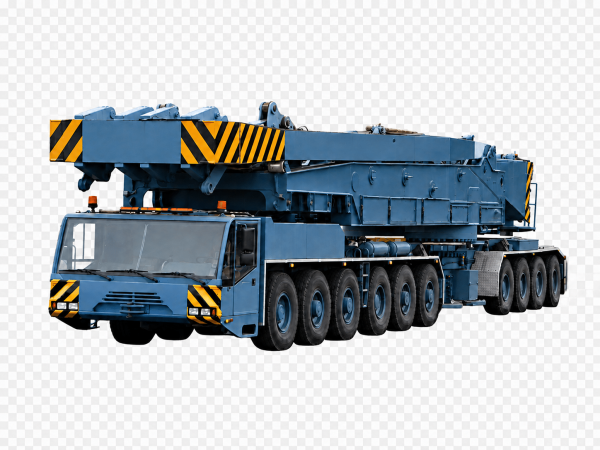
The Gottwald AK 680-3 is a large lattice-boom mobile crane rated in the Sarens specification as a 650/1200-ton machine. Originally built in 1980 as the conventional AK 680-1 for Scott Greenham, the crane later passed through the GWS fleet before being acquired by Sarens, which extensively rebuilt and refurbished it in 2001. Following the rebuild, including the installation of a newer-style Demag driver’s cab, Sarens internally designated the crane AK 680-3. The machine is carried on a 10-axle chassis and can be configured with an MB main boom from 17 to 113 m, an ML heavy-lift arrangement, and an LJ luffing-jib system with jib lengths up to 95 m in the official specification. Up to 195 tonnes of counterweight can be used, while the crane’s maximum travel speed is listed as approximately 63 km/h.
Reviews
There are no reviews yet.