

We use cookies to improve your experience. By using this site, you agree to our Cookie Policy and Privacy Policy.
The TCM Autogrù C 400 M + ROSPO M is a 40-ton class, four-axle telescopic mobile crane and heavy-vehicle recovery unit combining lifting and towing capability on a single road-mobile chassis. The crane uses a four-section hydraulic telescopic boom extending to approximately 18.6 m, with 360° slewing and a maximum working angle from -2° to +80°. Its crane configuration is rated at 23.3 tonnes at a 4 m radius under the applicable DIN/EN load chart, while the hook block is rated for 40 tonnes. The integrated ROSPO M recovery system is designed to lift and tow disabled vehicles by the front or rear axle and includes a 20,000 kg towing winch with 50 m of 18 mm rope. Four hydraulic outriggers provide stabilization, while the four-axle carrier is capable of road speeds of approximately 80–90 km/h, depending on the selected vehicle and operating mass.
*Crane Specifications, Load Charts, and Crane Manuals are for reference only.
Contact the crane manufacturer for manuals to operate the crane properly.
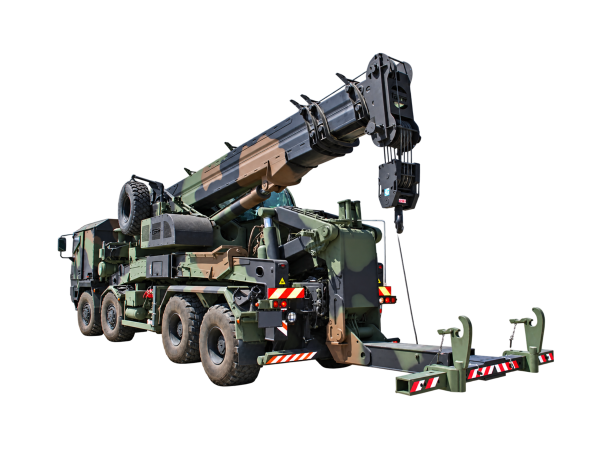
The TCM Autogrù C 400 M + ROSPO M is a 40-ton class four-axle telescopic mobile crane integrated with a heavy-duty vehicle recovery system. It was developed for applications that require both lifting and towing capability, particularly military support, vehicle recovery, logistics and infrastructure work. The combination of the C 400 M crane upperstructure with the ROSPO M underlift and towing assembly allows the machine to recover disabled heavy or light vehicles, reposition equipment and perform conventional crane lifting without the need for a separate recovery truck and mobile crane.
The crane is built around a four-element hydraulic telescopic boom fabricated from high-strength steel with an octagonal cross-section. The boom extends from approximately 6.2 m to 18.6 m, with the first telescopic section extending independently and the second and third extensions operating sequentially through hydraulic cylinders. Boom elevation is provided by a double-acting hydraulic cylinder with controlled lowering, giving an operating range from approximately -2° to +80°.
The C 400 M is classified as a 40-ton class crane, while the main stabilized load chart gives a maximum rated load of 23.3 tonnes at a 4 m working radius. The crane is fitted with a 40-tonne, four-sheave hook block, providing the reeving capacity required for its heavier lifting duties. Load capacities vary according to boom length, working radius and whether the crane is operating on fully extended outriggers or on tyres within the permitted working sector.
The upperstructure provides continuous 360° rotation. The turret is manufactured from high-strength steel and mounted on a double-row slewing bearing with internal gearing. Slewing is hydraulically driven through an epicyclic reduction gearbox and incorporates a multidisc oil-bath brake with automatic hydraulic braking. The main winch uses a planetary reduction system with an oil-immersed disc brake and a fixed-displacement piston motor, and is equipped with approximately 175 m of 14 mm anti-rotation rope.
Stability during crane operation is provided by four hydraulically operated outriggers with radial deployment. The outriggers use high-strength steel beams with horizontal extension and independent vertical hydraulic cylinders, allowing the machine to establish a broad and level support base. With the stabilizers fully deployed, the transverse support dimension is approximately 6.02 m, while the longitudinal stabilizer span is around 5.82 m. In transport condition, overall vehicle width is approximately 2.50 m.
A major feature of this version is the ROSPO M recovery system mounted at the rear of the vehicle. The system is designed to recover disabled heavy and light vehicles by lifting either the front or rear axle clear of the ground. Two double-acting hydraulic cylinders carry the lifted axle, while nitrogen-charged accumulators provide damping during towing to reduce shock loads transmitted through the recovery equipment and vehicle chassis.
The ROSPO M uses a heavy-duty articulated underlift assembly with vertical and horizontal boom elements and two telescopic extensions. The terminal fork assembly is width-adjustable so that it can accommodate different wheel tracks as well as single or twin-wheel axle arrangements. When folded into the transport position, the recovery equipment remains compact and is designed not to interfere with normal crane operation. The system can also retain access to the vehicle’s original towing coupling when the underlift is stowed.
Towing power is provided by a dedicated 20,000 kg recovery winch equipped with approximately 50 m of 18 mm rope and an epicyclic reduction gearbox. Rope-guide rollers allow the winch line to be redirected when required, giving the recovery operator more flexibility when pulling a disabled vehicle from an awkward position. Additional recovery equipment can include suspension locking devices, air-hose reels, portable-light reels and remote or wired controls for the ROSPO M functions.
The C 400 M + ROSPO M is installed on a heavy-duty four-axle road carrier in the illustrated configuration. Overall length is approximately 10.82 m, overall height about 3.85 m, and road-going width approximately 2.50 m, although final dimensions depend on the truck chassis selected for installation. The machine is intended for road travel at approximately 80–90 km/h, depending on the carrier, vehicle mass and local road regulations.
Crane power is supplied through a power take-off and hydraulic pump system driven from the truck. The hydraulic system operates boom elevation, telescoping, slewing, hoisting and outrigger functions, with controls located in the crane cab. Load-holding valves, descent-control valves and safety devices are incorporated to prevent uncontrolled movement in the event of hydraulic pressure loss. The exact chassis engine manufacturer, engine model, output and emissions standard depend on the commercial or military carrier used and are not fixed specifications of the crane upperstructure itself.
The crane cab is equipped with wide safety glazing, an adjustable suspension seat, hydraulic joysticks and a control display. Safety systems include a load-moment control system, overload warning, anti-two-block protection and digital indication of boom angle, boom length, operating radius and hook load. Interlocks are also used on the stabilizers to prevent vehicle travel unless the outrigger system has been returned to the correct transport position.
Overall, the TCM Autogrù C 400 M + ROSPO M is a specialized 40-ton class mobile crane and heavy-recovery vehicle that combines an approximately 18.6 m telescopic boom, 360° slewing, four hydraulic outriggers, a 40-tonne hook block and a 20-tonne-class recovery winch with an integrated hydraulic underlift. Its dual-purpose design makes it particularly suitable for military vehicle recovery, fleet support, roadside heavy recovery and other operations where lifting and towing capability are required from a single highly mobile machine.
Reviews
There are no reviews yet.