
We use cookies to improve your experience. By using this site, you agree to our Cookie Policy and Privacy Policy.
The TCM Autogrù C 400 M is a 40-ton class, four-axle telescopic mobile crane developed for road-mobile lifting, recovery and support operations. It features a four-section hydraulic telescopic boom extending to approximately 18.6 m, continuous 360° slewing and four hydraulically operated outriggers for stabilized lifting. The crane is built on a heavy-duty four-axle carrier capable of road speeds of approximately 80–90 km/h, depending on the vehicle configuration. Its compact transport dimensions, high-strength steel construction and off-road-oriented chassis make the C 400 M suitable for military, infrastructure, recovery and general lifting applications.
*Crane Specifications, Load Charts, and Crane Manuals are for reference only.
Contact the crane manufacturer for manuals to operate the crane properly.
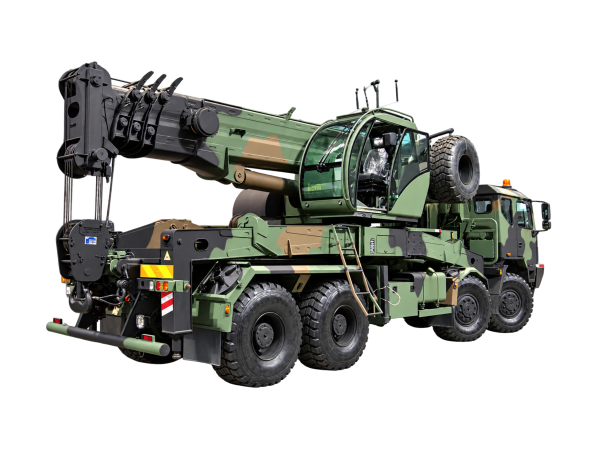
The TCM Autogrù C 400 M is a 40-ton class, four-axle telescopic mobile crane developed for road-mobile lifting, recovery and support duties. Its design combines a compact crane upperstructure with a heavy-duty carrier intended for both highway travel and operation on less prepared ground. The machine uses a robust high-strength steel chassis with the crane installation integrated into the carrier structure, giving it the rigidity needed to withstand both transport loads and lifting forces. With its four-axle layout, large off-road tyres and relatively compact overall dimensions, the C 400 M is suited to military, infrastructure, recovery and general lifting applications where mobility and fast deployment are important.
The crane is equipped with a four-section hydraulic telescopic boom extending to approximately 18.6 m. Intermediate boom lengths are available as the sections telescope, allowing the crane to work across a range of lifting radii and hook heights. Boom elevation is controlled by a double-acting hydraulic cylinder fitted with safety protection against uncontrolled lowering in the event of a pressure loss. The telescoping system also uses hydraulic cylinders and mechanical sequencing to extend the boom sections in a controlled manner.
The upperstructure provides continuous 360° slewing, allowing the crane to work around the carrier without repositioning the vehicle for every lift. Slewing is hydraulically driven through a reduction system and incorporates braking for controlled positioning. The main hoist is also hydraulically powered and uses an epicyclic reduction gearbox with an oil-immersed disc brake. A multi-sheave hook block rated at approximately 40 tonnes is used with the crane, matching the machine’s 40-ton class designation and providing the reeving arrangement required for heavier lifting duties.
Stability is provided by four hydraulic outriggers with horizontal extension and vertical jacking functions. Each outrigger can be controlled independently, allowing the operator to level the crane on uneven ground and establish a stable lifting base. With the outriggers fully extended, the support width increases substantially beyond the road-going width of the carrier, improving stability for lifting operations. The crane can also perform limited lifting duties on tyres within the permitted working sector, although stabilized operation on outriggers provides the greater lifting capability.
The C 400 M has an overall transport length of approximately 10.17 m, an overall height of about 3.67 m and a transport width of approximately 2.50 m. With the outriggers fully deployed, the stabilizer width increases to about 5.82 m, with an outrigger span dimension of approximately 6.02 m. These proportions give the crane a relatively compact travel envelope while still providing a wide stabilizing footprint during lifting operations.
The carrier is arranged on four axles and is designed for relatively high road mobility compared with crawler or industrial cranes. Maximum travel speed is approximately 80 to 90 km/h, depending on the specific vehicle and equipment configuration. This allows the crane to travel between operating locations without requiring separate heavy transport for normal road movements. The supplied technical information does not identify the exact carrier engine manufacturer, engine model, rated output or emission classification, so these details should not be stated without additional documentation for the individual machine.
The crane operator works from a dedicated cab mounted on the rotating upperstructure. The cab uses a steel structure with safety glazing and is arranged to provide clear visibility of the boom, hook and working area. It is equipped with crane instrumentation, control systems and an adjustable suspension seat. Safety systems include boom-position monitoring, hydraulic pressure controls, travel-limit devices and load-related protection intended to prevent unsafe crane movements.
Hydraulic power for the crane functions is supplied from the carrier through a power take-off system. Separate hydraulic circuits are used for the principal crane and stabilizer functions, with pressure-relief valves, filtration and cooling equipment incorporated into the system. The arrangement supports boom elevation, telescoping, slewing, hoisting and outrigger operation while providing the hydraulic protection required for controlled lifting work.
Overall, the TCM Autogrù C 400 M is a 40-ton class telescopic mobile crane combining a four-axle road carrier, approximately 18.6 m hydraulic boom, continuous 360° slewing and four-outrigger stabilization. Its relatively compact dimensions, high road speed and rugged chassis make it particularly suitable for applications where the crane must move quickly between locations while retaining the strength and stability required for heavy lifting, recovery and support operations.

Reviews
There are no reviews yet.