
We use cookies to improve your experience. By using this site, you agree to our Cookie Policy and Privacy Policy.
The Liebherr TCC 78000 is a 1,600-tonne rail-mounted heavy-lift gantry crane installed at Liebherr-MCCtec Rostock in Germany for handling exceptionally large and heavy cargo. Officially inaugurated in 2019, the TCC 78000 was developed to support the assembly, loading and handling of large maritime and offshore structures. It features a 105 m boom, 360° slewing, a maximum main-hoist capacity of 1,600 tonnes at a 36 m radius, and a maximum lifting height of 158 m using the auxiliary hoist. The crane travels on a 30 m-wide portal along more than 420 m of rail and is specifically designed to travel while carrying a load. Its electro-hydraulic drive system, very high hook height and combination of main and auxiliary hoists make it suitable for offshore wind components, shipbuilding, industrial plant construction and other ultra-heavy cargo operations.
*Crane Specifications, Load Charts, and Crane Manuals are for reference only.
Contact the crane manufacturer for manuals to operate the crane properly.
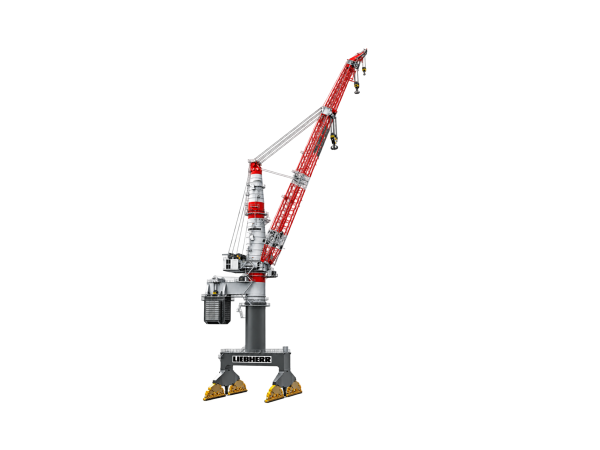
The Liebherr TCC 78000, with TCC standing for Travelling Cargo Crane, is one of Liebherr’s largest land-based heavy-lift cranes and was developed for exceptionally demanding cargo-handling and assembly work at the company’s maritime crane facility in Rostock, Germany. The crane was officially inaugurated in 2019, marking the start of a new heavy-lift capability at the site. Its principal role is to handle very large components associated with offshore wind, shipbuilding, industrial plant construction and other heavy-load applications, while also supporting Liebherr’s own assembly and shipment of large maritime cranes.
The TCC 78000 has a maximum lifting capacity of 1,600 tonnes, with the main hoist capable of lifting 1,600 tonnes at a 36 m working radius. The crane’s boom is approximately 105 m long, and the machine provides full 360° slewing. Its lifting system is supplemented by auxiliary hoists for lighter loads at substantially greater outreach. Current Liebherr technical data lists an auxiliary-hoist capacity of 250 tonnes at 99 m and a second auxiliary hoist rated at 25 tonnes at 105 m. Earlier Liebherr literature also listed a first auxiliary hook capacity of 490 tonnes at 92 m, indicating that published auxiliary-hook figures have varied with crane configuration or documentation revision.
Vertical reach is equally significant. The main hoist can achieve a maximum lifting height of approximately 112 m at a 34 m radius, while the second auxiliary hoist reaches up to approximately 158 m. With the boom raised, the overall crane height is about 164 m, making the TCC 78000 a prominent feature of the Rostock harbour skyline. This combination of very high lifting capacity and exceptional hook height was central to the crane’s development, particularly for assembling and loading increasingly large offshore and maritime structures.
Unlike a conventional crawler or mobile crane, the TCC 78000 is mounted on a massive travelling portal gantry. The portal has a 30 m track gauge and approximately 17 m of clearance, allowing the crane structure to span a large working area while maintaining access beneath it. The crane travels on two double rails and can move for more than 420 m between the Liebherr factory site and the adjacent quayside. A particularly important feature is its ability to travel with a suspended load, greatly improving flexibility when large components need to be transferred between assembly areas, storage zones and vessels.
The rail system and foundation were engineered to cope with the enormous wheel loads and lateral forces generated by the crane. The gantry is capable of travelling around a curved section of the dock while carrying heavy loads, which required substantial structural and civil engineering work. The foundation system incorporates hundreds of deep piles beneath the operating area to transfer the crane’s loads into competent ground. This heavy infrastructure is essential because the TCC 78000 is not simply a stationary lifting structure; it combines very high load capacity with full portal travel along the quay.
The crane uses an electro-hydraulic drive system rather than a conventional diesel-powered mobile-crane powertrain. This arrangement powers the principal crane functions, including hoisting, boom movement, slewing and gantry travel. Because it is a fixed-site rail-mounted installation rather than a road-going or crawler crane, parameters such as axle count, road speed and chassis engine specification are not applicable. The crane’s movement is entirely rail-based within the Rostock facility.
The TCC 78000 was designed around heavy-load logistics as much as pure lifting capacity. Its location directly on the Baltic Sea provides access for large vessels without the restrictions of locks or low bridges, while the adjacent terminal includes direct rail connections and high-capacity storage areas for oversized goods. The crane can therefore receive, assemble, reposition and load extremely large components within one integrated heavy-lift terminal. Liebherr also makes the crane available to external companies for heavy cargo projects rather than using it solely for its own manufacturing activities.
Its working applications include offshore and wind-energy components, shipbuilding modules, industrial plant equipment and other oversized heavy cargo. These duties benefit from the crane’s combination of 1,600-tonne capacity, very high hook height and long outreach. For offshore wind work in particular, the ability to handle increasingly large monopiles, foundations and related components close to the quayside has become an important part of the crane’s operating profile.
Overall, the Liebherr TCC 78000 is best described as a 1,600-tonne class travelling gantry crane with a 105 m boom, 360° slewing, up to 158 m lifting height and the ability to travel under load along a 30 m-wide portal. Its scale and operating concept place it well outside the normal mobile-crane category: it is a purpose-built heavy-lift logistics system designed to combine assembly, internal transport and ship loading in a single crane installation.