
We use cookies to improve your experience. By using this site, you agree to our Cookie Policy and Privacy Policy.
The Kato MR-250Rf is a 25-ton class rough terrain crane from Kato’s Cityrange Superboom Premium series, designated KRM-25H-F. Developed as a larger and more capable successor to the MR-200Rf, the crane combines a six-section 29.0 m telescopic boom with Kato’s hydraulically luffing and telescoping Premium SL Jib, providing a maximum lifting height of 38.4 m. Designed for urban construction, steel erection, industrial maintenance, and infrastructure projects, the MR-250Rf offers exceptional lifting performance while maintaining compact dimensions, advanced safety systems, and excellent maneuverability.
*Crane Specifications, Load Charts, and Crane Manuals are for reference only.
Contact the crane manufacturer for manuals to operate the crane properly.
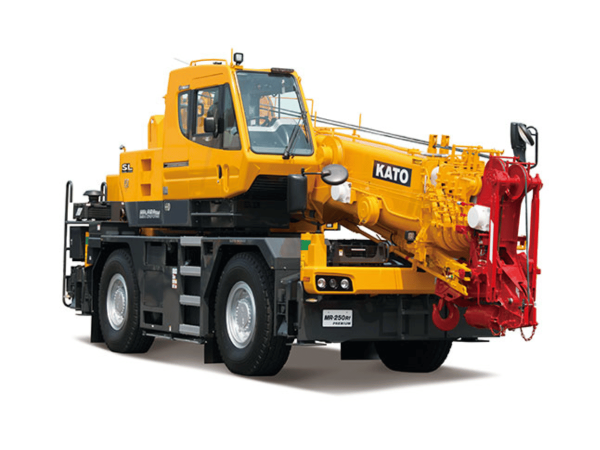
The Kato MR-250Rf belongs to the Cityrange Superboom Premium lineup and represents one of the most advanced 25-ton class rough terrain cranes produced by Kato. Built on a purpose-designed two-axle carrier, the crane combines compact transportation dimensions with lifting capabilities normally associated with larger machines. The model designation KRM-25H-F reflects its integration of Kato’s Premium SL Jib system, which significantly enhances flexibility when working around structures and obstacles.
At the core of the crane is a six-section fully hydraulic box-type telescopic boom extending from 6.7 m to 29.0 m. The boom employs synchronized extension, with sections two and three extending simultaneously while sections four, five, and six extend together. Maximum rated lifting capacity is 25 tonnes at a 2.8 m radius on the shortest 6.7 m boom using seven-part reeving. Even at longer boom lengths, the crane retains strong lifting capacities, including 13 tonnes on the 11.25 m boom, 12 tonnes on the 15.74 m boom, 9 tonnes on the 20.2 m boom, 8 tonnes on the 24.6 m boom, and 7 tonnes on the fully extended 29.0 m boom. A rooster sheave rated at 4 tonnes is also provided for auxiliary lifting duties.
One of the crane’s defining features is its Premium SL Jib. Unlike conventional fixed-angle fly jibs, the SL Jib is a hydraulically telescoping and luffing box-section jib that can be adjusted continuously between offsets of 7° and 60°. The jib itself telescopes from 5.3 m to 8.2 m, allowing operators to optimize reach and capacity according to site conditions. Maximum rated jib capacities are 3.0 tonnes on the 5.3 m configuration and 2.3 tonnes on the 8.2 m configuration. Combined with the fully extended main boom, the crane achieves a maximum lifting height of 38.4 m, compared with 30.0 m using the boom alone. This feature is particularly valuable in congested urban projects where loads must be positioned behind structures, beneath roofs, or into restricted work areas without relocating the crane.
An optional searcher hook system is available for specialized lifting operations. The searcher hook offers a lifting capacity of 7.5 tonnes and can be positioned in either high or low configurations through its 1.0 m mounting arrangement. This attachment increases versatility for handling lighter loads and precision lifting work.
The lifting system consists of dual independent hydraulic planetary winches equipped with negative brakes, automatic braking functions, and high/low-speed selection. Both the main and auxiliary winches provide rope speeds of up to 115 m/min. Hook speeds reach 16.4 m/min on the main hook with seven-part reeving, while the auxiliary hook can operate at 115 m/min. For efficient load handling, the crane also incorporates a high-speed no-load lowering function capable of 153 m/min.
Boom elevation ranges from -9° to 84°, enabling both below-grade and high-angle lifting operations. The boom can be raised through its full working range in approximately 38 seconds, while full telescopic extension of 22.3 m requires approximately 69 seconds. Slewing is powered through a hydraulic motor and planetary reduction gearbox with a maximum slewing speed of 2.5 rpm. Tail swing radius remains compact at only 2.42 m measured to the sheave bracket and 2.23 m to the counterweight, making the crane highly suitable for confined work environments.
The fully hydraulic H-type outriggers provide five extension positions. Maximum outrigger spread is 6.0 m, followed by intermediate positions of 5.2 m, 4.4 m, and 3.4 m, with a minimum spread of only 2.085 m. This wide range of outrigger configurations allows the crane to maintain useful lifting capacities even when operating in narrow streets, industrial plants, or congested urban developments.
Power comes from a Cummins QSB6.7-4C turbocharged and intercooled diesel engine meeting Japan’s 2014 special vehicle emission regulations. The six-cylinder direct-injection engine develops 201 kW (270 hp) at 2,000 rpm and produces 990 Nm of torque at 1,500 rpm from its 6.69-litre displacement. Compared with the MR-200Rf, the increased power output provides stronger travel performance and improved hydraulic responsiveness under demanding lifting conditions.
The carrier utilizes a selectable 4×2 and 4×4 drivetrain coupled with a torque converter transmission featuring automatic lock-up. The transmission can operate in both automatic and manual modes and provides four forward gears and one reverse gear. Maximum travel speed is 49 km/h, while gradeability reaches 60%. Steering flexibility is exceptional, with five steering modes available: front-wheel steering, rear-wheel steering, counter steering, crab steering, and independent steering. Using four-wheel steering, the crane achieves a turning radius of only 5.0 m, making it highly maneuverable despite its larger lifting capacity.
Safety systems are comprehensive and centered around Kato’s ACS (Automatic Crane System). Features include overload prevention with voice warnings, automatic swing stop, work-area limitation, automatic outrigger-width detection, anti-two-block protection, boom and jib lowering protection systems, hydraulic safety valves, drum hold safety systems, automatic brakes, outrigger locks, swing locks, and multiple monitoring functions. Standard equipment includes a winch monitoring camera, external ACS display, external voice annunciator, electronic level indicator with automatic outrigger leveling assistance, crane operation recording system, LED work lights, and extensive diagnostic monitoring. The carrier also incorporates advanced camera systems, obstacle detection sensors, safety-view monitoring, ABS braking, emergency steering, and steering lock protection systems.
Dimensionally, the MR-250Rf remains compact for a 25-ton class rough terrain crane. Overall length is 9,195 mm, width 2,395 mm, and height 3,495 mm. Gross vehicle weight is 24,455 kg, distributed almost evenly across both axles. These dimensions allow the crane to access restricted sites while still delivering lifting capacities and reach suitable for a wide range of construction and industrial applications.

Reviews
There are no reviews yet.