

We use cookies to improve your experience. By using this site, you agree to our Cookie Policy and Privacy Policy.
The Kato SL-500RfIII is a 50-ton class rough terrain crane developed as the successor to Kato’s highly successful SL-series hydraulic jib cranes. Designated as the KR-50H-F2, the crane combines a 40.0 m five-section SuperBoom with Kato’s signature hydraulically telescoping and luffing SL Jib system. The machine offers a maximum lifting capacity of 50 tonnes, a maximum boom tip height of 41.1 m, and an impressive maximum lifting height of 54.8 m when equipped with the SL Jib. Powered by a Cummins QSL9 Stage IV diesel engine and mounted on a three-axle carrier, the SL-500RfIII is designed for demanding urban construction, steel erection, industrial maintenance, and infrastructure projects where flexibility and compact operation are critical.
*Crane Specifications, Load Charts, and Crane Manuals are for reference only.
Contact the crane manufacturer for manuals to operate the crane properly.
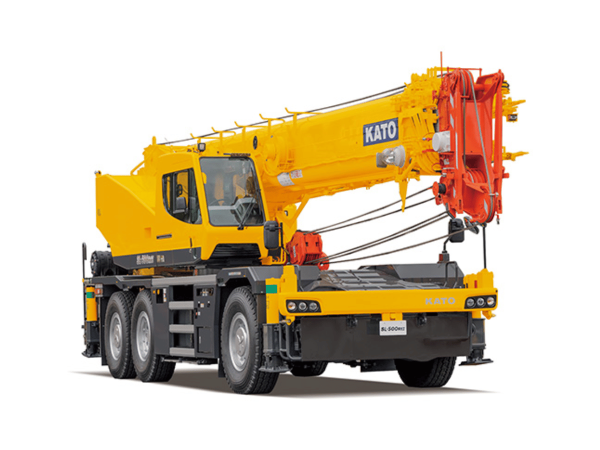
The SL-500RfIII represents the latest evolution of Kato’s SL Jib rough terrain crane concept. Unlike conventional rough terrain cranes that utilize fixed lattice fly jibs, the SL-500RfIII employs a hydraulically telescoping and hydraulically luffing box-type jib. This system allows operators to adjust both jib length and offset angle from the cab, dramatically improving load placement capabilities while reducing setup time and eliminating much of the manual work associated with traditional fly jib installation. The crane was developed to provide greater versatility on congested construction sites where crane repositioning is difficult or impossible.
The crane’s primary lifting structure is a five-section hydraulic telescopic boom extending from 10.1 m to 40.0 m. The boom utilizes a box-section design with synchronized hydraulic extension, where the third, fourth, and fifth sections telescope simultaneously. Maximum rated lifting capacity is 50 tonnes at a 3.0 m radius on the fully retracted 10.1 m boom using twelve-part reeving. At longer boom lengths, capacities remain substantial, including 30 tonnes on the 17.6 m boom, 15 tonnes on the 25.1 m boom, 12.5 tonnes on the 32.5 m boom, 9 tonnes on the 36.5 m boom, and 7.5 tonnes on the fully extended 40.0 m boom. Maximum boom tip height reaches 41.1 m.
A defining feature of the SL-500RfIII is its advanced SL Jib. The jib is a two-section hydraulic box-type design that telescopes from 9.4 m to 13.7 m and can be hydraulically luffed through offset angles ranging from 5° to 60°. This arrangement enables the crane to work around structures, beneath roofs, inside industrial facilities, and in locations where fixed-angle fly jibs would be severely limited. Maximum rated capacities are 4.2 tonnes on the 9.4 m jib and 3.0 tonnes on the fully extended 13.7 m jib. With the boom fully extended and jib installed, maximum lifting height reaches 54.8 m, placing the crane among the most capable hydraulic-jib rough terrain cranes in its class.
The lifting system is equipped with two independent hydraulic winches utilizing planetary reduction drives with integrated negative brakes. The main hoist achieves rope speeds of 135 m/min while the auxiliary hoist reaches 128 m/min. Hook speeds are equally impressive, with the main hook attaining 11.2 m/min on twelve-part reeving and the auxiliary hook reaching 128 m/min on a single line. High-speed no-load lowering is available at approximately 157 m/min, enhancing productivity during repetitive lifting operations.
Boom elevation ranges from 0° to 84°. Full boom raising from horizontal to maximum elevation requires approximately 49 seconds, while complete extension of the 29.9 m telescoping stroke takes around 97 seconds. Slewing is driven through a hydraulic motor and planetary gearbox system with selectable high and low speeds, producing a maximum slewing speed of 1.75 rpm. The crane maintains a rear swing radius of 3.55 m, allowing efficient operation in restricted work zones despite its larger 50-ton capacity.
The outrigger system utilizes a fully hydraulic H-type arrangement with integrated float and jack cylinder construction. Six outrigger positions are available, ranging from a maximum spread of 7.6 m to a minimum width of only 2.43 m. Intermediate positions of 7.2 m, 6.5 m, 5.4 m, and 4.3 m provide flexibility when operating in space-constrained environments. Dedicated load charts are supplied for every outrigger width, ensuring safe lifting performance under varying site conditions.
Power is provided by a Cummins QSL9-4C diesel engine compliant with Japan’s 2014 special-purpose vehicle emission regulations. The water-cooled six-cylinder engine displaces 8.849 litres and develops 254 kW (340 hp) at 2,100 rpm while producing a substantial 1,526 Nm of torque at 1,400 rpm. The powerplant is coupled to a fully automatic transmission with manual override capability, featuring six forward and two reverse gears. A torque converter with automatic lock-up clutch improves fuel efficiency and drivability.
The carrier is a three-axle rough terrain chassis utilizing selectable 6×2 and 6×4 drive modes. Maximum travel speed is 49 km/h and gradeability reaches 60%. Steering versatility is provided through five steering modes consisting of front-wheel steering, counter steering, crab steering, rear-wheel steering, and independent front/rear steering. The minimum turning radius is only 6.7 m in six-wheel steering mode despite the crane’s overall length of more than 12 m.
Safety equipment is centered around Kato’s ACS (Automatic Crane System) load moment indicator and overload prevention system with integrated voice warning functions. Additional safety features include automatic swing stop, anti-two-block protection, work area limitation, automatic outrigger-width detection, electronic level indicator, boom and jib lowering prevention valves, winch brake systems, swing brake, swing lock, and outrigger locking mechanisms. Depending on specification package, the crane can also be equipped with Kato’s Safety View System incorporating surround-view cameras, human detection assistance, PDF display capability, and clearance sonar systems for improved jobsite awareness.
Operator comfort receives considerable attention through a modern cab equipped with automatic climate control, liquid-sealed cab mounts, a fully adjustable suspension seat with armrests and headrest, power windows, intermittent windshield and roof wipers, AM/FM or Bluetooth audio systems, USB power outlets, winch monitoring cameras, LED work lighting, and numerous convenience features designed to support long operating shifts.
The crane measures 12.475 m in overall length, 2.75 m in width, and 3.73 m in height. Gross vehicle weight is approximately 35.7 tonnes. The larger chassis and three-axle arrangement allow the crane to carry its longer boom and larger hydraulic systems while maintaining roadability and maneuverability expected from a modern rough terrain crane.
Reviews
There are no reviews yet.