

We use cookies to improve your experience. By using this site, you agree to our Cookie Policy and Privacy Policy.
The KATO SR-250HV is a 25-ton class hybrid rough terrain crane developed by Kato Works as part of its environmentally focused “Hybrid Roughter” series. It combines a conventional diesel-powered rough terrain crane with an electric motor-driven hydraulic system and can be paired with the KATO EK-UNIT external power supply system. This arrangement allows the crane to perform lifting operations with significantly reduced fuel consumption, lower noise emissions, and, when powered by renewable electricity, virtually zero on-site CO₂ emissions during crane operation.
*Crane Specifications, Load Charts, and Crane Manuals are for reference only.
Contact the crane manufacturer for manuals to operate the crane properly.
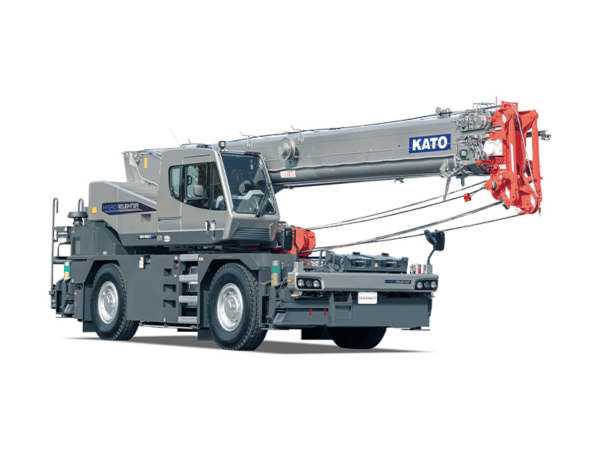
The KATO SR-250HV represents one of the earliest practical applications of hybrid technology in the rough terrain crane sector. Introduced by Kato Works as the “Hybrid Roughter” series, the crane combines a conventional diesel engine with an electric motor through a clutch-type parallel hybrid system. Unlike fully electric cranes that rely entirely on onboard battery capacity, the SR-250HV retains the operational flexibility of a traditional rough terrain crane while gaining the efficiency benefits of electric-powered crane functions.
The crane is rated at 25 tonnes, with a maximum lifting capacity of 25,000 kg at a 3.5 m radius on its fully retracted boom. The main boom consists of a four-section fully powered telescopic boom extending from 9.35 m to 30.5 m. For increased reach, a two-stage lattice fly jib is available, providing lengths of 8.0 m and 13.0 m, resulting in a maximum tip height of approximately 44.6 m. The crane can also be equipped with a single-line auxiliary boom head for lighter lifting duties.
In terms of working performance, the boom telescopes from minimum to maximum length in approximately 73 seconds, while the boom elevation range extends from approximately −3.5° to 80.5°. The boom can luff from minimum to maximum angle in roughly 31 seconds. The hoisting system achieves a maximum rope speed of approximately 123 m/min, and the crane’s slewing system rotates at up to 2.0 rpm, providing smooth and precise load handling.
The SR-250HV is mounted on a compact two-axle rough terrain carrier with an overall length of approximately 11.69 m, width of 2.62 m, and height of about 3.49 m in travel configuration. The gross vehicle mass is approximately 26,395 kg. Power for road travel is supplied by a Mitsubishi 6M60 diesel engine, a six-cylinder turbocharged and intercooled engine meeting Japanese emissions requirements of its era. The engine develops approximately 270 PS (199 kW) at 2,600 rpm and delivers around 785 N·m of torque at 1,400 rpm. The crane can travel at speeds up to 49 km/h, making it suitable for rapid movement between job sites without requiring additional transport equipment.
The hybrid system is the SR-250HV’s defining feature. The crane incorporates an electric motor rated at approximately 90 kW with a maximum torque of about 784 N·m, which can drive the hydraulic pumps used during lifting operations. This allows crane functions to be performed with reduced diesel engine load, lowering fuel consumption and noise levels compared with conventional rough terrain cranes. According to Kato’s published figures, the hybrid system can reduce CO₂ emissions during travel by up to 40% and during crane operations by approximately 20%. Noise levels during crane work are also substantially reduced, making the machine particularly attractive for urban construction projects, night work, and environmentally sensitive locations.
A unique aspect of the SR-250HV is its compatibility with the KATO EK-UNIT external power supply and hydraulic power package. The EK-UNIT is a containerized electrical power unit capable of supplying three-phase power and driving the crane’s hydraulic system through an electric motor. When connected to external electrical infrastructure, the crane can perform lifting operations without running its diesel engine. Kato promoted this configuration as enabling crane operations with effectively zero direct CO₂ emissions, particularly when the electricity source is renewable energy such as solar or wind power. The system also significantly lowers operating costs and greatly reduces site noise.
The EK-UNIT itself is equipped with a power supply specification of approximately 200–240 V, 50/60 Hz, producing around 58 kW output and supplying current in the range of 300–400 A. The unit measures roughly 2,360 mm long, 1,650 mm wide, and 1,550 mm high, with a weight of approximately 2,000 kg. When deployed on site, it enables the crane to undertake lifting operations using electrical energy rather than diesel fuel, creating a highly sustainable lifting solution for projects with strict environmental requirements.
The KATO SR-250HV remains a significant milestone in the evolution of rough terrain cranes, demonstrating how hybrid technology can be integrated into conventional crane architecture while maintaining the mobility, lifting performance, and operational versatility expected from a 25-ton class rough terrain crane. Its combination of diesel and electric drive systems, together with the innovative EK-UNIT external power concept, positioned it as one of the most environmentally advanced rough terrain cranes available during its introduction.
Reviews
There are no reviews yet.