
We use cookies to improve your experience. By using this site, you agree to our Cookie Policy and Privacy Policy.
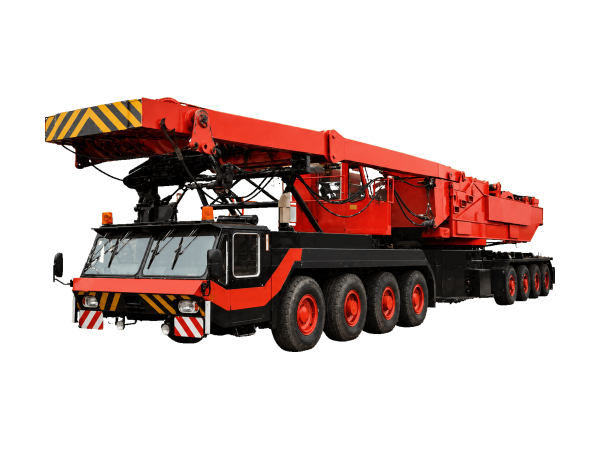
The Gottwald AK 350-83 belongs to a very small family of 350-ton Gottwald lattice-boom cranes. In total, three machines were built, and all differed from one another in important ways. The first was the AK 350-83 supplied to Sankyu in Japan, which is the crane shown in the attached Japanese brochure. It remains the most conventional of the three in overall concept and is the machine for which the brochure gives the clearest published lifting and working-range data. The brochure rates it at 350 tonnes at a 6 m working radius and shows a maximum conventional lattice main boom length of 93 m.
For high-reach work, the Sankyu AK 350-83 could be converted into a tower-crane arrangement with a 77 m tower and an 86 m luffing jib. The brochure states that this configuration allowed lifting work at heights of around 150 m. This gave the crane a very broad working envelope for major industrial construction, plant erection and other applications requiring both high capacity and substantial hook height.
The AK 350-83 was mounted on a large road-going carrier. The brochure photographs show a five-axle chassis, while the transport description explains how the front bogie could be connected to the tractor section and the rear bogie used as a trailer arrangement for movement on Japanese roads. For short relocations around a jobsite, the crane could also be moved with a wheeled support fitted to the boom tip, reducing the need to fully dismantle the boom between nearby working positions.
Stability was provided by a very large outrigger system, with the brochure specifying a maximum spread of 14.0 × 14.0 m. The outriggers incorporated safety pinning and pressure-monitoring provisions, while the crane was also equipped with overload protection, boom and jib over-hoist protection, winch and swing brake locking systems, and boom-angle indication. These safety systems are specifically highlighted in the Japanese publication.
The Sankyu machine was only one member of the AK 350 family. A second crane was supplied to the East German company VEB IMO Merseburg. That operator had previously used a Gottwald AK 270, but the AK 270 was badly damaged in a road accident. Because of the shortage of western currency in the German Democratic Republic, the replacement programme was unusual: instead of purchasing a complete new AK 350, VEB IMO Merseburg acquired only the AK 350 base machine from Gottwald and reused the boom sections from the damaged AK 270. Gottwald therefore supplied the crane base together with the necessary adaptors for the AK 270 boom and counterweight system. For this reason, the machine is commonly known as the AK 350/270.
The AK 350/270 was later acquired by van Seumeren and extensively rebuilt by Huisman into the MDC 3500. This reconstruction fundamentally changed the crane. A new main boom with a larger cross-section was installed, while the original AK 270 main boom was reworked into a luffing jib. The rebuild also introduced a hammer-shaped heavy-lift top and a derrick mast. Unlike the conventional lattice derrick structures used on many heavy-lift cranes, the MDC 3500’s derrick mast was fabricated from sheet steel and formed a large A-frame-like structure, giving the crane a very distinctive appearance.
After a later period of less certain ownership, the MDC 3500 eventually entered service with Sarens in Mexico. It was subsequently heavily damaged in a traffic accident, and Sarens has undertaken work to rebuild the crane. This machine therefore represents an unusually long evolutionary path from a hybrid AK 350/AK 270 combination into a heavily modified Huisman-designed heavy-lift crane.
The third 350-ton Gottwald machine was the MK 350-84, which was supplied to South Africa. Unlike the self-propelled AK 350 machines, this crane reportedly had no undercarriage drive and was equipped with double tyres on all axles. In practice, this makes it more of a mobile harbour-crane arrangement than a conventional road-going mobile crane. Its upper structure also differed significantly from the other two 350-ton Gottwald machines. Given the twin-tyre arrangement across the axles, its designation might appear at first glance as though it should have followed a different numerical suffix, but it was known as the MK 350-84.
In broad design terms, the AK 350 family shared a strong resemblance to the larger Gottwald AK 450. The boom sections were dimensionally very similar, and Gottwald also considered developing a Maxilift system for the AK 350. The proposed arrangement would have used a 26 m derrick mast and would have required an additional winch, but the system was never built.
The Sankyu AK 350-83 nevertheless remained a very capable heavy-lift crane in its own right. Its published specification combines a 350-tonne capacity at 6 m, 93 m maximum conventional main boom, 77 m tower, 86 m luffing jib, and 14 × 14 m outrigger spread. The brochure also places strong emphasis on road transportability, operator visibility, safety systems and the ability to move the crane between nearby working positions without complete boom dismantling.
*Crane Specifications, Load Charts, and Crane Manuals are for reference only.
Contact the crane manufacturer for manuals to operate the crane properly.
The second crane was supplied to the East German firm “VEB IMO Merseburg”. This company used to operate a AK270 before, but this crane was badly damaged in a traffic accident. Due to the shortage of western currencies in the GDR, the decision was made to buy only the base machine of a AK350 an re-use the boom sections of the AK 270. According to this, Gottwald only supplied the base machine an adaptors for the boom and counterweight. (Because of this, this crane is often referred to as the “AK 350/270”.)
Later, the crane was bought by van Seumeren who had it rebuild by Huisman to a “MDC 3500”. This included a new main boom with a larger cross section (while the old AK 270 main boom was reworked into a luffing jib) and a hammer-shaped heavy-load top as well as a derrick mast. Contrary to common practice, this mast isn’t built in the usual lattice style but made out of sheetmetal, making it look like a large A frame. After some time of unknown ownership, the crane was finally working for Sarens in Mexcio, were it was heavily damaged in a traffic accident. Sarens is currently working on rebuilding the crane.
The third crane was a MK 350-84 that was shipped to South Africa. It is said to work as an harbour crane there. The crane lacks a drive for the undercarriage and is equipped with double tyres on all axles. (Therefore, one should expect a “MK 350-88” designation.) Furthermore, the upper carriage is very different form the other to 350 t cranes.
In general, it can be said that the AK 350 does look much like the AK 450 – even the boom parts have the same dimensions. Gottwald also thought of building a Maxilift system for the AK 350s which would have required an additional winch on the 26 m (85 ft) derrick mast, but it was never built.

Reviews
There are no reviews yet.