
We use cookies to improve your experience. By using this site, you agree to our Cookie Policy and Privacy Policy.
The TCM Autogrù C 300E is a 30-ton class, four-axle telescopic mobile crane designed for installation on a commercial truck chassis and intended for road-mobile lifting, recovery and support work. It has a maximum rated capacity of 30 tonnes at a 3 m radius and uses a three-section hydraulic telescopic boom extending from approximately 6.2 m to 14.8 m. Boom elevation ranges from -2° to +80°, while the standard upperstructure provides 320° slewing. A 6.3 m folding lattice jib and an additional 3 m manual extension were available to increase working reach. Four hydraulic outriggers provide stabilization, and maximum road speed is approximately 80–90 km/h, depending on the carrier configuration. Crane functions are powered from the truck’s PTO-driven hydraulic system, while the chassis engine specification depends on the commercial carrier selected for the installation.
*Crane Specifications, Load Charts, and Crane Manuals are for reference only.
Contact the crane manufacturer for manuals to operate the crane properly.
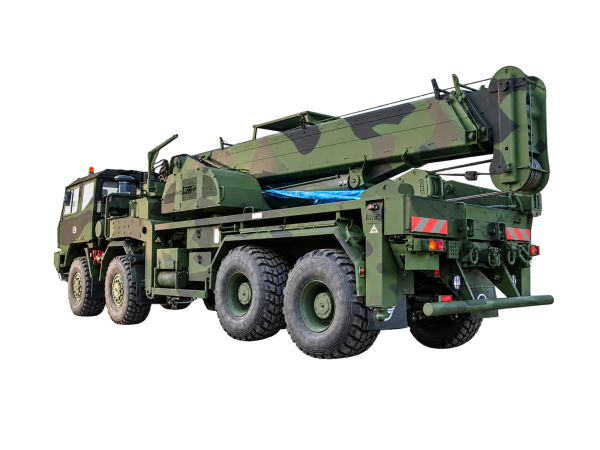
The TCM Autogrù C 300E is a 30-ton class truck-mounted telescopic mobile crane developed by TCM for applications requiring a combination of road mobility, compact dimensions and moderate heavy-lifting capability. The crane is designed to be installed on a suitable commercial vehicle chassis through a purpose-built auxiliary frame, allowing the carrier specification to be selected according to the destination market and operating requirements. In the illustrated configuration, the machine uses a four-axle carrier, providing the load distribution and chassis stability required for the crane installation while retaining conventional road mobility.
Maximum lifting capacity is 30 tonnes at a 3 m working radius. The C 300E operates without a standard counterweight in its basic load-chart configuration, although an optional 3-tonne counterweight with hydraulic handling equipment was available. The principal load charts cover lifting with the outriggers fully deployed and distinguish between the rear working sector and the front and side sectors, where permitted capacities vary according to boom length, radius and working direction.
The main boom is a three-section hydraulic telescopic boom manufactured from high-strength steel with an octagonal cross-section. The retracted boom length is approximately 6.2 m, extending through intermediate positions to a maximum of about 14.8 m. The first and second telescopic sections extend sequentially by double-acting hydraulic cylinders and can be extended or retracted under load. Boom elevation is controlled by a double-acting hydraulic cylinder, with an operating range from approximately -2° to +80°.
For additional reach, the C 300E could be equipped with a 6.3 m folding lattice jib, which is carried alongside the main boom when not required. A further 3 m manually extended section was available for the lattice attachment, providing a maximum additional jib system of approximately 9.3 m beyond the telescopic boom. The crane could also be fitted with a separate 2.5-tonne auxiliary winch, an auxiliary rope head and a 5-tonne hook block for lighter lifting duties at extended reach.
The standard upperstructure provides 320° slewing. The turret is constructed from high-strength steel and mounted on a double-row ball bearing with internal gearing. Slewing is driven hydraulically through an epicyclic reduction gearbox and incorporates an oil-immersed multidisc brake with automatic hydraulic braking. Continuous rotation was also listed as an optional feature, allowing the crane to be configured for unrestricted slewing when required.
The main hoist uses an epicyclic reduction gearbox with an oil-immersed multidisc brake and a variable-displacement hydraulic piston motor. The standard hook block is rated for 30 tonnes and uses three sheaves. Hoisting safety equipment includes upper and lower limit switches, safety valves on the hydraulic cylinders, adjustable pressure-relief valves and an electronic load limiter. The technical specification does not state a verified maximum hoisting speed or slewing speed, so these figures should not be assigned without additional documentation.
Crane stability is provided by four hydraulic outriggers arranged in front and rear pairs. The rear outriggers extend horizontally using double-acting hydraulic cylinders, while the front outriggers use adjustable hydraulic beams. With the stabilization system fully deployed, the transverse outrigger span is approximately 5.40 m, while the longitudinal spacing between the front and rear stabilizers is about 6.23 m. The crane’s transport width is approximately 2.50 m, allowing it to retain a conventional road-going envelope when the outriggers are retracted.
Overall transport length is approximately 10.26 m, although the exact dimension depends on the wheelbase of the commercial chassis selected for the installation. Overall height is approximately 3.13 m. The illustrated crane equipment package has a stated weight of approximately 14,200 kg, although final vehicle mass will depend on the carrier, accessories and installed equipment.
Hydraulic power for the crane is supplied from the truck through a power take-off connected to the vehicle transmission. A pair of pumps arranged in series supplies three independent hydraulic circuits. The system incorporates pressure-control valves, return filtration and an electrically ventilated oil cooler, while two hydraulic joysticks allow simultaneous crane movements. A dead-man safety control is included to prevent unintended operation. Because the crane is installed on different commercial truck chassis, there is no single chassis engine model, engine output or emission standard specified for the C 300E itself; these depend on the chosen carrier.
Maximum road speed is approximately 80 to 90 km/h, depending on the truck chassis and overall vehicle mass. This gives the C 300E substantially greater transfer speed than crawler, industrial or rough-terrain cranes and allows the crane to travel independently between jobs without separate transport under normal permitted road conditions. The four-axle arrangement also provides a practical platform for distributing the weight of the crane and its support structure.
The crane operator works from a separate upper cab constructed from steel and fitted with safety glazing for good visibility around the boom and load. Standard equipment includes heating, instrumentation, an adjustable pneumatic-suspension seat and a sliding access door. Optional equipment included a tilting crane cab, remote control for most crane functions, cameras for monitoring the winches, a personnel basket, a rear towing winch rated at 12,500 kg, and a width-adjustable lifting beam rated for up to 30 tonnes.
Overall, the TCM Autogrù C 300E is a versatile 30-ton class, four-axle telescopic truck crane combining a 30-tonne maximum lifting capacity, 14.8 m telescopic boom, optional 6.3 m lattice jib with 3 m extension, 320° standard slewing and road speeds of up to approximately 80–90 km/h. Its truck-mounted construction, relatively compact transport dimensions and range of optional lifting and recovery equipment make it suitable for general construction, military support, equipment recovery, infrastructure maintenance and other mobile lifting applications.

Reviews
There are no reviews yet.