
We use cookies to improve your experience. By using this site, you agree to our Cookie Policy and Privacy Policy.
The Kato SR-250RfII, model KR-25H-F2, is a 25-ton class rough terrain crane from Kato’s popular Rafter series. Introduced as the successor to the earlier SR-250Rf, the machine combines a four-section 30.5 m telescopic boom with a hydraulically luffing two-stage Power Jib measuring 8.7 m to 13.1 m. With a maximum lifting height of 44.6 m and a maximum lifting capacity of 25 tonnes, the SR-250RfII is designed for general construction, steel erection, infrastructure works, precast installation, and industrial maintenance applications. The crane incorporates Kato’s ACS safety system, improved operator comfort, modern emissions-compliant powertrain, and multiple outrigger configurations for enhanced versatility on confined job sites.
*Crane Specifications, Load Charts, and Crane Manuals are for reference only.
Contact the crane manufacturer for manuals to operate the crane properly.
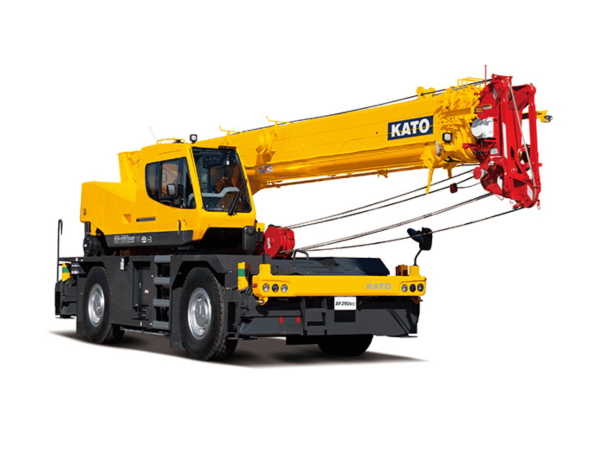
The SR-250RfII represents the latest evolution of Kato’s well-established 25-ton rough terrain crane platform. Designated KR-25H-F2, the crane was engineered to meet Japan’s modern emission and safety requirements while maintaining the compact dimensions and maneuverability expected from the Rafter series. Unlike the Cityrange MR series, the SR-250RfII emphasizes longer reach and greater lifting height, making it particularly suitable for building construction, bridge projects, industrial plants, and utility installations.
The crane is equipped with a four-section fully hydraulic box-type telescopic boom extending from 9.35 m to 30.5 m. The synchronized telescoping system extends the second, third, and fourth sections simultaneously, providing smooth boom operation and efficient deployment. Maximum rated lifting capacity is 25 tonnes at a 3.5 m radius on the shortest 9.35 m boom using seven-part reeving. Capacity remains impressive throughout the boom range, with 15 tonnes available on the 16.4 m boom, 12.5 tonnes on the 23.45 m boom, and 8 tonnes on the fully extended 30.5 m boom. A 4.5-ton rooster sheave is provided for auxiliary lifting duties and single-line operations.
One of the crane’s most significant features is its Power Jib system. The jib consists of a two-stage arrangement that can be configured at lengths of 8.7 m or 13.1 m. Unlike traditional fixed-offset fly jibs, the Power Jib can be hydraulically luffed through an offset range of 5° to 60°, allowing operators to position loads behind structures or into difficult-to-reach areas without relocating the crane. The maximum rated capacity is 3.3 tonnes on the 8.7 m jib and 2.1 tonnes on the 13.1 m jib. Combined with the fully extended main boom, the crane achieves a maximum lifting height of 44.6 m, compared with 31.5 m on the boom alone.
The hoisting system utilizes two independent hydraulic winches driven through planetary gear reducers with integrated negative brakes. Main and auxiliary winches both achieve rope speeds of up to 125 m/min, while high-speed no-load lowering reaches 163 m/min. Hook speeds reach 17.8 m/min on the seven-part main hook and 125 m/min on the auxiliary hook. These performance figures provide fast cycle times for repetitive lifting operations and increased productivity on busy construction sites.
Boom elevation ranges from 0° to 84°, with the full luffing movement completed in approximately 40 seconds. Telescoping speed is equally efficient, extending the boom’s 21.15 m stroke in approximately 65 seconds. Slewing is powered through a hydraulic motor and planetary reduction gearbox with a maximum slewing speed of 2.6 rpm. The crane’s tail swing radius is 3.1 m, balancing compact operation with upper structure stability.
The outrigger system is available in both H-type and X-type configurations. The H-type outriggers provide five extension positions with a maximum spread of 6.6 m and intermediate positions of 6.1 m, 5.0 m, and 3.8 m, down to a minimum spread of 2.31 m. This flexibility enables the crane to maintain useful lifting capacities in restricted work areas where full outrigger deployment is impossible.
Power is supplied by a Hino J08E six-cylinder diesel engine compliant with Japan’s 2014 special vehicle emission regulations. The water-cooled direct-injection turbo diesel has a displacement of 7.684 litres and produces 196 kW (263 hp) at 2,300 rpm with a maximum torque of 830 Nm at 1,600 rpm. The engine is paired with a torque-converter transmission offering both automatic and manual shifting modes, providing four forward gears and one reverse gear with Hi/Low range selection.
The carrier incorporates selectable 4×2 and 4×4 drive modes and offers excellent off-road capability with a gradeability of 60%. Maximum travel speed is 49 km/h. Steering versatility is enhanced through five steering modes consisting of front-wheel steering, rear-wheel steering, counter steering, crab steering, and independent steering. The minimum turning radius is only 5.1 m in four-wheel steering mode, making the crane highly maneuverable in confined urban projects and industrial facilities.
Safety remains a major focus of the SR-250RfII. The crane is equipped with Kato’s ACS (Automatic Crane System) featuring overload prevention, voice warnings, automatic swing stop, work-area limitation, anti-two-block protection, outrigger-width detection, electronic leveling assistance, boom and jib lowering protection systems, hydraulic safety valves, swing locks, and outrigger locks. Depending on specification level, additional features such as a Safety View System, surround-view cameras, human detection assistance, clearance sonar, wind-speed monitoring, and external ACS voice warning systems are available.
Operator comfort has also been significantly improved. The cab includes automatic climate control with dehumidification, a fully adjustable suspension seat with armrests and headrest, power windows, USB charging ports, LED work lights, winch monitoring cameras, digital monitoring systems, and optional Bluetooth audio systems. These features contribute to reduced operator fatigue during long working hours.
With an overall length of 11.47 m, width of 2.62 m, and height of 3.44 m, the SR-250RfII remains compact enough for transportation between job sites while providing the reach and capacity expected from a modern 25-ton rough terrain crane. Gross vehicle weight is 25,575 kg with nearly equal axle load distribution, ensuring stable travel characteristics and balanced crane performance.

Reviews
There are no reviews yet.