
Kato SR-700L Load Chart PDF + Specifications
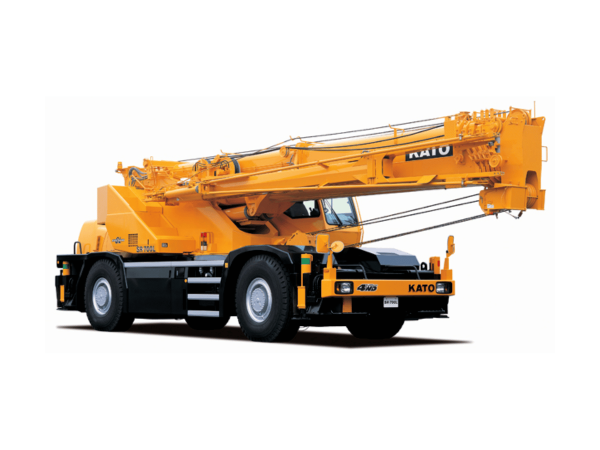
The Kato SR-700L is a 70-tonne class rough terrain crane developed by Kato Works for heavy lifting applications requiring a combination of high lifting capacity, long reach, and excellent jobsite mobility. Featuring a six-section fully hydraulic telescopic boom extending from 10.0 m to 44.5 m and a two-section hydraulically telescoping fly jib extending from 8.3 m to 13.2 m, the crane achieves a maximum lifting height of 45.5 m on the main boom and 58.6 m with the fly jib installed. Mounted on a two-axle 4×4 rough terrain carrier powered by a Mitsubishi turbocharged diesel engine, the SR-700L was designed to handle demanding construction, industrial, petrochemical, infrastructure, and plant maintenance projects while maintaining excellent maneuverability in confined working environments.
Download Load Chart Here
somdn_product_page
yes here
Available Downloads:
*Crane Specifications, Load Charts, and Crane Manuals are for reference only.
Contact the crane manufacturer for manuals to operate the crane properly.
Key Features & Benefits
The Kato SR-700L was engineered around a high-capacity six-section telescopic boom and a heavy-duty rough terrain carrier. The crane is rated at 70 tonnes at a 2.5 m working radius, making it one of the larger cranes in Kato’s rough terrain lineup. The boom is constructed from high-strength box sections and extends hydraulically from 10.0 m to 44.5 m. Extension is accomplished through a combination of three hydraulic cylinders and wire-rope synchronization, with boom sections two and three extending together and sections four, five, and six extending simultaneously. This arrangement provides smooth extension and improved structural efficiency throughout the boom’s operating range.
The boom can be luffed from 0° to 84° using twin direct-acting hydraulic cylinders equipped with pressure-compensated flow control valves. Boom elevation from horizontal to maximum angle requires approximately 66 seconds, while full extension from 10.0 m to 44.5 m takes approximately 135 seconds. At full extension, the crane achieves a maximum lifting height of 45.5 m.
To further increase working range, Kato equipped the SR-700L with a two-section fly jib that telescopes hydraulically from 8.3 m to 13.2 m. The jib can be offset between 7° and 60°, providing excellent flexibility for lifting over structures and obstacles. With the 13.2 m fly jib installed on the fully extended boom, the crane reaches a maximum lifting height of 58.6 m. The working range diagram in the brochure illustrates operating radii extending beyond 40 m while maintaining useful lifting capacities for steel erection, plant work, and industrial installations.
Hoisting functions are powered by independent main and auxiliary hydraulic winches driven through planetary reduction gearboxes by axial piston motors. The main winch achieves a maximum line speed of 160 m/min on the fifth rope layer, while the auxiliary winch reaches 150 m/min on the fourth layer. Hook speeds vary according to reeving configuration, with the main hook operating at approximately 10 m/min using a 16-part line arrangement and the auxiliary hook capable of 150 m/min in single-line operation. The main hoist carries 240 m of 18 mm wire rope, while the auxiliary hoist carries 125 m of the same diameter rope.
The slewing system employs a ball-bearing turntable providing continuous 360-degree rotation. Maximum swing speed is 1.8 rpm, and the crane maintains a compact tail swing radius of only 3.55 m despite its substantial lifting capacity. This compact rear swing dimension improves usability in congested industrial sites and urban projects.
Stability is provided through a hydraulic H-type outrigger system with integrated floats and cylinders. Operators can select six outrigger positions ranging from fully retracted at 2.69 m to fully extended at 7.60 m. Intermediate widths of 4.30 m, 5.40 m, 6.50 m, and 7.20 m allow the crane to adapt to restricted site conditions while maintaining appropriate lifting capacities. The crane’s lifting charts demonstrate substantial capacities even when outriggers are only partially extended, enhancing operational flexibility.
Power is supplied by a Mitsubishi 6D24-TLE2A turbocharged and intercooled diesel engine. This six-cylinder, water-cooled, direct-injection powerplant has a displacement of 11.945 litres and develops 257 kW (approximately 345 hp) at 2,200 rpm while producing 1,275 Nm of torque at 1,500 rpm. The engine drives a full-time 4×4 drivetrain through a torque converter and a fully automatic transmission featuring six forward and two reverse speeds. Maximum travel speed is 49 km/h, while gradeability reaches 60 percent, enabling the crane to negotiate demanding terrain conditions commonly encountered on construction projects.
The carrier utilizes hydro-pneumatic suspension with hydraulic locking cylinders, providing both travel comfort and lifting stability. Steering is fully hydraulic with independently controlled front and rear steering axles. The crane offers both two-wheel and four-wheel steering modes. Turning radius is 11.2 m in two-wheel steering mode and only 6.44 m in four-wheel steering mode, allowing the large 70-tonne machine to maneuver effectively in confined working areas. The minimum path-width diagrams in the brochure demonstrate the significant maneuverability benefits of four-wheel steering.
Safety equipment is centered around Kato’s ACS (Automatic Crane System) with voice alarm functionality. Additional safety features include an outrigger status detector, boom and swing automatic stop systems, overhoist prevention, hydraulic holding valves, winch holding valves, automatic winch brakes, hydraulic safety valves, slew lock, outrigger lock pins, joystick safety stop system, hydraulic oil temperature warning system, and return filter monitoring devices. These systems continuously monitor crane operation and help prevent unsafe working conditions.
Operator comfort was also given considerable attention. The cab features all-steel welded construction mounted on rubber isolators and includes an adjustable steering wheel, adjustable seat, seat belt, roof and front window wipers with washers, and ergonomic controls. Optional equipment included winch-view cameras, rear-view cameras, side-view cameras, cab heater, cab cooler, AM/FM radio, and ACS external indicators.
The crane has transport dimensions of 12.59 m in overall length, 2.99 m in width, and 3.68 m in height. Gross vehicle weight is approximately 39.75 tonnes, evenly distributed between the front and rear axles. Despite its substantial lifting capability, the SR-700L remains relatively compact for its class, which contributed to its popularity in infrastructure construction, refinery maintenance, heavy industrial erection, and general lifting services.


Reviews
There are no reviews yet.