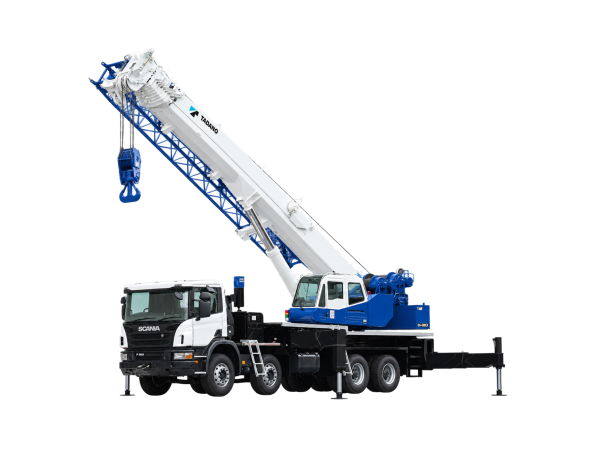
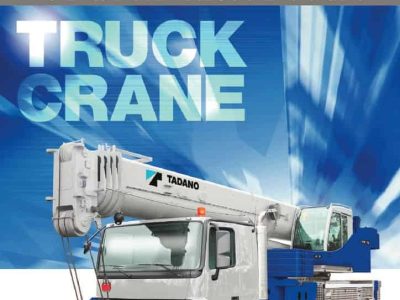
The Tadano GS-600EX is a 60-tonne truck crane developed around a Tadano hydraulic crane upperstructure installed on a conventional four-axle road carrier. Unlike the similarly named GR-600EX rough-terrain crane, the GS-600EX is a road-going truck crane and, in its Singapore specification, uses the Scania P360 CB8x4 8×4 chassis. The model was documented by Tadano by December 2013, placing its introduction in the early 2010s. It combines a relatively long telescopic boom, high road-transfer speed and commercial-truck running gear with Tadano’s AML-C crane control and outrigger-monitoring systems.
Maximum lifting capacity is 60,000 kg at a 3.0 m working radius. The boom is a five-section, full-power, partially synchronized telescopic structure with a hexagonal box profile. It retracts to 11.1 m and extends to 42.0 m, giving 30.9 m of telescoping travel. Full extension takes approximately 130 seconds. Two telescope cylinders together with extension and retraction cables provide the synchronized movement, and the operator can select between two boom telescoping modes according to the required working configuration.
For additional lifting height and radius, the GS-600EX can be equipped with a two-stage 8.8 m or 15.2 m swing-away jib. The jib can be offset at 5°, 25° or 45° and is stored alongside the base boom section during road travel. Hydraulic assistance is provided for mounting and stowing the jib. A separate single-top auxiliary boom sheave can also be fitted to the main boom head for single-line lifting work.
Boom elevation is controlled by a double-acting hydraulic cylinder fitted with a holding valve. The boom works through an angle range of approximately -2° to +80°, with elevation from 20° to 60° taking about 36 seconds. Tadano incorporated automatic speed reduction and slow-stop functions into the boom-elevation system to improve control as the boom approaches operating limits.
The main winch is hydraulically driven by an axial-piston motor through a reduction gearbox and provides powered hoisting and lowering. Maximum single-line pull is 54.9 kN, or approximately 5,600 kgf, while maximum rope speed is about 146 m/min at the fourth drum layer. The main winch carries approximately 227 m of 19 mm spin-resistant wire rope. The independently controlled auxiliary winch uses the same 54.9 kN single-line pull and reaches approximately 135 m/min at the second layer, with about 127 m of 19 mm rope.
The upperstructure provides continuous 360° slewing at a maximum speed of approximately 1.9 rpm. Slewing is driven by a hydraulic axial-piston motor through a planetary reduction gearbox. Tadano provided both free-slewing and locked-slewing modes, together with a manually operated slewing brake and positive front and rear slewing locks. These features allow the operator to select the appropriate upperstructure behaviour for different lifting and travelling conditions.
The crane is stabilized by four hydraulically operated outriggers. The front outriggers use a swing-out arrangement, while the rear units are H-type telescopic outriggers. The system permits different extension lengths on individual outriggers, with the AML-C system detecting each outrigger position and adjusting permissible crane capacity accordingly. Maximum outrigger extension is approximately 7.0 m, with intermediate positions of about 6.0 m and 5.1 m also available. This gives the GS-600EX greater flexibility on restricted urban worksites where full stabilizer deployment may not be possible.
A fixed 4.63-tonne counterweight is integrated with the slewing frame. Depending on transport or axle-load requirements, the crane can be configured with different hook blocks and removable equipment. Available hook equipment includes a 60-tonne six-sheave block, a 35-tonne three-sheave block and a 5.6-tonne single-line hook ball.
The GS-600EX uses Tadano’s AML-C Automatic Moment Limiter, which continuously monitors crane geometry and lifting condition. The system displays boom angle, boom length, load radius, actual hook load, permissible load, outrigger position, slewing angle and potential hook height. It provides visual and audible overload warnings and automatically prevents crane movements that would take the machine beyond its permitted operating envelope. Automatic speed-reduction and slow-stop functions are also integrated into boom and slewing operations.
The carrier is a Scania P360 CB8x4, giving the GS-600EX a four-axle 8×4 configuration. The two front axles are steerable, while the tandem rear axles are driven and incorporate hub reduction and differential locks. The chassis uses parabolic leaf springs at the front and heavy-duty leaf-spring suspension at the rear, with anti-roll bars on both axle groups. Minimum turning radius is approximately 12.0 m.
Power is supplied by the Scania DC13 114 360, a 12.7-litre, six-cylinder, four-stroke turbocharged and intercooled diesel engine. It produces 265 kW (360 hp) at 1,900 rpm and a maximum torque of approximately 1,850 Nm between 1,000 and 1,300 rpm. The engine complies with Euro 5 emissions requirements and uses SCR after-treatment. It is coupled to a Scania GRS905 transmission with 12+2 forward speeds, two reverse ratios and Opticruise automated control. Fuel capacity is approximately 300 litres.
The chassis is theoretically capable of approximately 80 km/h, although the Singapore-market GS-600EX is electronically limited to 60 km/h. Computed gradeability is approximately 50%. Gross vehicle mass is about 42.8 tonnes, with approximately 15.8 tonnes carried by the front axles and 27.0 tonnes by the rear tandem in the documented base configuration. Overall dimensions are about 13.48 m long, 2.59 m wide and 3.98 m high.
The GS-600EX also incorporates Tadano’s Eco Mode and HELLO-NET telematics system. Eco Mode is intended to reduce unnecessary engine speed during crane operations, while HELLO-NET records and communicates operating, location and maintenance information where supported. Together with AML-C and the individual outrigger-extension detection system, these features made the GS-600EX a relatively advanced truck crane for its period.
Overall, the Tadano GS-600EX is best described as a 60-tonne, four-axle truck-mounted hydraulic crane combining a 42.0 m five-section main boom, 15.2 m maximum jib, 1.9 rpm slewing speed, 146 m/min main-hoist line speed and a Euro 5 Scania 360 hp carrier. Its combination of road mobility, long boom, flexible outrigger deployment and modern Tadano control systems made it particularly suitable for urban construction, infrastructure maintenance and general lifting work where a conventional rough-terrain crane would be less efficient for road transfer.