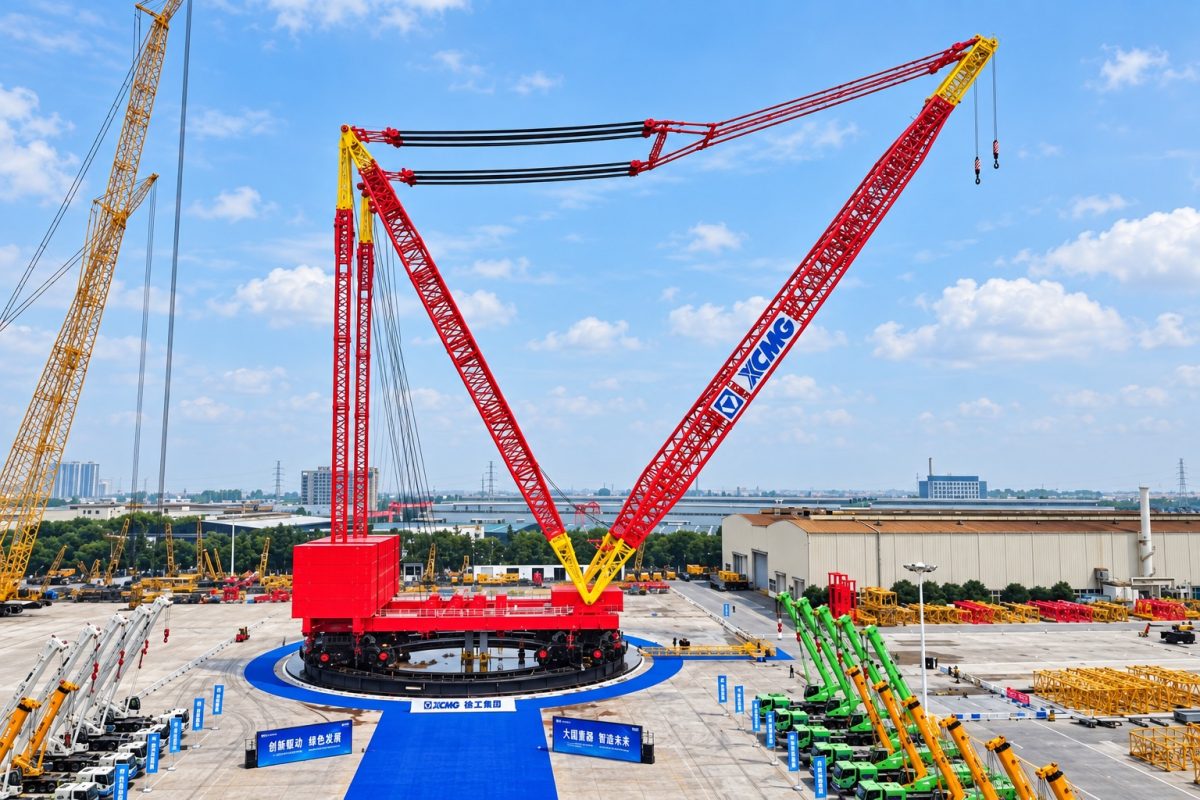
XCMG has taken another major step into the ultra-heavy lifting market with the completion of the first main unit of what it describes as the world’s largest-capacity ring crane.
Jointly developed by XCMG and Sinopec Heavy Lifting & Transportation Co., Ltd., the new crane is designed to achieve a maximum lifting capacity of 14,000 tonnes when both of its main units are combined. Its maximum rated lifting moment will reach an extraordinary 700,000 tonne-metres.
Those numbers are impressive, but I think focusing only on the headline capacity misses the more important part of the story.
The real significance of this crane is what XCMG and Sinopec intend to do with that capacity. Rather than simply building a larger machine for the sake of setting another record, the companies are targeting increasingly large modules used in nuclear power, conventional energy projects and offshore wind construction.
And that could change how some of the world’s largest industrial components are installed.
A 14,000-tonne crane built from two main units
Unlike a conventional crawler crane, the new machine uses a ring crane configuration and has been designed around a modular concept.
The complete system consists of two main units operating together in tandem. XCMG has now completed final assembly of the first unit, which the manufacturer says can also carry out lifting operations independently. Once the second unit is finished and integrated with it, the complete crane will provide the stated 14,000-tonne maximum capacity.
Industry reporting indicates that the two sections are effectively 7,000-tonne-class lifting units that combine to form the complete system.
This arrangement is particularly interesting from an engineering and project-planning perspective.
Building a crane capable of handling loads at this scale creates obvious challenges involving fabrication, transportation, assembly and site preparation. Breaking the system into major modules gives the manufacturer and operator more flexibility in how such an enormous lifting system is deployed.
It also means the first completed main unit is already capable of operating as a crane rather than being useful only when the complete system is assembled.
For contractors working on mega-projects, that flexibility could prove almost as valuable as the crane’s maximum capacity.
700,000 tonne-metres explains the real scale
Maximum lifting capacity always attracts attention, but anyone involved in lifting operations knows that the number written on the side of a crane tells only part of the story.
Radius matters.
A crane may have an enormous maximum capacity close to its centre of rotation, but heavy industrial projects often require equally large loads to be installed at substantial working radii.
This is why the new XCMG crane’s 700,000 tonne-metre maximum lifting moment is such an important figure.
To put its development into perspective, Cranepedia readers may remember XCMG’s XGC88000 crawler crane. The machine became one of China’s most important ultra-heavy crawler cranes and previously carried out major petrochemical lifting operations for Sinopec.
During its maiden project in Yantai in 2013, the XGC88000 lifted a 1,680-tonne propylene tower measuring 118 metres tall. Cranepedia has previously covered that milestone, along with the crane’s later work on other major industrial projects.
Readers who want to compare XCMG’s development in the super-heavy crawler crane category can also see our technical page for the XCMG XGC88000 specifications and load chart.
The new ring crane moves XCMG into an entirely different scale of lifting.
Why nuclear construction may be its most important application
One of the most interesting intended applications is nuclear power plant construction.
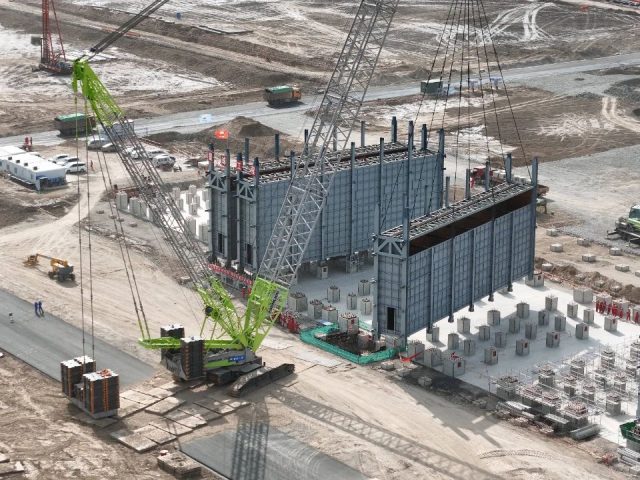
XCMG says the crane has been designed so that large nuclear modules and equipment associated with two nuclear islands can be installed from a single crane position while using one boom configuration.
Why is that important?
Every major crane relocation or configuration change requires planning, labour and time. On a nuclear construction site, where component weights can be enormous and schedules are closely controlled, reducing the number of crane movements can provide major logistical advantages.
Larger lifting capacity can also allow contractors to increase the size of prefabricated modules.
Instead of assembling many smaller pieces at height, more work can potentially be completed at ground level before an entire module is lifted into its final position.
That approach can reduce work at height and may simplify some stages of site assembly, although every project will naturally require its own detailed lifting study and engineering assessment.
For me, this is where cranes of this size become much more than record-setting machines. Their capacity can influence how engineers design the construction sequence itself.
Larger lifts could change conventional energy projects
The same principle applies to refinery, petrochemical and other conventional energy developments.
XCMG says the ring crane is intended to lift large towers and vessels as complete units rather than requiring them to be divided into smaller sections for installation.
This is something the heavy-lift industry has already experienced as crawler crane capacity has increased.
Cranepedia previously reported how the XGC88000’s first 1,680-tonne propylene tower installation demonstrated the advantage of lifting a very large vessel in one piece. The crane later handled a 2,155-tonne Fischer-Tropsch synthesis reactor, completing the lifting operation in around two and a half hours.
Of course, the lift itself may only take several hours. The engineering, transport, ground preparation, crane assembly and testing behind such a lift can take considerably longer.
But increasing crane capacity gives project engineers another option: build bigger on the ground and lift bigger at the end.
Offshore wind turbines continue to push crane capacity
The third major market identified by XCMG is offshore wind.
This should not be surprising.
Wind turbines continue to increase in output, and with higher-capacity turbines come larger towers, heavier nacelles and increasingly long blades. Installation equipment must therefore keep pace with turbine development.
XCMG says the new ring crane is intended to provide the lifting capacity and hook height required for the next generation of large wind turbines.
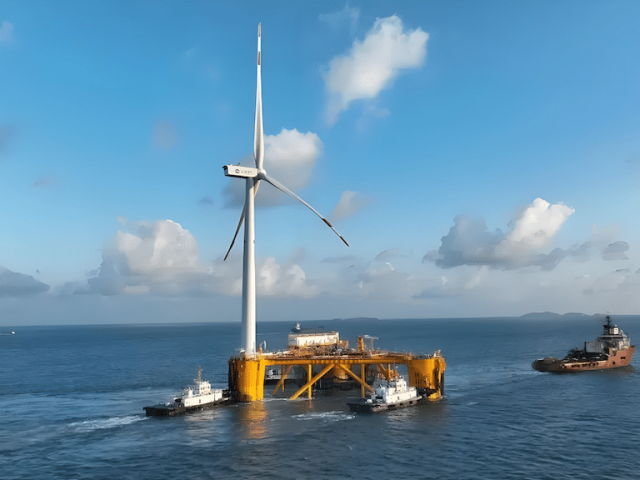
Cranepedia has already followed XCMG’s involvement in major wind projects, including the use of its XGC28000 crawler crane during construction work associated with a floating wind and aquaculture project.
The 14,000-tonne ring crane represents another level again.
Whether such extreme capacity becomes widely required in offshore wind will depend on how turbine sizes, foundation designs and construction methods develop. But manufacturers are clearly preparing lifting equipment for projects significantly larger than those we see today.
Electric direct drive is another important part of the story
Perhaps less visually dramatic than its lifting capacity, but equally interesting, is the crane’s drive system.
XCMG says the machine uses an electric direct-drive system, converting electrical energy directly into mechanical motion. According to the manufacturer, this arrangement can reduce energy consumption by more than 30% while improving operating efficiency by around 20%.
Those are manufacturer-stated figures and will ultimately need to be viewed against real project performance.
Nevertheless, electrification makes considerable sense for a ring crane.
Unlike a crawler crane that may need to travel regularly around a project, a ring crane is generally established around a fixed lifting area for major construction work. That creates different operating conditions and may make a high-capacity electrical system particularly suitable.
As energy projects become larger while contractors also look for ways to reduce fuel use, efficiency will increasingly become part of the discussion surrounding ultra-heavy lifting equipment.
The next milestone will be its first major lift
XCMG has called the development a major breakthrough in ultra-heavy lifting, and the numbers certainly support its position as an exceptional piece of engineering.
But the crane industry’s most meaningful records are usually established on a job site rather than in a specification sheet.
The first main unit has been completed. The next important stage will be completing the second section, integrating the full system and demonstrating what the 14,000-tonne crane can achieve under real project conditions.
That is the point I will be watching closely.
How quickly can the system be assembled? What ground preparation will it require? At what radii will its most useful capacities be available? And, perhaps most importantly, will project designers begin increasing module sizes because a crane like this now exists?
If that happens, XCMG and Sinopec will not simply have built the world’s largest-capacity ring crane.
They may have helped change the way the world’s largest industrial projects are constructed.