

We use cookies to improve your experience. By using this site, you agree to our Cookie Policy and Privacy Policy.
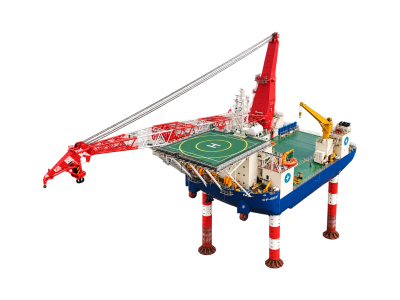
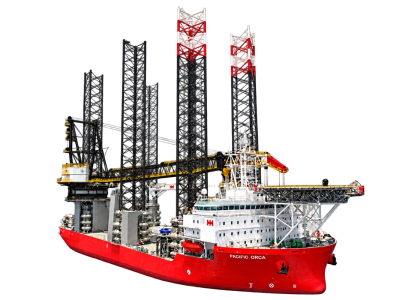
The Pacific Osprey, now known as Wind Osprey, is a self-propelled, self-elevating jack-up wind turbine installation vessel originally built for Swire Blue Ocean, part of the Swire Pacific Offshore group. Constructed by Samsung Heavy Industries in South Korea and delivered in 2013, the vessel was designed by Knud E. Hansen for offshore wind turbine transport and installation. It measures about 160.9 m long and 49 m wide, has a 4,300 m² working deck, accommodation for 111 people, six 105 m jack-up legs, DP2 dynamic positioning and a service speed of approximately 13 knots. In its original configuration, Pacific Osprey used an AmClyde ATL-60 main crane rated at about 1,150 tonnes at 31 m radius, with the boom later modified to provide approximately 132 m hook height above deck. The vessel was renamed Wind Osprey in December 2020 and later transferred into Cadeler’s O-class fleet. A major crane replacement completed in 2024 increased main crane capacity to 1,600 tonnes at 40 m radius and maximum main-hook height to approximately 160 m above deck, enabling the vessel to handle significantly larger modern offshore wind turbines.
*Crane Specifications, Load Charts, and Crane Manuals are for reference only.
Contact the crane manufacturer for manuals to operate the crane properly.
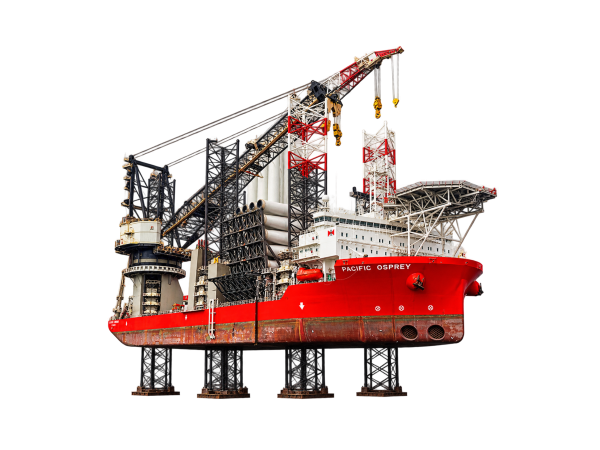
The Pacific Osprey is a purpose-built self-propelled jack-up wind turbine installation vessel developed for the transport, lifting and installation of offshore wind turbine generators. It was ordered as the sister vessel to Pacific Orca after Swire Pacific Offshore exercised an option for a second wind installation vessel, and it was constructed by Samsung Heavy Industries in South Korea. Pacific Osprey entered service in 2013 and formed part of a new generation of large wind installation vessels designed around high transit speed, strong station-keeping capability, rapid jacking and substantial crane capacity.
The vessel has an overall length of approximately 160.9 m, a length between perpendiculars of about 155.6 m, and a moulded breadth of 49.0 m. Depth to the main deck is approximately 10.4 m, with a design draught of around 5.5 m and a maximum draught of about 6.0 m. Maximum service speed is approximately 13 knots, giving the vessel relatively fast mobilisation between offshore wind projects compared with earlier jack-up installation units.
A defining feature of the vessel is its six-leg jack-up system. Each leg is approximately 105 m long and uses a high-speed rack-and-pinion jacking mechanism. Maximum leg protrusion below the hull is approximately 80 m, allowing the vessel to work in comparatively deep offshore locations while lifting the hull clear of wave action. The six-leg arrangement provides a highly stable elevated platform for heavy crane operations and also offers redundancy and flexibility when working on more difficult seabed conditions.
The vessel is equipped with a large open working deck of approximately 4,300 m². Current deck-loading capacity is stated at up to 15 tonnes per square metre, while jacking payload can reach approximately 11,000 tonnes. This gives the vessel substantial capacity for transporting turbine towers, nacelles, blades and associated installation equipment between port and offshore construction sites.
In its original Pacific Osprey configuration, the vessel was fitted with an AmClyde ATL-60 main crane. Unlike sister vessel Pacific Orca, which was originally listed at 1,200 tonnes at 31 m, Pacific Osprey’s pre-upgrade rating was approximately 1,150 tonnes at 31 m radius. A boom modification completed in 2020 increased maximum hook height to around 132 m above deck, improving the vessel’s ability to install taller wind turbines as offshore turbine dimensions increased.
The original crane arrangement became increasingly constrained as turbine sizes moved into the 15 MW and 20 MW class. Cadeler therefore undertook a major crane replacement programme for both Wind Osprey and Wind Orca. The work was completed in early 2024, replacing the older AmClyde cranes with new heavy-lift cranes rated at 1,600 tonnes at a 40 m radius. Maximum main-hook height increased to approximately 160 m above the main deck, giving the O-class vessels the lifting height and capacity needed for substantially larger next-generation turbines.
In its current Wind Osprey configuration, the main crane can lift 1,600 tonnes at 40 m radius and 1,200 tonnes at 50 m radius. A 425-tonne whip hook is also provided, together with a 15-tonne utility hoist suitable for man-riding operations. These figures represent a major increase in lifting capability compared with the vessel’s original configuration and allow Wind Osprey to handle modern nacelles, tower sections and other increasingly heavy offshore wind components.
An auxiliary crane is fitted for lighter deck handling and support work. Its main hoist is rated at approximately 35 tonnes at 30 m, with about 25 tonnes at 40 m in man-riding duty. The auxiliary hoist is rated at approximately 10 tonnes at 41 m. A separate deck crane is rated at around 25 tonnes at 30 m, also suitable for personnel-handling duties under the appropriate operating conditions.
Pacific Osprey was designed as a DP2 dynamically positioned vessel, allowing precise manoeuvring before the legs are lowered to the seabed. Propulsion and manoeuvring are provided by four 3.4 MW stern azimuth thrusters, two 2.2 MW retractable bow azimuth thrusters and two 2.2 MW bow tunnel thrusters. This arrangement gives the vessel strong low-speed control and redundancy during approach, positioning and departure from turbine installation locations.
Once positioned, the vessel lowers its six legs to the seabed and raises the hull clear of the water. Current operating limits include jacking in significant wave heights of around 2.5 m and wind speeds around 20 m/s, while maximum operating wind speed during jacking is stated at approximately 16 m/s under the specified reference conditions. By removing most wave-induced vessel motion before lifting begins, the jack-up system provides a stable platform for high-precision turbine installation.
Accommodation is provided for 111 people in single-berth cabins with private bathrooms. Facilities include mess and recreation spaces, conference rooms, offices, fitness areas and television lounges, allowing the vessel to remain offshore for extended installation campaigns. A 22 m diameter helideck rated for approximately 12.8 tonnes supports crew transfer and offshore logistics.
Pacific Osprey was renamed Wind Osprey on 8 December 2020 as Swire Blue Ocean transitioned into Cadeler. The vessel was subsequently reflagged from Cyprus to Denmark in November 2021 and now operates as one of Cadeler’s two O-class wind turbine installation vessels, alongside Wind Orca.
The 2024 crane upgrade significantly extended the vessel’s commercial life. Following the conversion, Wind Osprey has been positioned for installation of 15–20 MW class turbines, and Cadeler deployed the vessel on the Gode Wind 3 and Borkum Riffgrund 3 projects in Germany. It subsequently began installation work on the East Anglia THREE offshore wind farm, handling Siemens Gamesa SG 14-236 turbines.
Overall, the Pacific Osprey / Wind Osprey is best described as a large crane vessel and self-propelled jack-up wind turbine installation vessel. Originally entering service with an approximately 1,150-tonne AmClyde crane, six 105 m legs, a 4,300 m² working deck and DP2 positioning, it has since been substantially upgraded with a 1,600-tonne main crane and 160 m hook height. This combination of heavy-lift capability, large deck capacity, high jacking performance and self-propelled mobility has allowed the vessel to remain relevant as offshore wind turbines have grown dramatically in size since its original delivery.
On 23 August 2018, Pacific Osprey suffered a serious crane-related accident while berthed and jacked up alongside at Eemshaven in the Netherlands. The vessel’s main crane was undergoing maintenance when a box section of the crane boom collapsed onto the deck area adjacent to the bridge. Four crew members were injured in the incident, one seriously and three with minor injuries, while another crew member received medical treatment for shock. The vessel itself sustained significant damage, but there were no reported injuries to third-party personnel and no damage to the port infrastructure.
Following the accident, the damaged crane equipment was secured and removed, and Swire Blue Ocean began developing a replacement boom rather than simply restoring the original arrangement. The replacement was designed not only to return Pacific Osprey to service but also to improve its suitability for the rapidly increasing size of offshore wind turbines. The new boom was manufactured for the existing crane by NOV and incorporated a simplified design focused on wind turbine installation work.
The replacement boom measured approximately 115 m long and weighed about 422 tonnes. With the new boom installed, the crane retained a main lifting capacity of 1,200 tonnes at 31 m radius, while providing approximately 700 tonnes at 50 m radius. More importantly, maximum main-hook height increased to about 132 m above deck, representing roughly a 30 m increase in hook height compared with the previous configuration. This substantially improved Pacific Osprey’s ability to install larger next-generation wind turbines.
The new boom was shipped from NOV’s manufacturing facility to Denmark in early 2020. Swire Blue Ocean originally expected Pacific Osprey to return to service by 1 May 2020. The boom was lifted onto the vessel at Esbjerg on 14 April 2020 using two large shore cranes, after which the wire ropes, hooks and associated systems were installed. Load testing and final commissioning followed, with updated class approval obtained in May. The complete upgrade project was finished on 30 May 2020, and Pacific Osprey subsequently returned to operational service with its upgraded crane.
The 2020 upgrade enabled Pacific Osprey to handle significantly larger turbine components than before the accident. At the time, Swire Blue Ocean stated that the upgraded vessel could transport and install turbine combinations including multiple 10 MW-class units and up to three GE Haliade-X 12 MW turbines per loadout under normal operating conditions. The replacement boom therefore became more than a repair following the 2018 incident; it represented a major capability upgrade that extended the vessel’s usefulness as offshore wind turbine sizes continued to increase.