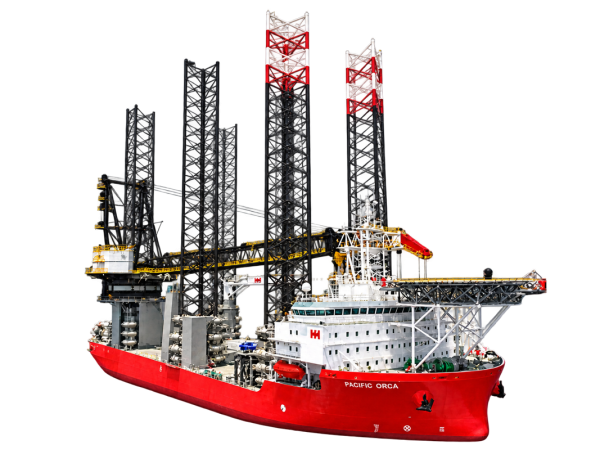
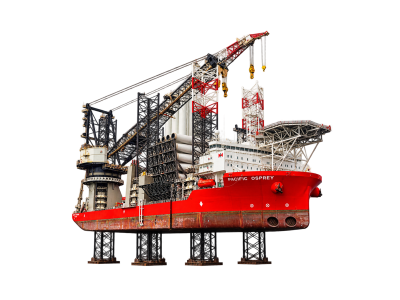
The Pacific Orca was developed as a purpose-built heavy-lift jack-up vessel for offshore wind turbine transport and installation. The project originated when Swire Pacific Offshore acquired Blue Ocean Ships in 2010 and ordered a new generation of wind farm installation vessel from Samsung Heavy Industries. Knud E. Hansen developed the conceptual and basic design, while Samsung constructed the vessel at its Geoje yard in South Korea. Pacific Orca was delivered in July 2012, followed by sister vessel Pacific Osprey. At the time, Pacific Orca was promoted as one of the world’s largest and most advanced wind turbine installation vessels.
The vessel was designed primarily for the offshore wind sector but with sufficient deck strength, crane capacity and station-keeping capability to support other offshore construction work. Its principal dimensions are approximately 160.9 m overall length, 155.6 m length between perpendiculars and 49.0 m moulded breadth. Depth to the main deck is about 10.4 m, while design draught is approximately 5.5 m and maximum draught around 6.0 m. Deadweight at jacking draught is approximately 8,400 tonnes, while the jackable payload is about 6,600 tonnes.
A major feature of Pacific Orca is its large open working deck of approximately 4,300 m², which was originally designed to carry up to 12 complete 3.6 MW wind turbine generator sets. This was a substantial transport capability at the time of construction and allowed the vessel to reduce the number of port calls required during turbine installation campaigns. The hull form was also optimized for relatively high transit speed, helping the vessel achieve a service speed of around 13 to 13.5 knots.
The vessel is equipped with six lattice-type jack-up legs, each approximately 105 m long, together with a high-speed rack-and-pinion jacking system. The original design enabled operations in water depths of approximately 60 m, with the hull elevated clear of the sea surface to provide a stable working platform for crane operations. Knud E. Hansen also indicated that the legs could be extended further if greater operational depth was required. Later design material cites a safe elevated height of around 22 m above sea level in deeper-water configurations, illustrating the substantial reserve built into the jacking system.
The original main crane was an AmClyde ATL-60 work-around-leg crane. Its main hoist was rated at 1,200 tonnes at 31 m radius, using two 600-tonne hooks in tandem. The auxiliary hoist was rated at 500 tonnes at 50 m radius, while a lighter whip hoist could handle 50 tonnes at approximately 110 m outreach. The main crane configuration was intended to place heavy nacelles and tower sections at heights approaching 120 m above sea level, which was sufficient for the offshore turbines being developed at the time.
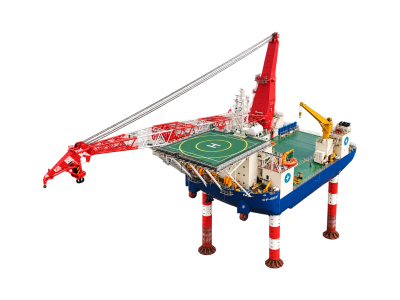
An additional auxiliary deck crane is fitted for general cargo handling and support operations. Published specifications list this auxiliary crane at around 35 tonnes, with operating outreach in the region of 6.5 to 30 m, although some earlier design material lists a 40-tonne figure depending on configuration. The vessel also includes a forward helideck approximately 22 m in diameter with a rated load capacity of about 12.8 tonnes, allowing crew and specialist personnel to transfer independently of port access.
Pacific Orca uses a diesel-electric propulsion system. Eight main generator sets provide electrical power to the propulsion, hotel and jacking systems. Published figures vary slightly between design and later operational documentation, with original project data listing eight 2.8 MWe generator sets, while another vessel fact sheet gives eight units rated at about 3,150 kW each. The propulsion arrangement includes four 3.4 MW stern azimuth thrusters, two 2.2 MW retractable bow azimuth thrusters and two 2.2 MW bow tunnel thrusters. This configuration works with a DP2 dynamic positioning system, allowing the vessel to maintain position accurately before and during jacking operations.
The high level of manoeuvrability was a key part of the vessel’s design. The combination of azimuthing stern units, retractable bow thrusters and tunnel thrusters provides good low-speed control around offshore turbine foundations, while the DP2 system gives redundancy for station keeping. Once on location, the vessel can position itself precisely, lower its six legs to the seabed and then raise the hull clear of wave action before heavy lifting begins. This transition from dynamically positioned vessel to rigid elevated platform is central to the installation method used by this class of jack-up vessel.
Accommodation is provided for 111 people, mainly in single-occupancy cabins. The vessel was designed to support extended offshore campaigns with crew accommodation, offices and associated service spaces integrated into the forward superstructure. This made Pacific Orca capable of operating as a self-contained offshore construction platform rather than merely a transport vessel.
The vessel’s commercial history also changed significantly after its early Swire years. Swire Blue Ocean became independent from Swire Pacific Offshore in 2020 and subsequently adopted the Cadeler name. Pacific Orca was renamed Wind Orca on 11 January 2021, and its ownership was listed under Wind Orca Limited. The vessel was later reflagged from Cyprus to Denmark in 2021. Cadeler has since positioned Wind Orca as part of its offshore wind installation fleet and announced major crane-upgrade plans intended to keep the vessel relevant for larger next-generation wind turbines.
It is therefore useful to distinguish between the vessel’s original Pacific Orca configuration and its later Cadeler-era configuration. The original vessel entered service with a 1,200-tonne main crane, approximately 97 m hook height above deck, six 105 m jack-up legs, and capacity for twelve 3.6 MW-class turbines. Later Cadeler plans called for a crane replacement that would raise crane capacity to around 1,600 tonnes, reflecting the rapid increase in size and mass of modern offshore wind turbines.
Overall, the Pacific Orca / Wind Orca is best described as a large DP2 self-propelled jack-up wind turbine installation vessel with six long lattice legs, a large heavy-lift crane and substantial deck cargo capacity. Its combination of a 1,200-tonne original main crane, 4,300 m² working deck, 8,400-tonne deadweight, approximately 60 m operational water depth, 13-knot-class transit speed and accommodation for 111 personnel made it a benchmark vessel for offshore wind construction when it entered service and laid the groundwork for the much larger installation vessels now serving the sector.