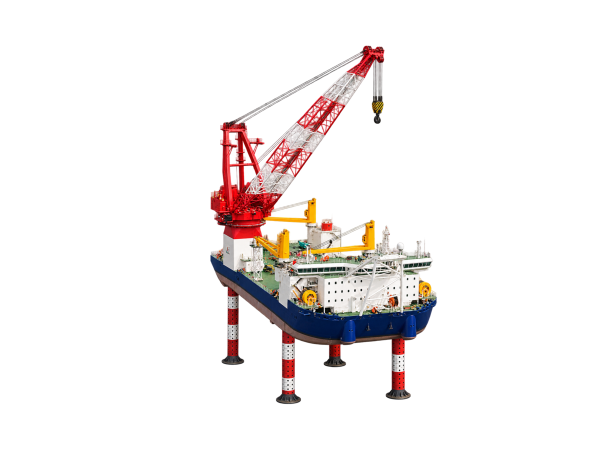
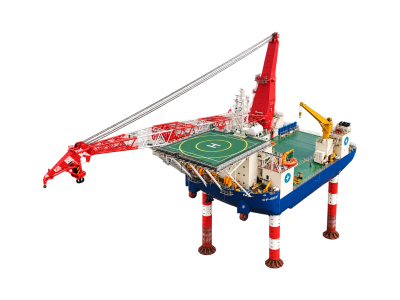
The CP-16001 is a large SEP-type offshore installation vessel, or self-elevating crane vessel, developed specifically for the construction of offshore wind farms. Although the name is sometimes written informally as “CP16000-1,” the correct vessel designation is CP-16001.
The project was undertaken jointly by Penta-Ocean Construction Co., Ltd., Kajima Corporation and Yorigami Maritime Construction Co., Ltd., with the vessel ultimately owned and operated by their joint venture, PKY Marine Co., Ltd. The vessel was conceived as a substantially larger successor to Penta-Ocean’s earlier CP-8001, which had introduced an 800-tonne-class offshore installation vessel into the Japanese market.
Development and Construction
The decision to construct a new 1,600-tonne SEP vessel was announced in November 2019, as Japan’s offshore wind sector began moving toward larger turbines and foundation structures in deeper coastal waters. The shipbuilding contract was signed on 30 January 2020, construction began later that year, and the vessel was launched in December 2021.
The vessel was built by PaxOcean Holdings at the Graha Shipyard in Batam, Indonesia. The basic vessel design and jacking system were supplied by GustoMSC of the Netherlands, while the main heavy-lift crane was supplied by Huisman, also of the Netherlands. After delays from the original schedule, CP-16001 was completed and formally delivered on 8 September 2023.
Vessel Dimensions and Classification
CP-16001 has an overall length of approximately 123 m, a beam of 45 m and a moulded depth of about 10 m. It can accommodate up to 100 people, allowing the vessel to support extended offshore installation campaigns without depending continuously on shore-based facilities.
The vessel is Japanese-flagged and classed by ClassNK as a self-elevating wind turbine installation ship. Registered gross tonnage is approximately 19,130 GT, and the vessel carries a DPS B notation corresponding to its dynamic-positioning capability.
Jack-Up System
One of the defining features of CP-16001 is its self-elevating jack-up system. The vessel is fitted with four closed circular legs, each measuring approximately 92.5 m in length.
Once positioned at the worksite, the legs are lowered to the seabed and the hull is raised clear of the sea surface. This effectively converts the vessel from a floating platform into a rigid offshore work platform, eliminating most wave-induced movement during heavy lifting. The design allows operation in water depths of up to approximately 50 m, making the vessel suitable for a wide range of Japanese fixed-bottom offshore wind projects.
Main Crane
The vessel is equipped with a fully revolving Huisman heavy-lift crane rated for a maximum lifting capacity of 1,600 tonnes. The crane has a 130 m boom and a maximum main-hook height of approximately 143 m above deck.
The combination of lifting capacity and hook height was selected specifically to handle the nacelles, tower sections, blades and foundation components associated with modern large offshore wind turbines. Penta-Ocean states that the crane is suitable for installation of 15 MW-class turbines.
Unlike a conventional floating crane, CP-16001 performs its principal heavy lifts after jacking the vessel clear of the water. This provides the crane with a highly stable base and allows heavy components to be positioned with greater precision despite challenging offshore conditions.
Dynamic Positioning and Marine Operations
Before the vessel is jacked up, precise positioning is assisted by a Kongsberg DP2 dynamic positioning system. The system controls vessel position and heading during approach and setup, allowing the jack-up legs to be placed accurately relative to turbine or foundation locations.
The DP system is especially important during the transition between free-floating and elevated operation. Once the desired position is reached, the legs are lowered, seabed contact is established and the hull is raised to a safe working elevation.
Offshore Wind Capability
CP-16001 was designed around the rapid increase in offshore wind turbine size. Early planning documents referred to construction of 10–12 MW wind turbines, while the completed vessel was described as capable of handling 15 MW-class machines.
Its deck area and jack-up capacity are sufficient to carry multiple large wind turbine components, helping reduce the number of port rotations required during an installation campaign. The crane can also handle various foundation types, including monopiles and jacket structures, giving the vessel a broader role than turbine erection alone.
First Major Project
After delivery, CP-16001 was assigned to the Kitakyushu Hibikinada Offshore Wind Farm in Fukuoka Prefecture. The vessel began operations there in November 2023, carrying out part of the foundation installation work as well as erection of 25 wind turbines rated at 9.6 MW each.
The project represented the vessel’s first major operational deployment and demonstrated its intended role as a Japanese-flagged heavy installation vessel for the country’s expanding offshore wind market.
Relationship to CP-8001
CP-16001 builds directly on Penta-Ocean’s experience with CP-8001, Japan’s earlier offshore installation vessel equipped with an 800-tonne crane. CP-8001 provided experience in jack-up operation, turbine installation and marine construction, while CP-16001 roughly doubled crane capacity and significantly increased hook height and installation capability.
The larger machine therefore represents a generational step rather than an entirely separate concept, retaining the SEP operating principle while scaling it for much larger turbines and foundations.
Overall Assessment
The Penta-Ocean CP-16001 is best classified as a 1,600-tonne self-elevating crane vessel / wind turbine installation vessel. Its combination of a 1,600-tonne fully revolving Huisman crane, 130 m boom, 143 m hook height, four 92.5 m jack-up legs, DP2 positioning and approximately 50 m working-water-depth capability makes it one of the most important heavy offshore installation vessels developed for Japan’s wind energy sector.


Reviews
There are no reviews yet.