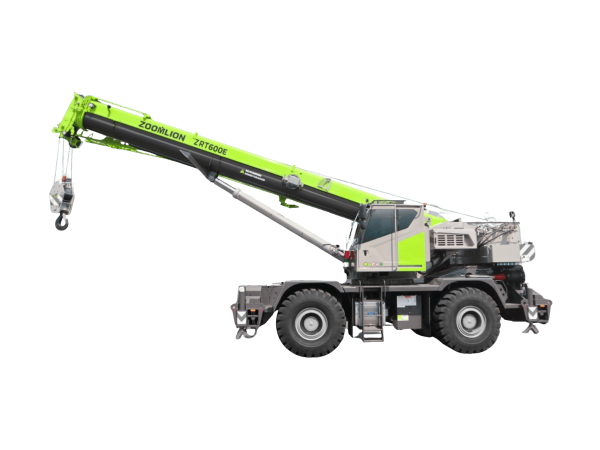
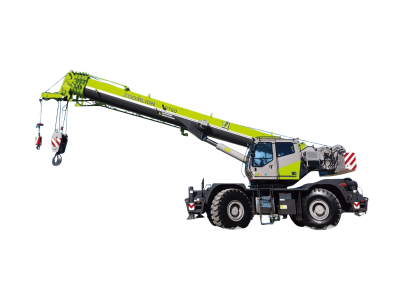
The Zoomlion ZRT600E was introduced as an enhanced version of the company’s 60-ton rough terrain crane platform, targeting construction contractors, industrial plants, petrochemical facilities, and infrastructure projects requiring reliable lifting capability on rough or undeveloped terrain. The crane was designed to combine high lifting performance with compact dimensions, simplified transportability, and modern operator-oriented control systems.
A major feature of the ZRT600E is its five-section telescopic boom constructed from high-strength steel using a U-shaped boom profile for increased rigidity and reduced structural weight. The boom extends hydraulically from 11.5 meters to 45 meters and uses synchronized telescoping systems to provide smooth extension and retraction. The boom head incorporates five sheaves for flexible reeving arrangements and simplified hook block changes. Boom elevation ranges from -2° to 80°, allowing the crane to perform both low-radius heavy lifting and high-angle lifting applications efficiently. Full boom extension requires approximately 95 seconds, while boom raising and lowering operations take around 45 seconds and 110 seconds respectively.
For increased lifting height and outreach, the crane can be fitted with a two-section lattice swing-away jib. The jib length ranges from 9.5 meters to 16 meters and supports offset positions of 0°, 15°, and 30°. With the jib installed, the crane achieves a maximum lifting height of approximately 62 meters, while the main boom alone provides a maximum lifting height of approximately 46.3 meters. The jib is side-stowed alongside the boom during transport and can be quickly deployed during crane setup.
The ZRT600E has a maximum rated lifting capacity of 60 tonnes at a 3-meter working radius and develops a maximum lifting moment of approximately 274 kN-m. The crane maintains effective lifting capacities throughout the boom range and supports multiple working configurations including fully extended outriggers, intermediate outrigger positions, and on-tire lifting operations. The lifting charts provided in the specification manual demonstrate strong lifting performance even at extended boom lengths and elevated boom angles.
The hoisting system uses hydraulic main and auxiliary winches driven by variable displacement hydraulic motors and planetary reduction gearboxes. Maximum single-line rope speed reaches approximately 130 meters per minute on the fourth rope layer, while maximum single-line pull is approximately 5,500 kg. The main winch stores approximately 210 meters of wire rope while the auxiliary winch stores around 110 meters. Standard hook equipment includes a 60-ton six-sheave main hook block and a 5.5-ton auxiliary hook block.
Power for the crane is supplied by a Cummins QSB6.7 turbocharged diesel engine producing approximately 194 kW at 2,200 rpm. The engine complies with non-road emission Stage III regulations and is paired with a powershift transmission system designed for rough terrain applications. Maximum travel speed reaches approximately 40 km/h while gradeability is rated at approximately 75%, giving the crane strong mobility across steep or uneven construction terrain.
The carrier chassis adopts a compact two-axle rough terrain configuration with both axles driven and steered. Steering modes include front-wheel steering, rear-wheel steering, coordinated four-wheel steering, and crab steering. These steering functions greatly improve maneuverability within confined industrial environments and crowded jobsites. The front axle is rigidly mounted while the rear axle incorporates oscillation capability with hydraulic suspension cylinders to maintain wheel contact and improve stability on uneven surfaces.
The outrigger system consists of hydraulically operated H-type outriggers capable of simultaneous or independent deployment. The outriggers can be positioned fully extended, intermediate, or fully retracted depending on available working space. Maximum outrigger spread reaches approximately 7.3 meters longitudinally and 5.2 meters laterally. Hydraulic locks integrated into the outrigger cylinders improve operational safety during lifting operations.
The hydraulic system uses dual variable displacement piston pumps to power hoisting, telescoping, and luffing functions, while additional gear pumps operate slewing, steering, outriggers, and braking systems. Hydraulic oil capacity is approximately 650 liters. The slewing mechanism consists of a hydraulic motor driving a planetary reduction gearbox and slewing ring bearing arrangement, providing continuously variable slewing speeds from 0 to 2.2 rpm.
Operator comfort and safety were important priorities in the crane’s design. The spacious side-mounted cab features large panoramic glazing for improved visibility, ergonomic pilot-operated controls, air conditioning, adjustable seating, and integrated monitoring displays. The crane is equipped with multiple safety systems including a rated capacity indicator, anti-two-block system, emergency stop controls, boom angle indicators, hydraulic safety valves, slewing lock systems, and outrigger warning devices. The electronic control architecture continuously monitors crane operating conditions and provides real-time diagnostic information to the operator.



Reviews
There are no reviews yet.