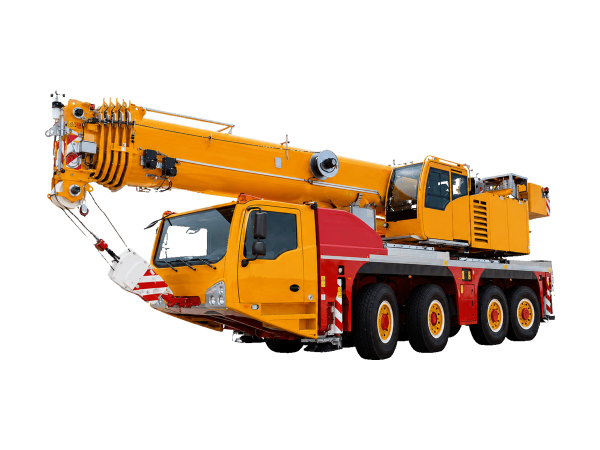
The Demag AC 100/4L, shown in the supplied datasheet under the Terex brand, is a four-axle all-terrain crane in the 100-tonne capacity class. A defining feature of the model is its unusually long telescopic main boom for a four-axle crane. The manufacturer equipped the AC 100/4L with a 12.0 to 59.4 m telescopic boom, giving the crane substantial reach while retaining a compact road-going chassis. At the time of this specification, the manufacturer particularly emphasized the combination of lifting capacity, long boom and roadability within common European axle-load limits.
The main boom uses a single-cylinder automatic telescoping system and extends through a series of intermediate lengths to its maximum 59.4 m configuration. The standard boom head incorporates five sheaves and is rated for capacities up to 64.5 tonnes through the standard head arrangement. With the optional S1 heavy-lift attachment, two additional sheaves are fitted, increasing the boom-head capability to 80 tonnes. The crane itself remains rated in the 100-tonne class, with the 100-tonne load achieved through the appropriate short-boom, high-counterweight configuration shown in the load charts.
One of the AC 100/4L’s most important characteristics is the range of boom extensions available. The HAV10 is a 10 m folding swing-away jib, while the HAV19 can be configured at either 10 or 19 m. Both can be manually offset by 20° or 40°. Hydraulic-offset versions, identified as HAV-HY10 and HAV-HY19, were also available. With the 19 m extension mounted to the 59.4 m main boom, the crane reaches a maximum straightforward boom-and-jib system length of approximately 78.4 m.
The crane could also be equipped with the VA8, an 8 m variable telescopic boom extension, which could be combined with the HAV19 swing-away jib. This gave the AC 100/4L a particularly versatile extension system for its class, allowing different combinations of boom extension, offset and jib length to suit restricted sites or applications requiring additional hook height. A compact 1.5 m MS1 runner was another available attachment and was rated for a maximum capacity of approximately 26.6 tonnes.
The counterweight system is equally flexible. The basic EG21 counterweight package totals 21.3 tonnes in six pieces, with 4.7 tonnes permanently mounted at the rear of the crane. The counterweight system can be expanded to a maximum of 26.1 tonnes. A special NEG21 arrangement was also offered for markets with restrictive road regulations, allowing the crane to be de-rigged to less than 40 tonnes total weight and below 12 tonnes per axle under suitable conditions. The datasheet lists numerous intermediate counterweight combinations ranging from less than one tonne up to the full 26.1 tonnes.
The AC 100/4L is carried on a four-axle chassis with a standard 8 × 6 × 8 drive and steering arrangement. Axles 1, 2 and 4 are driven, while all four axles are steered. Active rear-axle steering is provided on axles 3 and 4, with six steering programs for road and site manoeuvring. An optional 8 × 8 × 8 drivetrain was also available, giving permanent drive to all four axles. Hydropneumatic suspension with axle-load compensation and hydraulic locking is fitted, with manual or automatic levelling depending on specification.
The carrier engine is an MTU 335-3b producing 335 kW (455 hp) and 2,000 Nm of torque. In the supplied version, the engine complies with EUROMOT 3a, Tier 3 and CARB requirements. The document also notes that from October 2011 an updated EUROMOT 3b / Tier 4 Interim / CARB version was to become available. Exhaust after-treatment uses a Daimler stainless-steel system with an SCR catalyst. Fuel capacity is 400 litres of diesel, accompanied by a 40-litre AdBlue tank.
Power is transmitted through a ZF AS-Tronic automated gearbox with an integrated hydraulic retarder. The transmission provides 12 forward and two reverse gears, together with a two-stage transfer case incorporating a selectable off-road ratio and longitudinal differential lock. Maximum road speed is listed as 80 km/h, subject to tyre specification and local regulations. Depending on tyre and vehicle configuration, the crane could also be arranged to travel with significant counterweight on board, including 5.4 tonnes within a 12-tonne axle-load configuration and 21.3 tonnes within a 16-tonne axle-load arrangement.
The superstructure has its own independent engine, an MTU 129-3b rated at 129 kW (175 hp) with 630 Nm of torque. Like the carrier engine, it is specified to EUROMOT 3a, Tier 3 and CARB standards in the supplied datasheet, with the later EUROMOT 3b/Tier 4 Interim version noted for availability from October 2011. The crane engine drives the hydraulic system used for the hoist, slewing, boom elevation, telescoping and outrigger functions. Fuel capacity for the upper engine is 200 litres of diesel with a 20-litre AdBlue tank.
Working speeds are designed for relatively fast cycle times for a crane of this class. The main hoist provides rope speeds of up to approximately 115 m/min, with a maximum line pull of 67 kN using an 18 mm rope. Slewing speed is approximately 1.4 rpm. Boom elevation from 0° to 82° takes around 60 seconds, while telescoping the boom from 12.0 to 59.4 m takes approximately 395 seconds. A second hoist was available as an option for two-hook work with the various boom extensions.
The crane uses an H-type four-point outrigger system, hydraulically extending both horizontally and vertically. Four different outrigger bases are provided as standard, enabling the crane to operate within different site constraints rather than always requiring the full support footprint. At maximum extension, the principal load charts show an outrigger base of approximately 8.10 × 7.20 m, with lifting duties rated through 360°.
In transport form, the AC 100/4L is particularly compact for its boom length and capacity. The dimensional drawing shows an overall length of approximately 13.8 m and, with 16.00R25 tyres, a vehicle width of about 2.55 m. The manufacturer highlighted that the crane could travel with its 59.4 m main boom plus a 10 m folding jib, giving a 69.4 m boom-system length, while remaining within a four-axle configuration at 12-tonne axle load under the stated conditions.
Operator control is handled through the Demag/Terex IC-1 crane control system, which incorporates the load moment indicator, operating-condition display, load-chart information, warning functions and crane data logging. The crane cab could be tilted by up to 20° and was available with features such as seat heating, air-conditioning preparation and adjustable access platforms. An optional system also allowed the carrier to be moved from the crane cab while rigged, including under load where permitted by the operating conditions.
Overall, the Demag AC 100/4L is characterised by its combination of a 100-tonne capacity class, four-axle carrier and exceptionally long 59.4 m telescopic boom. With up to 26.1 tonnes of counterweight, an optional 19 m swing-away jib, variable extension system, 80 km/h road speed and separate MTU engines for carrier and crane operation, it was designed to offer a wide working envelope without moving into a larger five-axle chassis class.
Key Features:
- Main Boom: The AC 100/4L is fitted with a long 59.4-meter main boom.
- Jib: It comes with a 19-meter folding swing-away jib, complemented by an 8-meter variable extension system, capable of achieving a maximum lifting height of 81.7 meters.
- Control System: The inclusion of the IC-1 Plus control system adds precision and versatility to its operations.
- Design: The crane shares design elements with the new five-axle models, offering simplified servicing and increased component commonality.
- Compact Dimensions: Despite its powerful capabilities, the AC 100/4L maintains a width of just 2.55 meters, equivalent to a standard truck, ensuring it can navigate and operate in restricted spaces with ease.
- Performance: The AC 100/4L excels in performance and fast rigging times, making it highly adaptable to a variety of job site requirements.
With its optimal combination of power, compact size, and advanced technological features, the AC 100/4L is engineered to meet the demands of modern lifting tasks, particularly attracting those looking for a reliable and efficient crane with a broad operating range. Customer service and reliability will ultimately influence its market success, but initial sales figures post-update indicate a positive trend in reclaiming customer trust. The AC 100/4L is shaping up to be a valuable asset for rental companies and end-users who require top-tier lifting solutions.
Milestones


Reviews
There are no reviews yet.