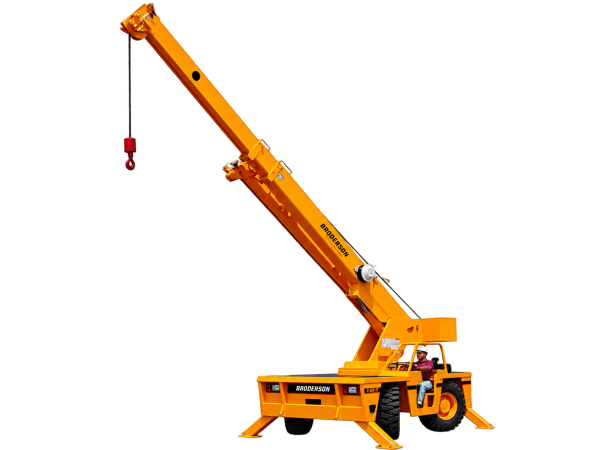
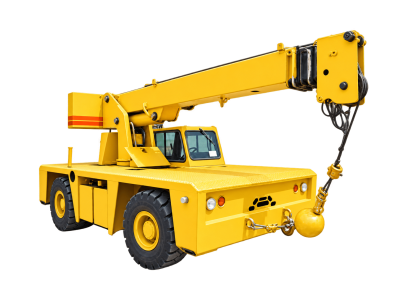
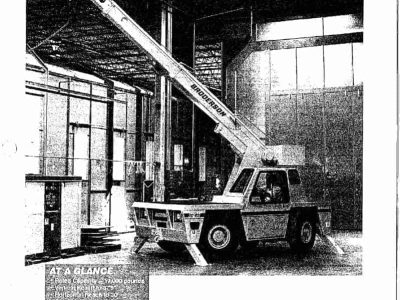
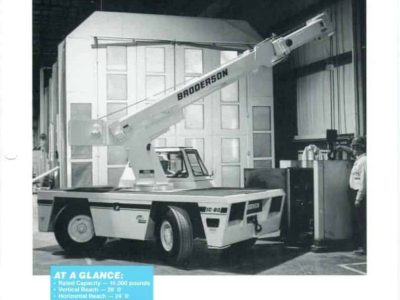
The Broderson IC-200-1C and IC-200-2C are self-propelled industrial carry-deck cranes developed for lifting operations in confined environments such as factories, warehouses, processing plants and maintenance facilities. Their compact dimensions, low-profile chassis and ability to travel with a suspended load make them suitable for work where a conventional truck crane or larger rough-terrain crane would be impractical. The supplied technical specification identifies the two models primarily by their different boom lengths: the IC-200-1C has a 15 ft 4 in to 28 ft 0 in telescopic boom, while the IC-200-2C extends from 15 ft 4 in to 36 ft 2 in. Both use a continuous-rotation upper structure with boom elevation from approximately 0° to 73°.
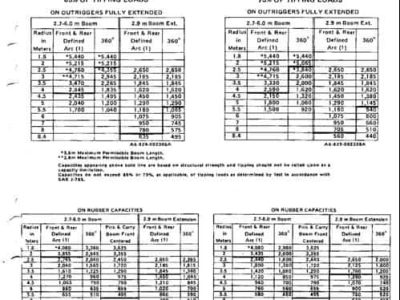
The lifting charts on pages 2 and 3 show a maximum rated capacity of 30,000 lb when operating on outriggers at short working radii. The crane can also lift while on rubber, with capacity reducing according to load radius and boom length. For example, the IC-200-1C chart lists 16,500 lb on rubber at a 6 ft radius, while the outrigger rating at the same radius is 30,000 lb. The longer-boom IC-200-2C similarly retains a 30,000 lb maximum outrigger rating but provides greater reach through its extended boom geometry. Both models therefore combine high short-radius lifting capability with the mobility expected of a carry-deck crane.
The boom is a hydraulically powered telescopic assembly. The specification on page 4 gives a boom elevation time of approximately 21 seconds for the IC-200-1C and approximately 21 seconds for the IC-200-2C, while boom extension takes approximately 22 seconds for the 1C and 35 seconds for the 2C because of the longer telescopic stroke. Slewing is continuous and the rotation speed is approximately 1.7 rpm. The hoist is hydraulically driven through a planetary reduction system, with a line speed stated at approximately 100 ft/min and a line pull of about 10,000 lb.
A 15 ft boom extension was available as an attachment. The brochure notes that it could be used in straight or offset positions, including 0°, 15° and 30° offset arrangements, depending on the configuration. This extension increases working height and radius beyond the main boom, although its load ratings are substantially lower than those of the main boom and are governed by the separate extension-capacity tables shown on the load-chart pages.
Standard engine power comes from a GM 4.3L V6 gasoline engine with six cylinders and a displacement of approximately 262 cu in, rated at 110 hp. An optional Cummins 4BT3.9 four-cylinder turbo-diesel was also offered, with approximately 239 cu in displacement and the same stated 110 hp output. The brochure also lists LPG and dual-fuel systems among the available engine-related options. No modern EPA Tier or EU Stage emissions classification is stated in the supplied specification, which is consistent with the age of the brochure, and no such emissions rating should be assigned without separate documentation for the particular machine.
Power is transmitted through a four-speed forward and reverse powershift transmission. The listed travel speeds are approximately 3 mph in first gear, 6 mph in second, 11 mph in third and 19 mph in fourth. The standard rear axle is a two-wheel-drive steering axle, while a four-wheel-drive arrangement was optional. The front axle is planetary driven and incorporates a limited-slip differential. Unlike larger road-going mobile cranes, the IC-200 is not described in conventional truck-crane axle-count terms; it is a compact four-wheel industrial crane with one front and one rear axle assembly.
The crane uses full hydraulic steering, with two hydraulic cylinders attached to each axle. The system permits either independent two-wheel steering or coordinated four-wheel steering, which significantly improves maneuverability in narrow industrial spaces. The stated turning radius is approximately 12 ft 8 in, while maximum gradeability is listed at approximately 75%. Service braking is provided by a split hydraulic system operating multiple-disc wet brakes, and a mechanically actuated parking brake acts on the transmission.
Operating weight is approximately 27,200 lb for the IC-200-1C and 27,640 lb for the IC-200-2C. Four independently controlled hydraulic outriggers are fitted, using box-beam construction with direct-connected holding valves. The crane also incorporates a carry deck rated at approximately 17,000 lb, allowing materials and equipment to be transported around a jobsite in addition to being handled by the boom. This combination of compact size, high short-radius lifting capacity, pick-and-carry capability and optional four-wheel drive and four-wheel steering made the Broderson IC-200 series particularly suitable for industrial maintenance and indoor lifting applications.

Reviews
There are no reviews yet.