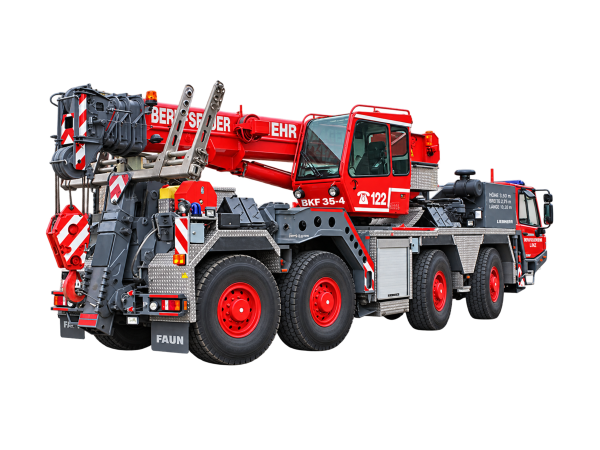
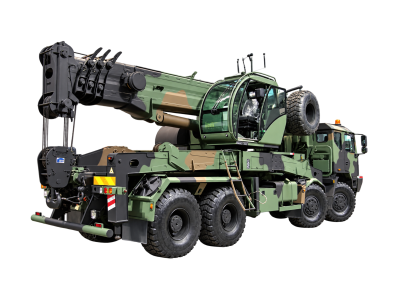
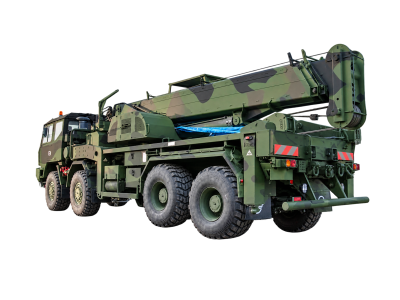
The Tadano Faun BKF 35-4 is a purpose-built four-axle recovery crane combining the functions of a telescopic mobile crane with a heavy-vehicle towing and recovery system. Its layout is designed so that the machine can work independently as a crane in “solo” operation or be converted into towing configuration using the rear recovery cradle. This dual-purpose arrangement made the BKF 35-4 particularly suitable for military, emergency and heavy-vehicle recovery work where lifting and towing capability are required from the same vehicle.
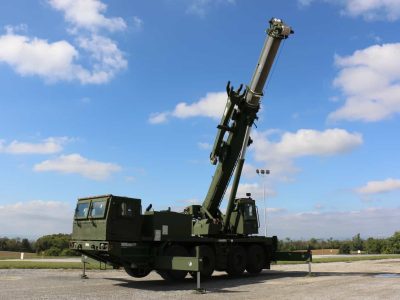
The crane is fitted with a multi-section telescopic boom with boom lengths shown at approximately 6.9 m, 12.1 m, 17.3 m and 22.5 m. The lifting-height diagram indicates a maximum boom angle of around 81.2°, with the crane capable of working through 360°. Depending on boom length and working radius, the crane can reach hook heights approaching the mid-20-metre range, while shorter boom configurations provide the stronger lifting duties required for recovery work.
The BKF 35-4 is mounted on a four-axle chassis. In solo configuration with the lifting cradle and towing coupling fitted, axle loads are approximately 9,100 kg on the first axle, 9,100 kg on the second axle, 6,930 kg on the third axle and 6,930 kg on the fourth axle, giving a total machine weight of approximately 31,960 kg. With optional equipment, total mass is approximately 32,000 kg.
When configured for towing operation with the recovery cradle carrying its maximum permitted hoisting load, axle loading changes significantly. The first and second axles are each approximately 8,060 kg, while the third and fourth axles can each carry up to 12,000 kg. Total permitted vehicle mass in this condition is up to approximately 40,000 kg. The technically admissible axle-load limits are higher, with 12,000 kg allowed on each of the first two axles and 13,000 kg on each of the rear two axles, for a technically admissible total of 44,000 kg.
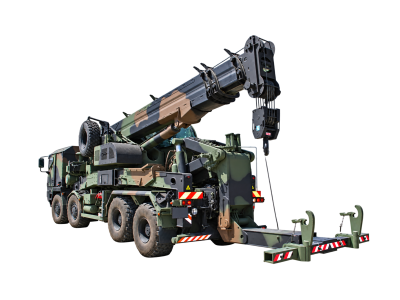
The vehicle uses a dedicated rear towing cradle that extends behind the chassis for recovery duties. In towing configuration, the crane upperstructure remains folded over the vehicle while the recovery system extends rearward to support and tow the disabled vehicle. The arrangement is designed so that the BKF 35-4 can lift part of the casualty vehicle clear of the ground and carry the imposed axle load on the rear of the recovery truck during transport.
Overall vehicle dimensions are approximately 11.85 m in length in solo condition, with the principal wheelbase arrangement shown as roughly 2.20 m + 3.14 m + 1.70 m between the four axles. Overall height is approximately 3.79 m in solo configuration and about 3.70 m in towing configuration. Vehicle width is approximately 2.76 m, while the outrigger spread can reach about 6.20 m when fully deployed. The minimum turning circle is approximately 25 m, reflecting the long four-axle chassis.
The stabilizer system consists of four outriggers extending from the chassis to provide the wide support base required for crane lifting operations. With the stabilizers fully deployed, the footprint gives the BKF 35-4 sufficient working stability for 360° crane operation. When folded, the outriggers remain close to the vehicle body so that the machine can retain a comparatively compact transport profile despite its recovery equipment.
The lifting-height diagram shows the crane working across a range of boom angles and radii, with rated capacities decreasing as radius and boom length increase. The machine is clearly optimized for relatively short-radius heavy recovery lifts rather than long-reach construction work. Its telescopic boom and recovery cradle therefore complement one another: the crane can lift or reposition damaged vehicles and components, while the rear underlift system provides the means to tow the recovered vehicle away.
The supplied material does not state the chassis engine model, engine output, transmission, road speed, winch specification or emissions standard, so these details should not be assigned without additional technical documentation for the specific BKF 35-4 version.
Overall, the Tadano Faun BKF 35-4 is best described as a four-axle heavy recovery crane with a 22.5 m telescopic boom, 360° working capability and an integrated rear towing cradle. With an operating mass of about 32 tonnes and a permissible towing-operation mass of up to 40 tonnes, it was designed to combine crane lifting, vehicle recovery and towing within a single specialized mobile platform.

Reviews
There are no reviews yet.