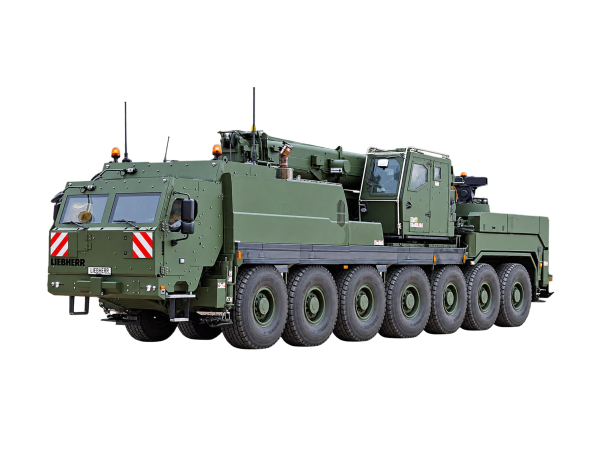
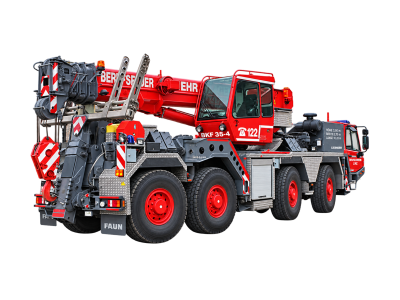
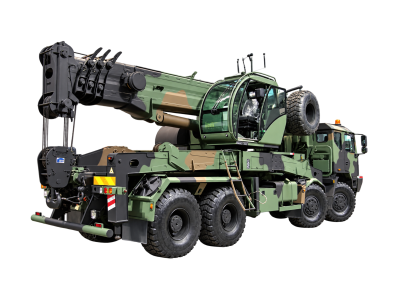
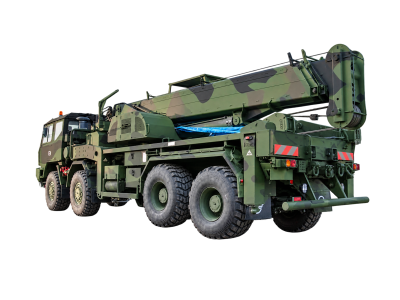
The Liebherr G-BKF is a purpose-built armoured recovery crane developed for the German Armed Forces to combine heavy vehicle recovery, towing and crane lifting in one highly mobile platform. In 2017, the German Army ordered 33 of these unusual armoured recovery vehicles, with deliveries beginning in 2019 and planned for completion in 2021. The G-BKF was selected to replace the FAUN BKF 35-4 recovery crane, which had been adopted by the German Army in the early 2000s. Compared with the older vehicle, the G-BKF introduced a more modern all-terrain chassis, greater crew protection, advanced crane electronics and a more integrated recovery system.
The crane is mounted on a four-axle all-terrain chassis and has an operating weight of approximately 44 tonnes. Its driveline is configured as 8x8x8, meaning all four axles are driven and all four are steerable. Large 445/95 R25 tyres with run-flat inserts, selectable differential locks and a semi-automatic tyre-pressure control system improve traction in difficult terrain. The rear axles use active electro-hydraulic steering with several steering programmes, including normal road steering, all-wheel steering, crab steering, reduced swing-out and independent rear-axle steering.
Power comes from a six-cylinder Liebherr turbo-diesel engine rated at 400 kW, or 544 hp, with maximum torque of approximately 2,500 Nm. The engine is coupled to an automated ZF TC-Tronik HD transmission with torque converter. Maximum road speed is approximately 80 km/h, while the chassis is designed to negotiate steep gradients and demanding off-road conditions.
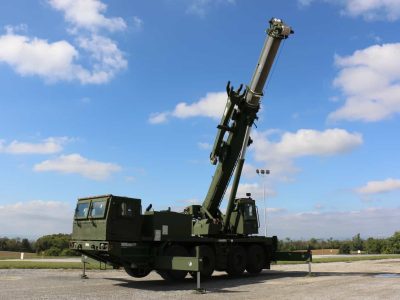
The crane upperstructure is fitted with a 20.9 m telescopic boom consisting of a pivot section and three telescopic sections. Boom length varies from approximately 7.0 m to 20.9 m, with extension by a hydromechanical telescoping system. Maximum lifting capacity is 22.8 tonnes, placing the G-BKF in roughly the 23-tonne lifting class despite its much heavier recovery-vehicle chassis. The crane can also travel with suspended loads on tyres under approved conditions, increasing its usefulness during recovery and support operations.
Slewing is continuous through 360°, with a maximum slewing speed of approximately 2 rpm. The main hoist provides a maximum single-line rope speed of about 105 m/min, while boom elevation and telescoping are designed for relatively fast operation for a recovery crane of this size.
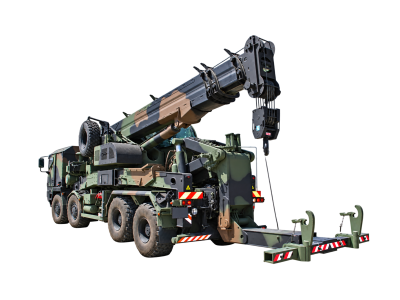
A defining feature of the G-BKF is its integrated vehicle-recovery system. Two Rotzler Treibmatik winches are mounted at the rear. The larger TR 200 develops approximately 200 kN of line pull, while the smaller TR 80 provides about 80 kN. The winches can be used with return pulleys to increase pulling force, and the smaller unit can also be repositioned to assist with self-recovery.
The rear underlift and lifting cradle allow disabled vehicles to be raised by their axles for towing. With the appropriate adapters, the system can handle vehicles imposing up to approximately 16 tonnes on the recovery equipment. The underlift uses a two-stage extension, while dedicated recovery jacks improve stability during heavy winching and lifting operations.
Crew protection was a central part of the design. Liebherr worked with Rheinmetall Defence on the protected driver’s cab and crane cab, with ballistic protection developed to military standards. The crane cab also retains the visibility and controls required for precise lifting and recovery work, while climate-control and optional protective ventilation systems support operation in demanding environments.
The G-BKF uses Liebherr’s LICCON crane control system, while crane, towing, winching and recovery functions can also be operated by radio remote control. This allows the operator to work from a safer position with improved visibility during complex recovery operations.
Overall, the Liebherr G-BKF is best described as a 22.8-tonne armoured four-axle recovery crane with an 8x8x8 all-terrain chassis. Its combination of a 20.9 m telescopic boom, 400 kW Liebherr diesel engine, 80 km/h road speed, twin Rotzler recovery winches, 16-tonne underlift and armoured crew compartments makes it a highly specialised military recovery system designed to replace the earlier FAUN BKF 35-4 and provide the German Army with a more capable modern recovery platform.

Reviews
There are no reviews yet.