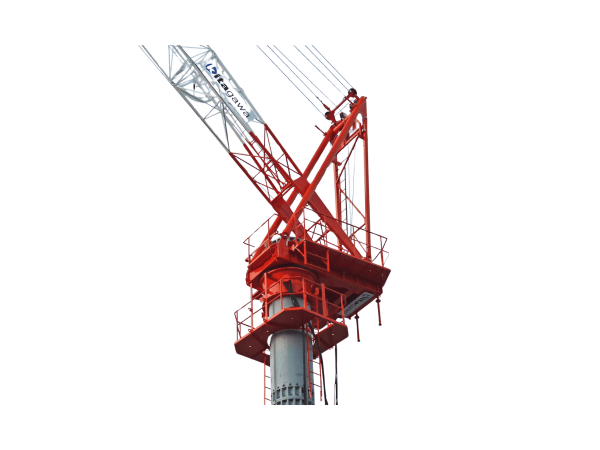
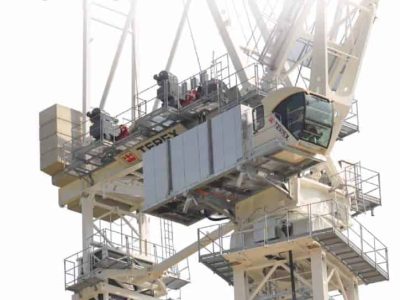
The Kitagawa JCL040H is part of the Bilman series of tower cranes manufactured by Kitagawa, a Japanese manufacturer known for producing reliable lifting equipment for building construction. The Bilman series cranes are designed to provide efficient lifting performance in confined urban construction sites, where cranes must achieve significant height while maintaining a relatively compact working radius.
One of the key design concepts behind the JCL040H is the integration of major components such as the crane body, hoisting winch, and control system into a unified production system. This integrated approach improves overall reliability and simplifies maintenance, ensuring that the crane can operate continuously on demanding construction sites.
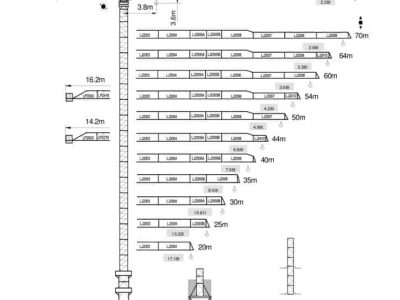
The crane uses a luffing jib configuration, allowing the jib angle to be raised and lowered to reduce the working radius when necessary. This design is particularly useful in congested urban environments where multiple cranes may operate simultaneously and overswing must be minimized. The crane can be equipped with several jib length options, including 25 m, 30 m, 35 m, and 40 m, allowing contractors to select the most suitable configuration for their specific project.
Depending on the selected jib length, the crane can achieve a maximum lifting height of approximately 145 m with a 25 m jib, while configurations with longer jibs reach slightly lower maximum heights. The maximum installation height varies between approximately 95 m and 123 m, depending on the jib configuration.
The crane is designed with a hydraulic climbing system, allowing it to increase its height as the building under construction grows. The climbing system provides a climbing stroke of about 1.7 m per operation, enabling the crane to be raised progressively during the construction process without dismantling the entire structure.
The hoisting system of the JCL040H uses an electric hoisting motor rated at approximately 26 kW, controlled through an inverter system that allows variable speed operation. The hoisting system offers multiple lifting speeds depending on the load and operating mode. At high speed, the hoisting speed can reach 25 m/min, while slower speeds allow precise control when handling heavier loads.
The luffing motion, which controls the raising and lowering of the jib, is driven by a 10/5 kW motor, providing lifting speeds of approximately 11 m/min or 5.5 m/min depending on the operating mode. Slewing movement is powered by a 5.5 kW motor with inverter control, allowing the crane to rotate at approximately 0.4 rpm, providing smooth and controlled positioning of loads.
Another important operational feature of the JCL040H is that most crane operations can be controlled from the swivel frame, simplifying operation and allowing the operator to manage lifting, slewing, and jib movement efficiently from a centralized control position. The crane’s structural design also emphasizes simplicity and durability, allowing easier maintenance and inspection compared with more complex crane structures.
Safety is addressed through a number of integrated protection systems. These include a load moment limiter, an overwinding prevention device, a luffing limiter, and a slewing limiter. These devices help prevent dangerous operating conditions such as overload, excessive hook travel, or uncontrolled crane movement.
The crane’s structure consists of several modular components. The crane body weighs approximately 22.4 tonnes, while the mast sections range from about 2.5 to 3.2 tonnes each depending on the section type. The base frame weighs around 4.6 tonnes, and the crane has a total gross weight of approximately 45.9 tonnes when fully assembled. The maximum individual component weight during transport is about 2.8 tonnes, making it easier to transport and assemble using standard construction site equipment.
The electrical system operates on a three-phase AC power supply of 200–220 V at 50 or 60 Hz, with a total equipment capacity of approximately 50.5 kW and a required power supply capacity of about 80 kVA.
Overall, the Kitagawa JCL040H Bilman series tower crane is designed to provide reliable lifting performance, flexible working configurations, and efficient climbing capability for building construction. Its relatively simple structure, wide working area, and integrated safety systems make it a practical solution for contractors working on mid- to high-rise construction projects where lifting height and operational reliability are critical.



Reviews
There are no reviews yet.