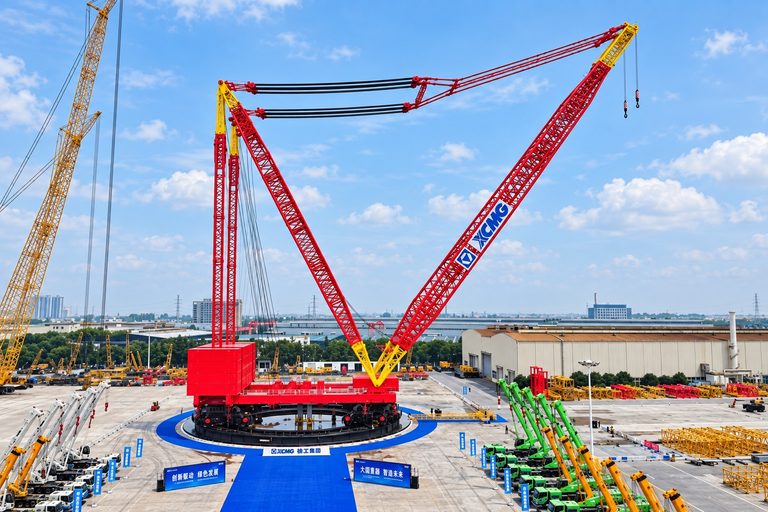
The XCMG XGC11000 was developed to address the growing demand for ultra-heavy lifting solutions in the energy, petrochemical, infrastructure, and renewable energy sectors. Designed as an 800-tonne crawler crane, it serves as one of the most capable models in XCMG’s crawler crane range, combining enormous lifting capacity with exceptional versatility through a wide range of boom, tower jib, superlift, and wind power configurations. The crane is particularly suited for the erection of large refinery modules, petrochemical reactors, nuclear power components, bridge segments, and modern wind turbine installations.
At the heart of the machine is a maximum rated lifting capacity of 800 tonnes, while the crane delivers a maximum lifting moment of 10,800 tonne-metres. Under standard heavy-duty boom (HB) configuration, the crane can lift up to 650 tonnes, while other configurations allow capacities of 330 tonnes on the light-duty boom, 230 tonnes with tower jib, and 165 tonnes using the wind power jib arrangement. These multiple operating modes allow the XGC11000 to be configured specifically for project requirements, ranging from heavy industrial lifting to high-elevation wind turbine erection.
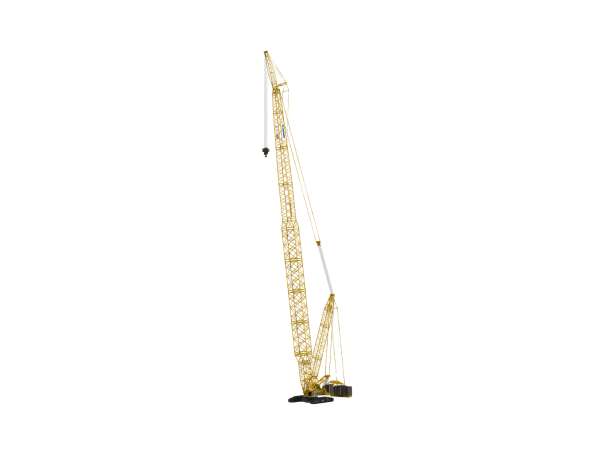
The standard heavy-duty boom configuration offers boom lengths from 24 metres to 96 metres, while the light-duty boom extends from 66 metres to 108 metres. For luffing jib operations, the crane can be equipped with a tower jib ranging from 24 metres to 84 metres attached to main boom lengths of 30 to 66 metres. Specialized wind power configurations provide boom lengths between 78 and 102 metres with a dedicated 12-metre wind power jib, designed specifically for modern wind turbine construction projects.
One of the defining characteristics of the XGC11000 is its advanced Superlift (SL) system. The SL heavy-duty boom configuration offers boom lengths from 48 metres to 114 metres, while the SL light-duty boom extends from 114 metres to 147 metres. The transformed SL boom configuration further increases maximum boom length to 165 metres, enabling the crane to perform extremely high-elevation lifts. Tower jib combinations under the Superlift system can reach 96 metres, creating exceptional hook heights for specialized projects.
For wind energy applications, XCMG developed dedicated Superlift wind power configurations including SHJ-S7, SHJ-S9, and SHJ-TS4 arrangements. These configurations allow boom lengths from 96 metres up to 168 metres, combined with a 12-metre wind power jib, making the XGC11000 suitable for the installation of increasingly larger wind turbine generators and hub assemblies.
The crane’s lattice boom system utilizes high-strength seamless steel chord members combined with specially engineered four-chord lattice construction. This design enhances structural efficiency while minimizing weight, allowing greater lifting performance at extended boom lengths. The boom sections are manufactured using high-strength steel and precision fabrication techniques to ensure rigidity and durability under extreme loading conditions.
The upperstructure is built around a heavy-duty box-section turntable fabricated from high-strength steel plate. The slewing system employs a three-row roller bearing with external gearing and dual planetary drives, providing high load-carrying capacity, smooth operation, and long service life. Hydraulic buffering and free-swing functions contribute to precise load positioning during complex lifts.
Hoisting performance is supported by powerful main and auxiliary winches using 28 mm diameter wire rope. The main and auxiliary hoists achieve maximum single-line speeds of 130 m/min, while boom luffing and auxiliary luffing systems operate at up to 56 m/min. The crane’s maximum slewing speed is 0.7 rpm, and maximum travel speed reaches 1.0 km/h, providing controlled movement both during lifting and site repositioning.
Power is provided by a turbocharged, electronically controlled diesel engine complying with EU Stage III (Euro III) emission standards. The engine develops 420 kW of rated power and is supported by a 700-litre fuel tank, enabling sustained operation on demanding project sites. The hydraulic system combines open and closed-loop circuits with electronic proportional pilot control and variable displacement pumps, ensuring smooth operation, accurate load control, and efficient power management.
The crawler undercarriage features two independently driven track frames fitted with 1.5-metre-wide crawler shoes. Travel drives utilize imported planetary reducers and variable displacement hydraulic motors, allowing both synchronized and independent track movement for precise maneuvering. Despite its immense lifting capability, the crane maintains an average ground pressure of only 0.146 MPa, distributing load effectively across the crawler tracks.
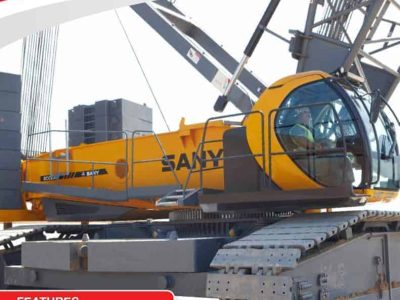
Operator comfort and visibility were also key design priorities. The spacious operator’s cab features ergonomic controls and can tilt upward by 20 degrees to improve visibility during high boom operations. For transport, the cab can rotate 90 degrees to reduce overall transport width. Advanced PLC-based controls manage all crane functions, including hoisting, slewing, luffing, crawler travel, and safety monitoring systems.
Safety systems include a comprehensive load moment limiter, boom angle protection, over-hoist and over-release protection, anemometer, level gauge, hydraulic safety valves, anti-two-block devices, travel and slewing alarms, emergency stop functions, and boom backstop protection systems. These features are integrated into the crane’s electronic control architecture to maximize operational safety during heavy lifting operations.
Transportability was carefully considered despite the crane’s size. The heaviest single transport component weighs approximately 71 tonnes, while the maximum transport dimension is approximately 12.0 m × 3.3 m × 3.4 m, simplifying logistics compared with cranes of similar capacity. The complete crane has an operating weight of approximately 496 tonnes in its standard configuration.
With its 800-tonne class lifting capability, 10,800 tonne-metre lifting moment, 165-metre maximum boom system, advanced Superlift technology, dedicated wind power configurations, and robust engineering design, the XCMG XGC11000 stands among the most capable heavy crawler cranes produced by XCMG and is widely suited for the world’s most demanding heavy lifting and renewable energy projects.


Reviews
There are no reviews yet.