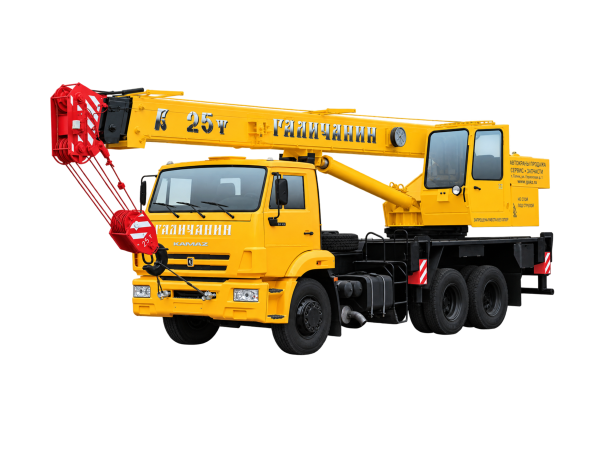
The GAKZ KC-55713-1, marketed under the Galichanin name, is a 25-tonne class truck-mounted telescopic mobile crane developed by the Galich Mobile Crane Plant in Russia. It became one of the manufacturer’s most widely used models in the 25-tonne category, combining a relatively straightforward crane upperstructure with a commercially available KAMAZ truck chassis. The model was already well established by the mid-2000s: in March 2007 GAKZ announced production of the 3,000th KC-55713-1, at that time mounted on KAMAZ-53215 and KAMAZ-55111 chassis and equipped with a 21.7 m boom. Later production shifted to the KAMAZ-65115 platform.
The KC-55713-1 has a maximum lifting capacity of 25 tonnes, with the classic 21.7 m version developing a maximum load moment of approximately 80 tonne-metres. Maximum rated capacity is around 25 tonnes at a 3.2 m working radius. This places the crane firmly in the general-purpose 25-tonne truck-crane class, suitable for construction materials, precast components, machinery installation, utilities and routine loading work.
The traditional version uses a three-section telescopic boom with a rectangular cross-section. Boom length ranges from approximately 9.7 m when retracted to 21.7 m when fully extended. Later updated KC-55713-1 specifications increased the nominal maximum boom length slightly to 22.0 m, while retaining the same general three-section layout and 80 tm load-moment class. The boom design was intentionally conventional and robust, with emphasis on structural strength, repairability and straightforward maintenance.
An optional 9 m lattice jib can be carried on the side of the main boom and installed when additional height or outreach is required. With the 21.7 m main boom, maximum hook height is approximately 21.9 m, increasing to about 30.0 m with the 9 m jib fitted. Maximum working radius with the main boom is approximately 18 m on the earlier configuration. The jib is primarily intended for lighter loads at increased hook height rather than for maintaining the crane’s maximum capacity.
The crane’s hydraulic hoist provides several operating speeds. Earlier specifications give a nominal lifting and lowering speed of about 5 m/min with heavy loads, approximately 12 m/min in a higher-speed mode with lighter loads, and up to about 40 m/min in later standard documentation depending on reeving and configuration. Earlier literature for some versions also quotes a maximum single-line rope speed approaching 96 m/min, illustrating that published speed figures vary with production period and reeving arrangement.
Slewing performance also varies somewhat between generations. The established 21.7 m series literature lists a maximum upperstructure rotation speed of approximately 2.5 rpm, while later updated variants use revised hydraulic systems and may have different slewing speeds. The crane can operate through a broad working sector, and later KC-55713-1 versions were configured for 360° operation under appropriate outrigger and load conditions.
The KC-55713-1 is most commonly associated with the KAMAZ-65115 6×4 chassis, giving the crane three axles, with one steering front axle and a driven tandem rear bogie. Earlier machines were also produced on KAMAZ-53215 and KAMAZ-55111 chassis. The KAMAZ-65115 version gives the crane good road mobility while keeping the complete machine within the size and weight envelope expected for a conventional truck-mounted crane.
Later Euro 5 versions of the KAMAZ-65115-based crane use a KAMAZ 740-series diesel engine, while exact engine specification varies with chassis production year. Current archived GAKZ data for the later 22 m configuration identifies the KAMAZ-65115 as a Euro 5 carrier. Because the KC-55713-1 remained in production over a long period and was installed on several generations of KAMAZ chassis, engine model, horsepower and emissions level should be treated as chassis-specific rather than as a single fixed crane specification.
Maximum road speed is approximately 60 km/h. The later 22 m version has a transport width of about 2.55 m and an operating mass in minimum configuration of approximately 20.5 tonnes. Earlier 21.7 m machines were of similar overall size, with a total length around 12 m, width about 2.5 m and height approximately 3.6 m, depending on the exact chassis and production period.
Four hydraulic outriggers provide the stabilizing base for lifting operations. Updated versions can work with both fully extended and reduced-width outrigger positions, allowing the crane to operate in confined areas where full stabilizer deployment is not possible. The later 22 m model uses a maximum outrigger footprint of approximately 4.2 × 5.6 m and a reduced configuration of about 4.2 × 2.28 m. This partial-outrigger capability improved the crane’s usefulness on urban construction sites and narrow roads.
One of the strengths of the KC-55713-1 was its relatively uncomplicated mechanical layout. GAKZ positioned the model as an economical crane for standard lifting duties, and the three-section boom, conventional hydraulic system and widely used KAMAZ chassis helped simplify servicing and spare-parts support. The crane also became the basis for a larger KC-55713 family fitted to different chassis, including 6×6 Ural and KAMAZ carriers and later versions with longer 23.7 m and 28 m booms.
Overall, the GAKZ KC-55713-1 Galichanin is best described as a durable and widely produced 25-tonne, three-axle truck crane combining an 80 tm maximum load moment, approximately 21.7–22.0 m three-section telescopic boom, optional 9 m lattice jib and KAMAZ 6×4 road chassis. Its production history, including the completion of the 3,000th unit in 2007, reflects the model’s popularity as a straightforward general-purpose mobile crane for construction and industrial work across Russia and other CIS markets.



Reviews
There are no reviews yet.