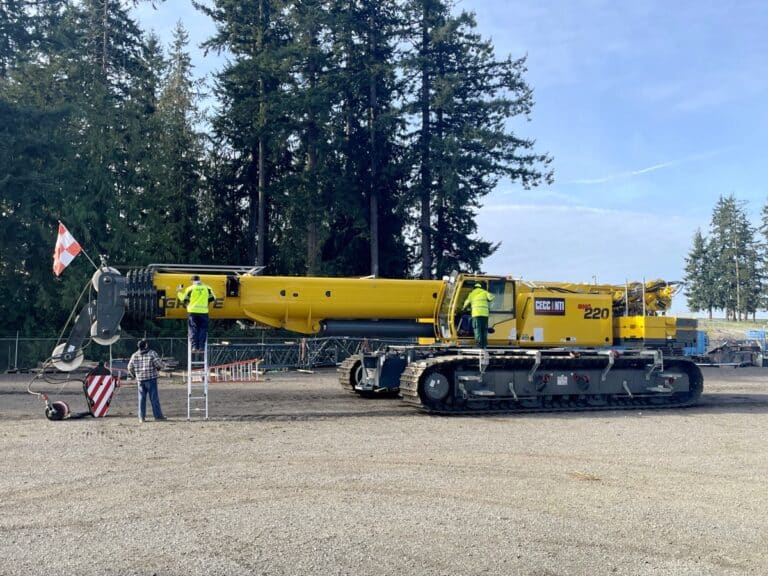
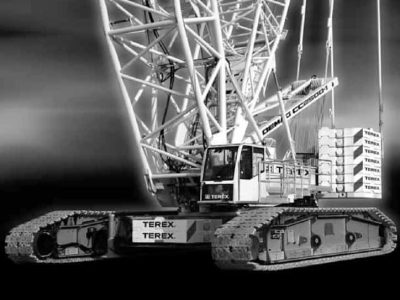
The Demag PC9600 crawler crane was introduced during the early 1990s as part of Demag’s range of heavy lattice boom crawler cranes designed to meet the growing demand for high-capacity lifting equipment in infrastructure, energy, and industrial construction projects. During this period, Demag was one of the leading European manufacturers of heavy lifting machinery, with a strong reputation for engineering crawler cranes capable of handling extremely large loads while maintaining operational reliability.
The PC9600 was engineered to provide a lifting capacity of 800 tonnes at a radius of 9 metres, placing it firmly within the heavy-lift crawler crane category used for large-scale industrial projects. At the time of its release, cranes of this class were increasingly required for erecting large steel structures, lifting heavy refinery components, installing power plant equipment, and supporting bridge and port construction. The modular design of the PC9600 allowed contractors to configure the crane according to specific lifting tasks, improving flexibility on demanding job sites.
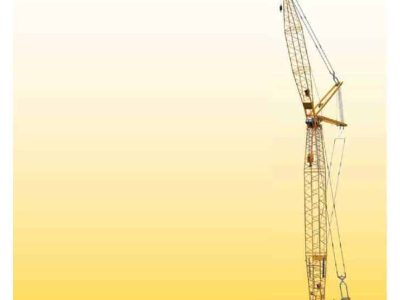
A key component of the crane’s lifting system is its lattice boom configuration, which can be assembled with a main boom length ranging from 42 m to 126 m. The lattice boom structure is designed to provide high strength while maintaining relatively low structural weight, allowing the crane to achieve greater lifting heights and working radii without excessive loads on the crawler undercarriage. The main boom foot pin arrangement incorporates a horizontal offset of approximately 2700 mm and a vertical offset of around 3790 mm, contributing to the crane’s structural geometry and stability.
The slewing system is designed for controlled rotation of the superstructure and provides a maximum slewing speed of about 0.6 rpm, which is typical for cranes of this size where smooth and precise movement is more important than high rotational speed. Lifting operations are carried out through a heavy-duty winch system capable of delivering a maximum line pull of approximately 223 kN, with a maximum hoisting line speed of about 80 m/min under no-load conditions. These specifications allow the crane to handle heavy loads while maintaining efficient lifting cycles.
Power for the crane’s superstructure is supplied by a Mercedes-Benz MB OM 444 LA diesel engine, a robust V-type engine widely used in heavy industrial machinery. The engine produces approximately 612 kW (832 PS), delivering sufficient power to operate the crane’s hydraulic systems, winches, slewing drives, and auxiliary components. The engine drives hydraulic pumps that control the crane’s primary lifting and motion functions, enabling smooth operation and precise control during heavy lifting operations.
The crane utilizes a crawler undercarriage designed to distribute the substantial weight of the machine and its loads across a large ground contact area. This design allows the PC9600 to operate effectively on construction sites with varying ground conditions. The crawler crane configuration also allows the crane to move short distances while assembled, reducing setup time when repositioning within a job site.
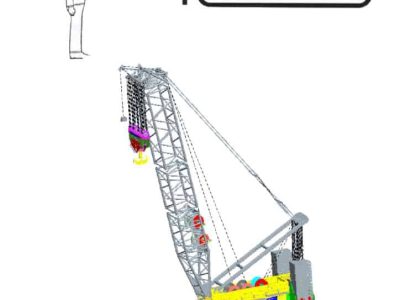
For heavy lifting configurations, the PC9600 employs a large counterweight system and derrick mast arrangement. The crane uses a derrick mast of approximately 42 m, which supports the counterweight system to increase lifting performance at large radii. The maximum counterweight installed on the crane is around 360 tonnes, while the derrick counterweight tray can accommodate up to approximately 800 tonnes. In addition, the crane includes about 100 tonnes of central ballast, which helps stabilize the machine during heavy lifts.
The crane’s working footprint is defined by its outrigger-style support base used during certain assembly configurations, measuring approximately 18.5 m by 18.5 m, with a reduced configuration footprint of around 14 m by 14 m. The large tail swing radius of roughly 14.19 m reflects the substantial size of the rotating upper structure required to house the engine, winches, and counterweight support systems.
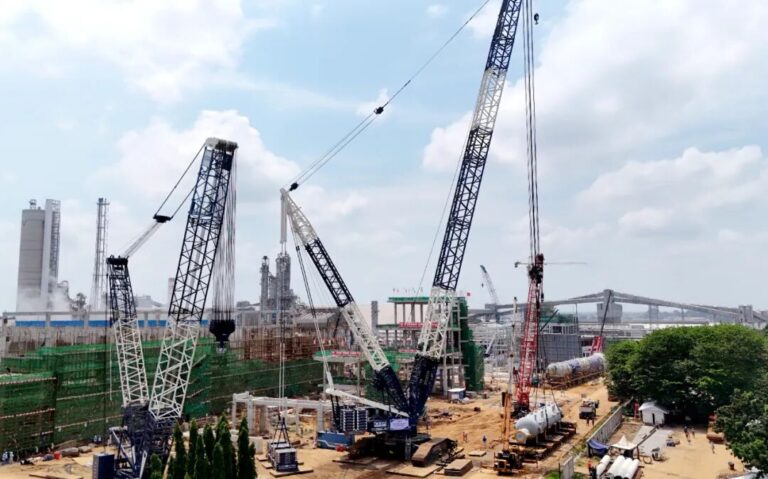
During the 1990s and early 2000s, the PC9600 became part of the Terex-Demag product lineup after corporate restructuring within the Demag group. Despite changes in branding over time, the crane remained known for its strong structural design and reliable performance in large lifting operations. Cranes in this class were often deployed on major projects such as refinery construction, offshore module assembly, heavy bridge erection, and large industrial plant installations.
The Demag PC9600 crawler crane represents an important step in the development of high-capacity crawler cranes, combining powerful hydraulic systems, large modular lattice boom structures, and heavy counterweight configurations. Its design reflects the engineering philosophy of Demag during the era—prioritizing lifting performance, structural robustness, and adaptability for complex heavy lifting operations. Even decades after its introduction, cranes of this class remain valuable assets in the heavy construction and industrial sectors.