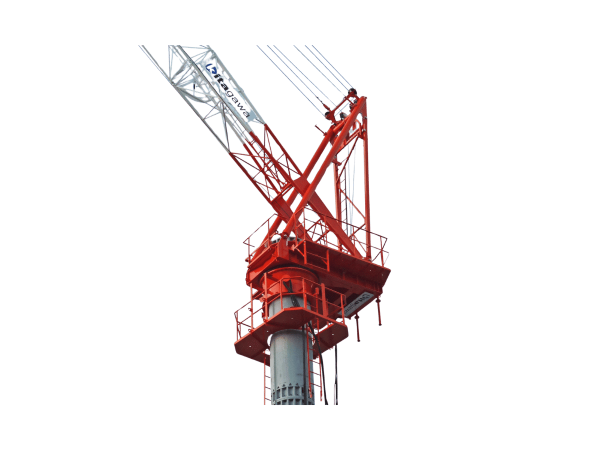
The Kitagawa JCL050C is one of the models in the Bilman series of tower cranes manufactured by Kitagawa, a Japanese company known for producing construction lifting equipment designed for efficiency, reliability, and compact site operation. The crane is primarily intended for building construction in urban environments, where space is often restricted and cranes must operate safely among surrounding structures.
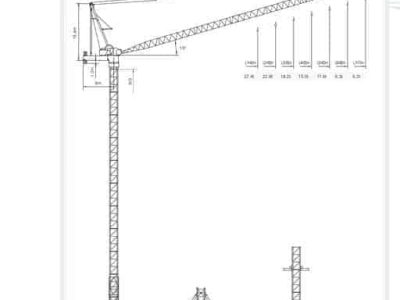
The JCL050C uses a luffing jib configuration, allowing the jib angle to be raised and lowered during operation. This design reduces the crane’s working radius when necessary and allows multiple cranes to operate on congested sites without interference. Luffing jib cranes are particularly advantageous in dense city construction projects where overswing must be minimized.
The crane can be equipped with several jib length options, including 17.8 m, 24.4 m, and 31 m. Depending on the configuration, the crane achieves a maximum lifting height of approximately 110 m, with slightly lower heights available when longer jibs are installed. The maximum installation height ranges from approximately 75 m to 90 m, depending on the jib length and mast configuration.
The hoisting system is designed to provide both high speed and precise load control. The crane’s maximum hoisting speed reaches 49 m/min when lifting loads of 1.1 tonnes or less, allowing fast material handling on construction sites. For heavier loads up to approximately 2.8 tonnes, the crane operates at lower speeds to ensure safe and controlled lifting. Multiple hoisting speeds are available, including slow, mid-speed, and high-speed operation.
To improve operational control and energy efficiency, the JCL050C uses inverter control systems for hoisting, luffing (undulation), and slewing motions. The hoisting system is powered by a 15 kW electric motor, while the luffing mechanism uses a 6.3 kW motor, and the slewing system is driven by a 2.2 kW inverter-controlled motor. These systems provide smooth acceleration and deceleration during crane movements, reducing mechanical stress and improving operational precision.
The crane’s slewing mechanism allows full 360-degree rotation, with a slewing speed of approximately 0.5 rpm. This rotational capability allows the crane to efficiently service a wide working area around the construction site.
The JCL050C also features a climbing system that allows the crane to increase its height as the building structure rises. The climbing operation uses an electric chain block method, allowing the crane to be raised incrementally with a climbing stroke of approximately 4.5 m. This system enables the crane to grow with the structure being built without requiring complete disassembly.
From a structural standpoint, the crane is designed for transport and assembly efficiency. The maximum component weight is approximately 3.06 tonnes, allowing the crane to be transported using standard construction vehicles. According to the transport arrangement, the crane can be moved in four loads using 10-ton trucks or eight loads using 4-ton trucks, providing flexibility depending on transport conditions.
The crane incorporates several safety devices to ensure safe operation. These include an overload prevention system, undulation limiter, slewing limiter, and fall prevention system for the main body. These systems monitor crane operation and prevent dangerous conditions such as overloading or excessive movement.
Electrical power is supplied through a three-phase AC system rated at 200–220 V and 50/60 Hz, with an equipment capacity of approximately 23.5 kW and a required power supply capacity of around 30 kVA.
Another advantage of the JCL050C is its compatibility with JCL030 mast sections, allowing contractors to reuse existing components and simplify equipment logistics on construction projects. The crane also uses two types of assembly bolts—M27 and M16—to secure structural components during installation.
Overall, the Kitagawa JCL050C Bilman tower crane is designed to provide efficient lifting performance, compact site operation, and reliable construction capability. Its inverter-controlled lifting system, flexible jib configurations, and climbing capability make it well suited for urban building construction and mid-rise structural projects where precision, safety, and operational efficiency are essential.




Reviews
There are no reviews yet.