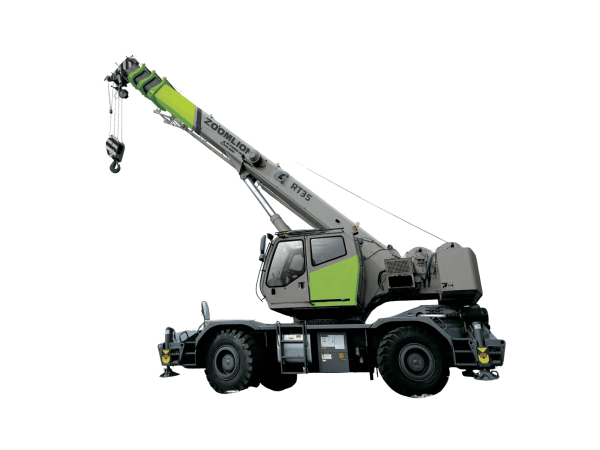
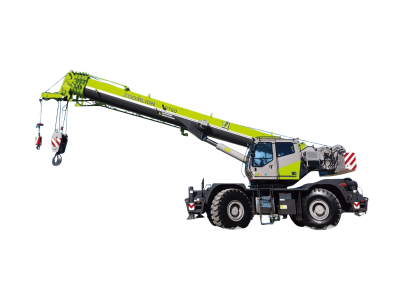
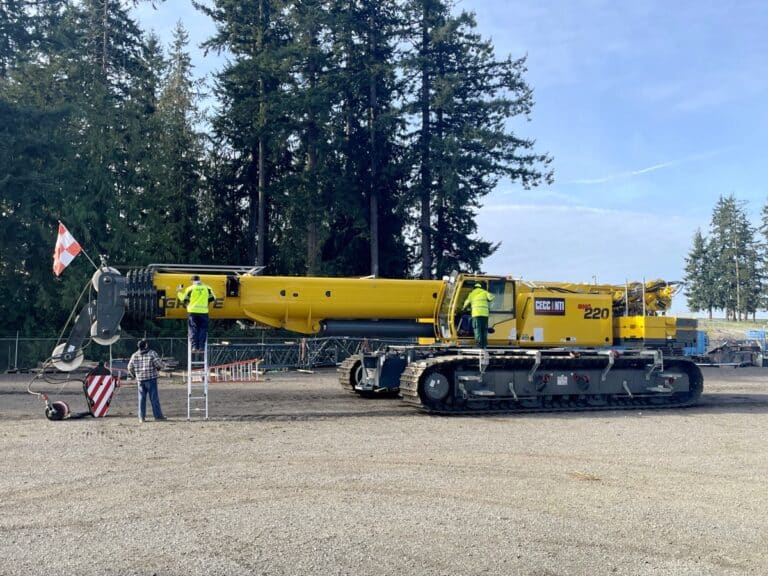
The Zoomlion RT35 was developed as a compact and versatile rough terrain crane for industrial, infrastructure, and maintenance applications where maneuverability and off-road mobility are critical. Designed primarily for refinery work, factory maintenance, general construction, pipeline projects, warehouse operations, and utility lifting tasks, the crane combines strong lifting capacity with a relatively compact chassis and efficient hydraulic control systems.
The crane is built on a dedicated two-axle rough terrain carrier chassis equipped with permanent four-wheel drive and a fully hydraulic steering system. The RT35 supports multiple steering modes including front-wheel steering, four-wheel coordinated steering, and crab steering. These steering configurations, combined with the crane’s short overall length and compact wheelbase, provide excellent maneuverability in narrow jobsites and congested industrial facilities. Large ground clearance together with favorable approach and departure angles improves off-road capability and terrain adaptability.
Power is supplied by a Cummins electronically controlled diesel engine paired with an automated transmission and steerable drive axles. The drivetrain is designed to maintain reliable traction and strong power delivery even under sudden terrain resistance and difficult site conditions. The crane achieves maximum travel speeds of approximately 38 km/h forward and 15 km/h in reverse. The combination of four-wheel drive, hydraulic suspension, and specialized rough terrain tires improves mobility on uneven surfaces and undeveloped construction areas.
A major feature of the RT35 is its four-section telescopic main boom constructed from high-strength steel. The boom extends hydraulically from approximately 9.8 meters to 31 meters and is optimized to provide strong lifting performance while maintaining compact transport dimensions. Boom elevation ranges from -3° to 78°, allowing the crane to perform both low-radius heavy lifts and high-angle lifting operations. The fully extended main boom provides a maximum lifting height of approximately 31 meters. Boom extension requires approximately 70 seconds while retraction takes around 75 seconds. Boom raising time is approximately 46 seconds and lowering time is approximately 47 seconds.
For applications requiring additional lifting height and working radius, the RT35 can be equipped with offsettable lattice jibs. Two jib configurations are available, including a 9-meter jib and a 15-meter jib. Both jib systems support offset positions of 0°, 20°, and 40° for improved flexibility during lifting operations over obstacles or confined structures. With the jib installed, the crane achieves a maximum lifting height of approximately 46 meters. The jib can be side-stowed during transportation and rapidly installed during crane setup.
The RT35 has a maximum rated lifting capacity of 35 tonnes at a 3-meter working radius and develops a maximum lifting moment of approximately 1,344 kN-m on the basic boom. Even with the boom fully extended, the crane maintains a lifting moment of approximately 870 kN-m. The crane supports lifting operations on fully extended outriggers, mid-position outriggers, fully retracted outriggers, and on-tire lifting configurations. Extensive lifting charts included throughout the specification manual demonstrate the crane’s flexibility under multiple working conditions and stability configurations.
The hoisting system uses hydraulic winches with maximum rope speeds of approximately 150 meters per minute. The slewing system provides continuous 360-degree rotation with maximum slewing speed reaching approximately 2.5 rpm. Hydraulic operating pressure is approximately 27 MPa with rated hydraulic flow of around 400 L/min. Hydraulic oil tank capacity is approximately 600 liters, ensuring stable performance during extended lifting operations.
The outrigger system uses hydraulically controlled outriggers with a maximum outrigger spread of approximately 6.81 meters longitudinally and 6.8 meters laterally when fully extended. Multiple outrigger extension positions improve flexibility for lifting operations in restricted working environments. The crane’s complete operating weight is approximately 32 tonnes with front axle load around 15 tonnes and rear axle load around 17 tonnes. Wheelbase is approximately 3,820 mm while front and rear track width measures approximately 2,444 mm.
The RT35 uses a single-cab design serving as both the driving cab and crane operating cab. The spacious cab features a large skylight to improve upward visibility during high-angle lifting operations. Interior equipment includes an air-cushioned seat, air conditioning system, digital display units, keyboard controls, and advanced data bus technology with integrated diagnostics and warning systems. Audible and visual alarms assist the operator by monitoring crane status and lifting conditions in real time.
Safety systems integrated into the RT35 include overload warning systems, boom angle indicators, load monitoring systems, hydraulic safety valves, anti-two-block protection devices, and onboard fault diagnosis systems. The crane is also designed for efficient pick-and-carry operations and can perform “on tires” lifting without extending the outriggers in certain operating conditions, improving efficiency for short-distance material handling tasks and restricted industrial jobsites.