The Liebherr LTM 11000D represents an important development in the evolution of large telescopic all-terrain cranes produced by Liebherr during the 1990s. The crane was essentially an upgraded heavy-lift derivative of the Liebherr LTM 1800, which itself was one of the most powerful telescopic cranes of its era with a rated lifting capacity of around 800 tonnes. By equipping the crane with additional lifting aids such as a lattice derrick boom and suspended counterweight system, Liebherr was able to increase the maximum lifting capacity to approximately 1,000 tonnes, resulting in the designation LTM 11000D.
The concept behind the LTM 11000D was to combine the mobility and rapid setup advantages of a telescopic all-terrain crane with the enhanced lifting power typically associated with lattice boom crawler cranes. This allowed contractors to transport the crane between job sites more easily while still achieving extremely high lifting capacities when the crane was fully assembled with its heavy lift equipment.
The crane is mounted on a multi-axle all-terrain carrier chassis, which distributes the weight of the crane and allows road travel between construction sites. Like other large Liebherr mobile cranes of its generation, the carrier includes multiple steering axles to improve maneuverability despite the crane’s substantial size. The telescopic boom is transported separately in some configurations due to its size and weight, often carried on a dedicated transport trailer when moving between job sites.
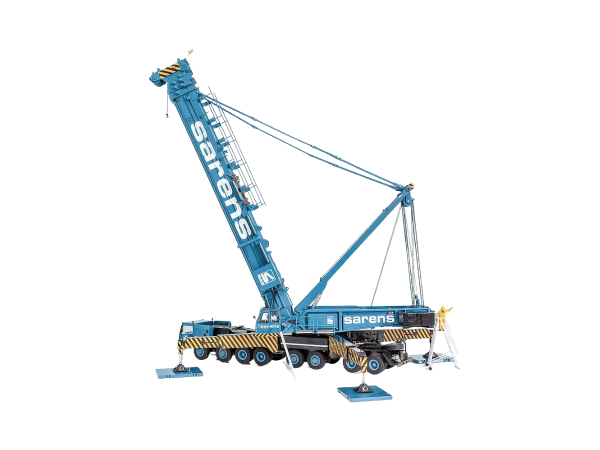
The main lifting structure consists of a heavy-duty four-section telescopic boom constructed from high-strength steel. This boom forms the base configuration for normal lifting operations. For heavy lifting tasks requiring higher capacities, the crane can be equipped with a lattice derrick boom system mounted behind the superstructure. This derrick mast supports a suspended counterweight system, which significantly improves the crane’s lifting capability by reducing the load on the main boom and improving stability during heavy lifts.
The suspended counterweight arrangement is a key feature of the LTM 11000D. Instead of fixed counterweights attached directly to the crane, the system uses a suspended tray connected through the derrick mast. This configuration allows the counterweight to move slightly during lifting operations, helping to balance loads more effectively and allowing the crane to achieve higher lifting capacities at larger radii.
Power for the crane’s superstructure is provided by a Mercedes-Benz MB OM 444 LA diesel engine, producing approximately 612 kW (832 PS). This powerful engine drives the hydraulic pumps responsible for the crane’s hoisting winches, boom elevation system, slewing mechanism, and auxiliary hydraulic functions. The hydraulic system allows precise control of crane movements, which is essential when handling very large loads.
The crane’s hoisting system features powerful winches designed to handle heavy loads with high reliability. The maximum line pull is approximately 223 kN, while the maximum hoisting speed can reach about 80 m/min, allowing efficient lifting cycles during construction operations. The slewing mechanism allows continuous rotation of the upper structure with a maximum slewing speed of around 0.6 rpm, providing smooth and controlled rotation during heavy lifting operations.
In heavy lift configuration, the crane is equipped with a derrick mast approximately 42 metres in height, supporting large counterweight packages. The maximum counterweight installed on the crane can reach around 360 tonnes, while additional suspended counterweight trays may be used to further enhance lifting performance depending on the lifting configuration.
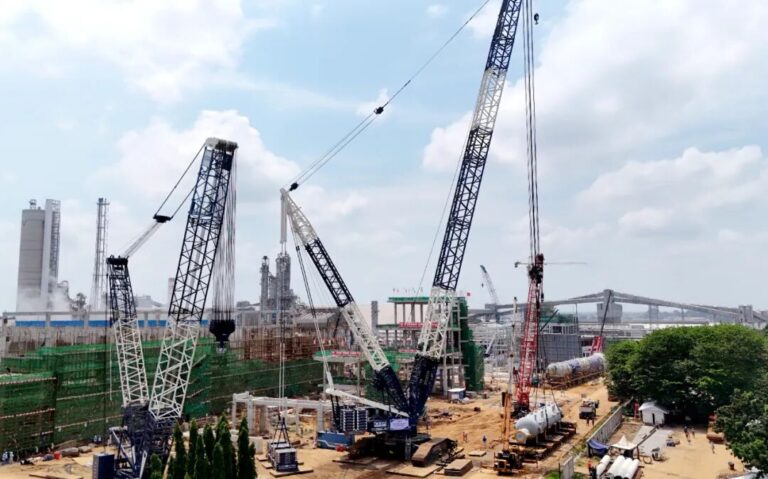
Because of its extremely high lifting capacity and versatile configuration options, the LTM 11000D was typically used in demanding heavy construction tasks such as bridge beam installation, petrochemical plant construction, heavy industrial equipment erection, and infrastructure projects. Its ability to combine telescopic boom flexibility with derrick-supported heavy lifting made it a valuable crane for projects requiring both mobility and extreme lifting power.
The Liebherr LTM 11000D stands as a notable example of the engineering approach used during the era to push the limits of telescopic crane performance. By adapting an existing large mobile crane platform and integrating derrick mast technology, Liebherr created a machine capable of entering the 1,000-ton lifting class while still retaining the transport flexibility of an all-terrain crane.





Reviews
There are no reviews yet.