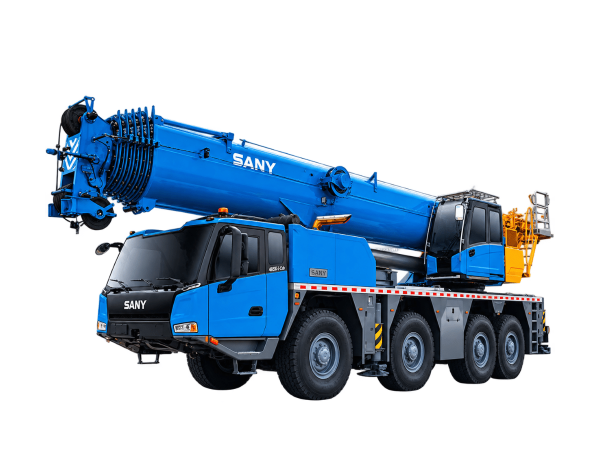
The SANY SAC1400T7 is a compact four-axle all-terrain crane intended to combine relatively high lifting capacity and a long telescopic boom with the road mobility and manoeuvrability of an 8×8×8 carrier. An important point when documenting the crane is the difference between its marketing designation and the technical table contained in SANY’s brochure. The brochure cover identifies the SAC1400T7 as having a 140 t lifting capacity, whereas the technical specifications on page 9 state a maximum lifting capacity of 130 t. For technical reference, the 130-tonne figure should therefore be identified as the value given in the specification table rather than silently treating the two figures as interchangeable.
The crane is equipped with a seven-section U-shaped telescopic main boom, extending from a basic length of 13 m to a maximum main-boom length of 70 m. SANY uses a single-cylinder automatic pinning telescoping arrangement, in which one double-acting cylinder controls the extension and retraction of the boom sections to provide the required intermediate boom combinations. The boom operates through an angle range of approximately 0° to 81°. According to the technical specifications, maximum lifting height is 13.5 m on the basic boom and 70.5 m with the longest main boom.
For additional reach, the SAC1400T7 can be configured with a mechanical or hydraulic jib. The specification gives a maximum combined boom-and-jib length of 97 m, producing a stated maximum lifting height of 97.5 m. Jib offset angles are 0°, 20° and 40°. SANY also lists the hydraulic jib and a 9.5 m boom extension among the optional equipment, so the precise auxiliary-boom configuration fitted to an individual crane should be confirmed rather than assuming every SAC1400T7 carries the complete 97 m arrangement.
The crane’s rated lifting moments provide a further indication of its operating capability. SANY specifies a maximum lifting moment of 3,822 kN·m on the basic boom, 2,123 kN·m with the longest main boom, and 947 kN·m with the longest boom plus mechanical or hydraulic jib. The minimum rated working radius is 3 m, while the superstructure tail-swing radius is 4.17 m. The outriggers are arranged in an H-pattern with four-point support and use hydraulically telescoping two-stage beams. At full extension, the specified longitudinal-by-transverse outrigger span is 7.93 × 7.9 m.
Hoisting is through an electro-proportional variable-motor winch system designed to provide stepless speed variation and controlled low-speed movement. The specification page gives a maximum rope speed of 125 m/min for the winch, using 20 mm diameter rope. The listed rope capacities are 300 m and 200 m, depending on the winch arrangement, with an 8.3-tonne line pull shown in the operating data. The crane’s slewing system uses dual-motor drive, and the specification gives a maximum slewing speed of approximately 1.2 r/min. Boom raising/lowering is listed at approximately 70/80 seconds, while the complete telescoping operation is shown as approximately 700/700 seconds for extension/retraction.
Counterweight is modular, allowing the crane to be adapted to different lifting and transport requirements. The complete counterweight system totals 40 tonnes, with SANY showing several combinations including 1, 9, 17, 19, 24, 26 and 40 tonnes. Of particular interest for site logistics is the crane’s ability to travel short distances between working locations while carrying 24 tonnes of counterweight. The brochure describes this transport arrangement as 16 tonnes at the front, comprising 8 + 4 + 4 tonnes, together with 7 tonnes at the rear and 1 tonne incorporated around the winch area.
The carrier is a purpose-built four-axle chassis with an 8×8×8 wheel formula, meaning all four axles are driven and all four are involved in steering. Hande axles are specified. The drive axles use planetary transmission and inter-wheel differential locks; the third axle additionally incorporates an inter-axle differential, while the second axle has a disengagement function. Axles 1 and 2 use hydraulically assisted steering with mechanical linkage feedback, while axles 3 and 4 employ electro-hydraulic steering. This arrangement provides six steering modes, including conventional road steering, all-wheel steering, crab steering and specialised front/rear steering configurations for confined sites.
All four axles use height-adjustable hydro-pneumatic suspension with hydraulic lockout. This is particularly relevant to an all-terrain crane because it provides both road-driving comfort and chassis control on uneven construction sites. The SAC1400T7 has a stated minimum turning radius of 8.1 m, while the minimum turning radius measured at the boom head is 11.3 m. Minimum ground clearance is 346 mm, approach angle is 23° and departure angle is 11°. SANY specifies maximum gradeability at 67%. The crane runs on 445/95 R25 (16.00 R25) tyres, with nine tyres listed when the spare is included.
Power for the carrier comes from a Cummins Z10E440 31 inline six-cylinder turbocharged and intercooled diesel engine. SANY lists maximum output at 323 kW at 1,900 rpm and maximum torque at 2,200 N·m between 900 and 1,400 rpm. The brochure identifies the engine as meeting Euro III / EU Stage III emissions requirements. A 450-litre fuel tank is specified. Power is transmitted through a FAST AMT gearbox with 12 forward and two reverse ratios, giving the carrier both low-speed grade-climbing capability and higher-speed road travel. Maximum travel speed is 85 km/h, while the technical table quotes fuel consumption of approximately 70 litres per 100 km under the manufacturer’s stated reference conditions.
The carrier’s braking arrangement uses a dual-circuit pneumatic service-brake system with disc brakes, with double air chambers on the first and second axles. Spring-applied parking brakes operate through the second, third and fourth axles. A hydraulic transmission retarder provides supplementary braking, particularly for prolonged downhill travel. The overall carrier measures approximately 15,012 mm long, 2,800 mm wide and 4,000 mm high, with the specification giving a gross vehicle mass of 50,000 kg.
SANY has also placed considerable emphasis on electronic monitoring and operator assistance. The SAC1400T7 incorporates a load moment indicator that monitors the operating envelope in real time; SANY claims a load-bearing measurement error below 3% and a radius error below 0.3 m. An axle-load monitoring system uses sensor data to calculate vehicle weight and display axle-loading information. Tyre temperature and pressure are monitored continuously, while an anti-electromagnetic-interference system is provided for operation in environments affected by strong electrical or magnetic fields.
Another notable function is one-touch boom extension and retraction. After the required operating condition is selected through the crane interface, the control system can automatically telescope the boom instead of requiring continuous joystick input throughout the complete sequence. The hoisting system coordinates with boom movement so that hook height is automatically maintained during the process. These functions are aimed at reducing repetitive operator input while improving consistency during crane setup.
The upper operator’s cab uses a steel-frame construction and is designed for broad visibility around the working area. The cab can optionally tilt from 0° to 20°, which is useful when operating at steep boom angles. SANY states that the seat is 450 mm wider and that legroom has increased by 30% compared with the preceding design. The adjustable seat can recline to 140°, while the electrically adjustable seat and armrest console move together. Automatic heating and air conditioning are provided. The carrier cab similarly uses air suspension and provides three-person seating together with a folding co-driver berth, a 12.1-inch central display, LED lighting and heating/air-conditioning.
From a safety and control standpoint, the hydraulic circuits incorporate balance valves, relief valves and two-way hydraulic locks. Boom length and angle sensors, together with pressure sensing, provide operating information to the crane’s control system. When the system detects movement beyond the permitted operating envelope, hazardous crane functions can be inhibited and an audible warning generated. The electrical architecture uses CAN BUS communication, with the carrier incorporating a 12.3-inch LCD instrument display and 12.1-inch central screen for information including tyre pressure and temperature, steering, suspension, hydraulic and outrigger status. The electro-hydraulic outrigger system also provides automatic levelling.
The SAC1400T7 can be supplied with equipment including an auxiliary winch, hydraulic jib, 9.5 m boom extension, alternative 50-tonne and 100-tonne hook blocks, outrigger pads, boom-tip camera, high-voltage detector, rear towing hook, spare-wheel carrier and other application-specific equipment. As these items are identified as optional in SANY’s documentation, they should not be presented as standard equipment unless the specification of the individual machine confirms their installation.
The supplied specification brochure does not provide a clear debut, launch or first-delivery date for the SAC1400T7. For that reason, a specific introduction year should not be assigned from this document alone. Establishing the crane’s debut would require a separate historical source such as a dated SANY product announcement, exhibition launch report or contemporary industry publication. This distinction is important when preparing an archival crane description because the date of a brochure is not necessarily the date on which the crane model first entered the market.





Reviews
There are no reviews yet.