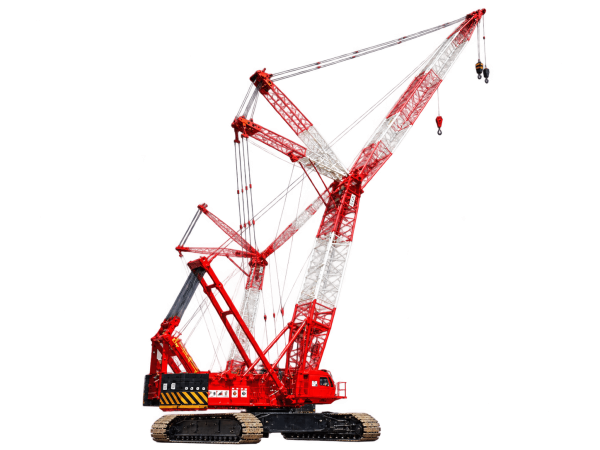
The Kobelco 7650 is a large conventional lattice-boom crawler crane in Kobelco’s 7000-series range, designed for high-capacity lifting where crawler mobility, long boom configurations and substantial lifting capacity are required. The supplied Kobelco specification brochure identifies the crane’s maximum rating as 650 metric tonnes at a 6.0 m working radius with the heavy-duty boom, while its standard boom arrangement is rated at 400 tonnes at 10.0 m. The brochure itself was printed in 2004, although it does not state the model’s original market introduction date, so the printing date should not be taken as the crane’s debut year.
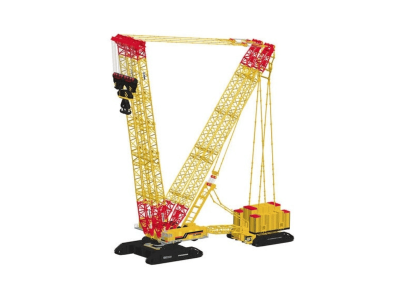
The 7650 can be assembled with either heavy-duty or standard lattice boom systems. Both use a 24 m basic boom. The heavy-duty boom can be extended to a maximum of 60 m, while the lighter standard boom can reach 102 m, giving the crane considerably greater reach when maximum capacity is not required. The manufacturer’s working-range information shows standard boom arrangements progressing through intermediate lengths up to the 102 m maximum. No conventional fixed-jib lifting configuration is specified in the supplied English brochure; the principal long-reach attachment covered is the luffing jib.
For luffing-jib operation, the Kobelco 7650 has a maximum lifting capacity of 230 tonnes at a 16.0 m radius. Its basic luffing arrangement consists of a 30 m main boom with a 24 m jib, while the longest configuration reaches 78 m of main boom combined with a 72 m luffing jib. The load charts in the supplied brochure cover numerous combinations between these limits, allowing the crane to be configured for heavy lifts at shorter radii or long-reach work where height and working radius are the main requirements. The 78 m boom and 72 m jib combination gives the crane a particularly substantial overall lattice structure for applications such as power stations, petrochemical construction and major structural erection.
Hoisting performance is based around hydraulically driven winches. Both the main and auxiliary hoists have high/low rope speeds of 100/44 m/min, measured on the first drum layer. Boom hoisting operates at 50/22 m/min, while the luffing-jib hoist operates at 100/44 m/min. Maximum slewing speed is approximately 0.6 rpm. These figures reflect the emphasis of the 7650 on controlled handling of very heavy loads rather than high rotational speed, while the two-speed hoist arrangements provide faster line movement when conditions permit and slower operation for load positioning.
Propulsion and hydraulic power are provided by a Cummins KTA-19-C600, a water-cooled, four-cycle, direct-injection diesel engine. The engine is rated at 441 kW at 2,000 rpm, equivalent to approximately 600 PS, and is paired with a 900-litre fuel tank. The hydraulic installation uses multiple variable-displacement pump groups serving the hoisting, boom, jib, travel and slewing systems. Because the Kobelco 7650 belongs to an earlier generation of crawler cranes, the supplied brochure does not specify a modern regulated exhaust-emission classification such as EU Stage or U.S. EPA Tier, and it would therefore be inappropriate to assign one without documentation for the individual crane.
As a crawler crane, the 7650 does not have road axles; movement is through its twin crawler assemblies. Travel speed is 1.0 km/h in high range and 0.6 km/h in low range, with an unloaded gradeability stated at 30%. In a standard configuration with a 24 m boom and 400-tonne hook, operating mass is approximately 510 tonnes. With a 30 m boom, 24 m luffing jib and 230-tonne hook, operating mass increases to approximately 540 tonnes. The crane uses approximately 140 tonnes of standard counterweight, with an additional 84 tonnes of counterweight available for configurations requiring greater lifting performance. Average ground pressure is quoted at about 125 kPa in the standard 24 m boom configuration and approximately 133 kPa in the basic luffing-jib configuration.
The Kobelco 7650 is therefore best characterised as a high-capacity conventional crawler crane combining a 650-tonne maximum rating, 102 m standard boom and a maximum 78 m + 72 m luffing-jib combination. Its heavy-duty and standard boom systems allow the machine to be adapted between high-capacity lifting and longer-reach work, while the substantial counterweight system, crawler undercarriage and multiple hydraulic winches provide the stability and controlled movement expected from a crane of this size. The configuration and capacities quoted here are based primarily on the supplied Kobelco specification and load-chart document, with the manufacturer’s published Japanese specifications used to confirm operational figures.

Reviews
There are no reviews yet.