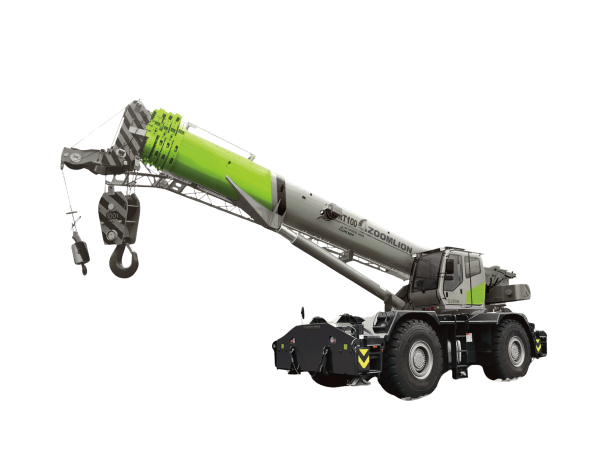
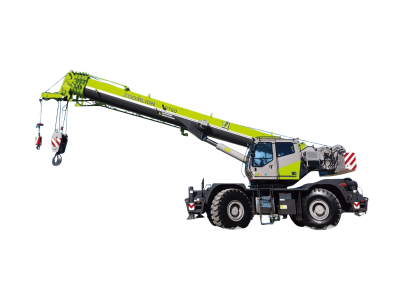
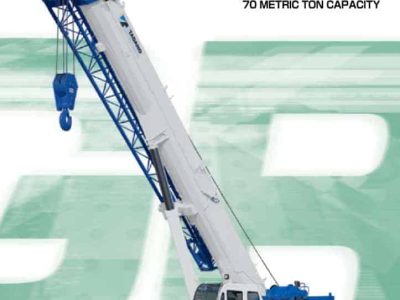
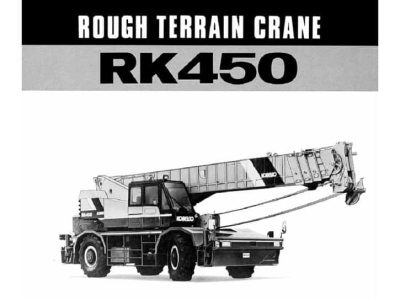
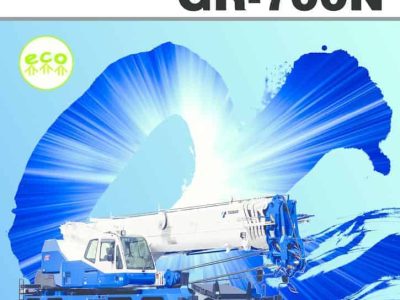
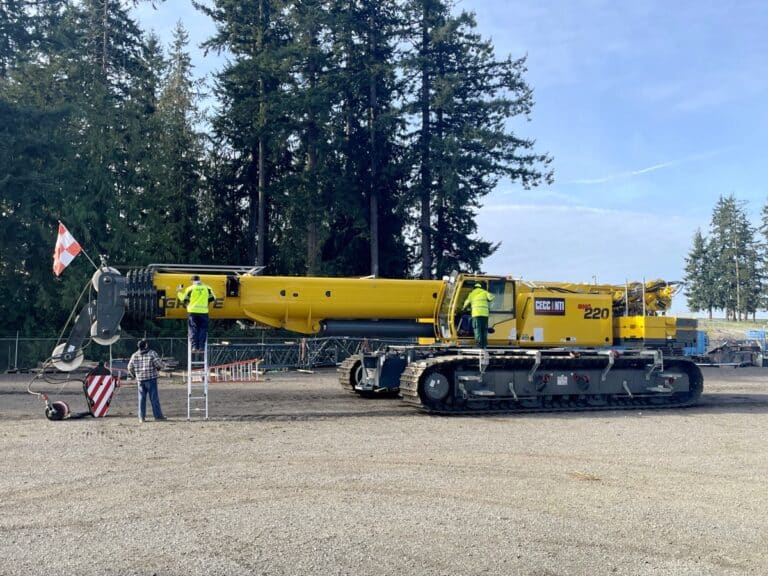
The Zoomlion RT100 was developed to provide increased lifting capacity and reach within the rough terrain crane segment while maintaining compact dimensions and strong off-road mobility. Designed primarily for petrochemical construction, infrastructure projects, industrial maintenance, mining operations, and heavy lifting work on undeveloped terrain, the crane combines high lifting performance with versatile maneuverability and advanced hydraulic control systems.
The crane is built on a dedicated rough terrain carrier chassis featuring four-wheel drive and four-wheel steering systems. Multiple steering modes are available, including front-wheel steering, coordinated four-wheel steering, and crab steering, significantly improving maneuverability in confined industrial facilities and narrow construction sites. The fully hydraulic steering system and compact wheelbase help the crane maintain excellent mobility while reducing turning radius during positioning operations. According to the specification data shown on page 4, the crane has a wheelbase of approximately 4,600 mm and track width of approximately 2,960 mm.
A major feature of the RT100 is its five-section fully hydraulic telescopic boom constructed from high-strength steel. The boom extends from approximately 11.5 meters to 43 meters and is designed to provide strong lifting performance across the entire working range. Boom elevation ranges from -3° to 78°, enabling the crane to handle both low-radius heavy lifts and high-angle lifting operations efficiently. Full boom extension requires approximately 170 seconds while retraction takes approximately 150 seconds. Boom derricking upward requires around 82 seconds while lowering takes approximately 72 seconds.
For applications requiring additional lifting height and outreach, the RT100 can be equipped with offsettable lattice jibs. Two jib configurations are available, including a 10-meter offsettable jib and a 17-meter offsettable jib. Both jib systems support offset positions of 0°, 20°, and 40° for increased operational flexibility when lifting over obstacles or in restricted areas. With the jib installed, the crane achieves a maximum lifting height of approximately 61.5 meters, while the fully extended main boom provides a maximum lifting height of approximately 45.6 meters. Detailed lifting charts for jib operations are shown on pages 11 and 12 of the specification manual.
The RT100 has a maximum rated lifting capacity of 100 tonnes at a 3-meter working radius and develops a maximum load moment of approximately 3,329 kN-m on the basic boom. Even with the boom fully extended, the crane maintains a lifting moment of approximately 1,338 kN-m. The crane supports lifting on fully extended outriggers, mid-position outriggers, fully retracted outriggers, and “on tires” lifting configurations. Extensive lifting charts shown throughout the specification manual demonstrate strong lifting performance under multiple working conditions and boom configurations.
The hoisting system uses hydraulic winches capable of maximum rope speeds of approximately 125 meters per minute. The hydraulic system operates at a rated pressure of approximately 30 MPa with rated hydraulic flow reaching approximately 500 L/min. Hydraulic oil tank capacity is approximately 1,200 liters, ensuring stable hydraulic performance during extended lifting operations. The slewing system provides continuous 360-degree rotation with slewing speeds reaching approximately 2 rpm.
Power for the crane is supplied by a Cummins electronically controlled diesel engine paired with an automated transmission system and steerable drive axles. The drivetrain is designed to maintain strong traction and reliable power output under rough terrain conditions and varying road resistance. The crane uses hydraulic suspension and specialized rough terrain tires to maximize off-road capability and stability. Maximum travel speed reaches approximately 24 km/h in both forward and reverse directions.
The RT100’s rough terrain chassis is designed for excellent gradeability and terrain adaptability. Large ground clearance and favorable departure and approach angles allow the crane to travel effectively across uneven surfaces and undeveloped construction sites. Overall dimensions shown on page 4 indicate an overall length of approximately 14,275 mm and an overall width of approximately 3,260 mm. Total operating weight is approximately 65 tonnes, with front axle load around 33 tonnes and rear axle load around 31.8 tonnes.
The crane is equipped with a single-cab design serving both driving and lifting operations. The spacious cab includes a large skylight to improve visibility during high-angle lifting operations. Interior equipment includes an air-cushioned seat, air conditioning system, digital display units, keyboard controls, and advanced data bus technology with integrated monitoring systems. Audible and visual warning systems provide operational alerts, fault diagnostics, and lifting data to improve both efficiency and safety.
Safety systems integrated into the RT100 include rated capacity indicators, anti-two-block devices, overload warning systems, hydraulic safety valves, boom angle indicators, and electronic monitoring systems that continuously supervise crane operating conditions. Detailed lifting capacity charts throughout the specification document provide rated load information for fully extended outriggers, partially extended outriggers, retracted outriggers, and on-tire lifting operations across the crane’s full boom range.