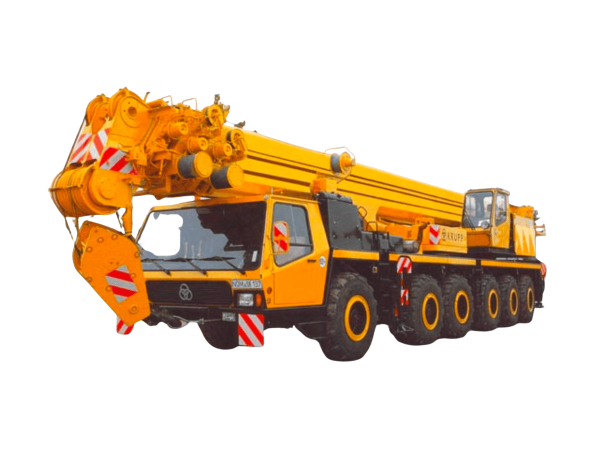
The Krupp 140 GMT-AT was developed as part of Krupp’s GMT-AT series of all terrain cranes, which became well known for combining compact transport dimensions with strong lifting capacities and advanced carrier engineering. The crane was designed for heavy lifting operations requiring both highway mobility and strong rough-terrain capability, making it suitable for petrochemical plants, bridge projects, industrial construction, and infrastructure work.
The crane was mounted on a specially engineered six-axle all terrain carrier manufactured using a welded box-type chassis fabricated from high-tensile steel. The carrier utilized a hydro-pneumatic suspension system with axle lock-out capability and adjustable suspension ranges, allowing improved stability and off-road travel performance. The suspension system provided height adjustment ranges of approximately +6 inches/-6 inches and +4 inches/-8 inches depending on operating conditions.
The axle arrangement consisted of six axles with multiple steering and driven axle configurations. Axles 1, 2, 3, 5, and 6 were steerable, while axles 2, 5, and 6 were driven. The driven axles utilized planetary reduction systems with transverse differential locks on all drive axles and an inter-axle differential lock on axle 5. This arrangement provided excellent traction and maneuverability on uneven terrain and confined job sites.
Power for the carrier was supplied by a 12-cylinder Daimler-Benz OM424 water-cooled diesel engine producing approximately 420 hp at 2,300 rpm. The engine was paired with an Allison five-speed automatic transmission combined with a two-speed transfer case. Fuel tank capacity was approximately 210 gallons. The crane achieved a maximum travelling speed of approximately 45 mph (72 km/h) with gradeability rated at 48 percent and a turning radius of approximately 46 ft.
The superstructure was powered by a separate Daimler-Benz OM366LA six-cylinder water-cooled diesel engine producing approximately 195 hp at 2,300 rpm. Fuel capacity for the superstructure engine was approximately 105 gallons. This dual-engine arrangement allowed independent crane operation while reducing unnecessary fuel consumption during lifting operations.
The telescopic boom consisted of four sections using a rope-supported telescoping system with one base section and three hydraulically powered boom sections. Basic boom length measured approximately 14.6 m (48 ft) and extended hydraulically to a maximum length of approximately 46.3 m (152 ft). The boom utilized a remote lock-out system designed to improve telescoping reliability and operational safety.
Boom telescoping times varied according to extension stages. Standard extension cycles required approximately 90 seconds for the first section, 80 seconds for the second section, and 52 seconds for the third section. In high-speed telescoping mode, extension times were reduced to approximately 50 seconds, 44 seconds, and 30 seconds respectively.
The crane could be equipped with several jib configurations depending on lifting requirements. A two-stage swing-away lattice extension measuring approximately 12.5 m (41 ft) to 20 m (66 ft) was available for general lifting work. For increased lifting height and working radius, lattice extension systems with inserts could be configured from 11.6 m (38 ft) up to 36 m (118 ft) for straight or offset operation. An optional hydraulic power luffing jib ranging from approximately 14 m (46 ft) to 38.6 m (126.6 ft) was also available, significantly increasing operational flexibility for industrial lifting and high-elevation work.
Maximum rated lifting capacity was 140 tonnes, while the crane utilized 90-ton, 55-ton, and 35-ton hook block arrangements depending on working configuration. The counterweight system totaled approximately 46,300 lbs (21 tonnes) arranged in six hydraulically removable sections to simplify transport and crane setup.
The hydraulic system consisted of three separate circuits utilizing two axial piston pumps with infinitely variable speed and load control together with an additional three-section axial piston pump. The hydraulic oil reservoir capacity was approximately 400 gallons. The system was designed to provide smooth simultaneous crane motions and precise load handling performance.
Main and auxiliary hoists utilized axial piston motors with planetary gear reducers and fail-safe braking systems. Maximum single-line pulling force reached approximately 22,050 lbs while maximum single-line rope speed reached approximately 525 ft/min. Drum diameter measured 22 inches with 1-inch wire rope and rope length of approximately 985 ft. The auxiliary hoist specifications were identical to the main hoist.
Boom elevation was controlled through a hydraulic cylinder with integral holding valves. The boom operating angle ranged from approximately -1.2° to +82.2°. Standard boom luffing time was approximately 120 seconds, while high-speed mode reduced luffing time to approximately 65 seconds.
The slewing system utilized an axial piston motor with planetary reduction gearing, holding brake, and service brake. Two slewing speed ranges were available with infinitely variable control up to approximately 1.6 rpm.
The outrigger system incorporated independently controlled horizontal and vertical hydraulic beam movements with controls located on each side of the chassis. A sight-leveling device was also provided to assist crane setup.
Both carrier and operator cabins were designed with emphasis on visibility and operator comfort. The operator cab utilized a full-vision aluminum structure with safety glass, fully adjustable suspension seating, diesel coolant heaters, and integrated crane operating instrumentation. The carrier cab used a three-man aluminum cab design with bunk, suspended seating, ventilation system, and optional stationary heaters for cold-weather operation.
Safety systems included hoist limit switches, hydraulic lock valves, pressure relief valves, drum rotation indicators, and an electronic load moment indicator with automatic cut-out systems for overload protection. The crane also incorporated working radius indicators, load moment monitoring systems, and lowering limit switches to improve operational safety during lifting operations.





Reviews
There are no reviews yet.