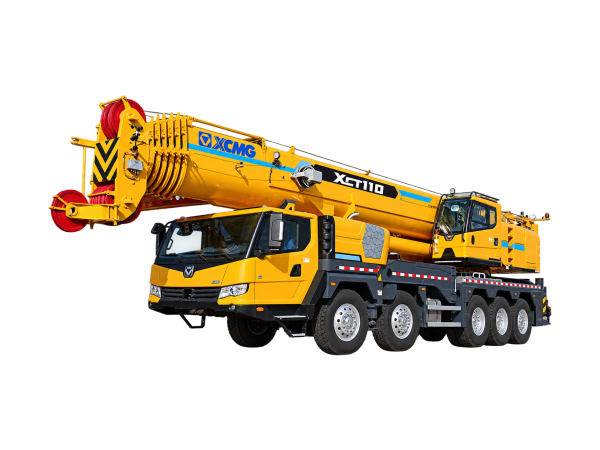
The XCMG XCT110 is a 110-tonne truck crane positioned in the upper range of XCMG’s XCT-series road-mobile telescopic cranes. It was developed for general engineering projects including building construction, urban redevelopment, transportation infrastructure, ports, bridges, oilfields and mining work. A major feature of the model is its unusually long 73 m seven-section telescopic boom, which gave it particularly strong reach for a truck crane in the 110-tonne class.
The XCT110 should be distinguished from other similarly named machines such as the XCT110-1, XCT110_M and XCT110_Y2, which use different boom lengths, chassis arrangements and specifications. The standard XCT110 covered here is the version with the 73 m main boom.
Lifting Capacity and Main Boom
Maximum rated lifting capacity is 110 tonnes. The crane uses a seven-section U-shaped telescopic boom extending from approximately 13.4 m to 73 m.
XCMG promoted this 73 m boom as one of the longest in its class when the model was introduced. The boom uses a single-cylinder pinning telescoping system, allowing the individual boom sections to be extended and locked automatically while reducing boom weight compared with a multiple-cylinder arrangement.
Maximum working radius is approximately 60 m, while maximum lifting height with the main boom is around 73–74 m, depending on crane geometry and hook arrangement.
Jib and Maximum Lifting Height
With lattice jib equipment installed, the XCT110 reaches a maximum lifting height of approximately 96.4 m.
This additional height makes the crane suitable for high-rise construction, industrial structures and other applications where the 73 m telescopic boom alone is insufficient.
Five-Axle Carrier
The standard XCT110 is built on a five-axle carrier with a travel-state mass of approximately 54.99 tonnes.
Published axle loads are approximately 9.99 tonnes on the first axle, 10 tonnes on the second, 13 tonnes on the third and fourth axles, and 9 tonnes on the fifth axle.
The chassis incorporates hydraulically controlled rear follow-up steering. XCMG designed the system to provide stable road handling at higher speeds while reducing the turning radius during low-speed manoeuvring. The model was also promoted as one of the first Chinese truck cranes in this class with four-wheel drive capability, improving traction on difficult construction sites.
Carrier Engine and Transmission
One widely documented XCT110 configuration uses a Weichai diesel engine rated at approximately 316 kW, with maximum torque of around 2,060 Nm.
The powertrain is built around a low-speed, high-torque concept, using an automatic transmission with a broad ratio range. XCMG stated that this drivetrain was designed to improve both fuel efficiency and climbing performance compared with earlier generations.
A later or market-specific XCT110 configuration has also been documented with a Cummins ISM11E5 440 engine rated at approximately 324 kW at 1,900 rpm and 2,080 Nm at 1,200 rpm, meeting China V emissions requirements. This means the exact engine specification should be matched to the individual crane’s production year and market.
Road Performance
Maximum road speed is approximately 90 km/h, which is high for a 110-tonne truck crane.
Maximum gradeability is around 45%, while the crane uses a chassis designed for both highway travel and low-speed jobsite manoeuvring.
Overall dimensions are approximately 15.545 m long, 3.0 m wide and 3.89 m high.
Hoisting Performance
The main winch provides a maximum single-line speed of approximately 135 m/min on the fourth rope layer.
Maximum single-line pull is around 104 kN, with a 22 mm diameter wire rope approximately 265 m long. The auxiliary hoist uses a similar 22 mm rope, with around 210 m of rope and a maximum line pull of approximately 74 kN.
Standard hook equipment includes a 110-tonne double hook, a 60-tonne single hook and a 7-tonne single-line hook. The 110-tonne hook uses up to 12 parts of line.
Slewing and Boom Operating Speeds
Maximum slewing speed is approximately 2.0 rpm.
The main boom can be raised from roughly -1° to 81° in about 60 seconds. Full telescoping from 13.4 m to 73 m takes approximately 580 seconds in one detailed specification.
Outrigger System
The crane uses four hydraulic outriggers with a maximum transverse span of approximately 7.9 m.
The wide outrigger footprint provides the stability required for full-capacity 360° lifting operations when the crane is correctly levelled and configured.
Hydraulic and Control Systems
The XCT110 uses electronically controlled hydraulic systems for hoisting, telescoping, luffing and slewing.
XCMG emphasized low-speed control and combined-motion smoothness in the XCT generation. The crane uses a closed hydraulic circuit for the main hoisting system and electro-hydraulic controls to improve operating efficiency and precision.
The single-cylinder boom pinning arrangement also reduces the number of large telescopic cylinders inside the boom and allows a greater proportion of the boom cross-section to be devoted to structural strength.
Operator Cab and Safety Systems
The upper cab can tilt upward by approximately 20°, giving the operator a better view of the hook and load during high-boom operations.
The cab includes safety glazing, air conditioning, adjustable seating and an integrated human-machine interface for crane monitoring.
Electronic safety systems monitor boom geometry, lifting load and crane operating condition. Load-moment protection and limit systems prevent unsafe movements when the crane approaches its permitted working envelope.
XCT110 Versus XCT110-1
The XCT110 and XCT110-1 should be treated as separate database entries.
The standard XCT110 is consistently documented with a 73 m seven-section boom and approximately 96.4 m maximum lifting height. By comparison, listings for the XCT110-1 generally describe a 75 m main boom and somewhat different chassis and engine specifications.
Likewise, the XCT110_M is another distinct variant, using a 60 m boom, while the newer XCT110_Y2 uses a four-axle carrier and 60.5 m boom.
Overall Assessment
The XCMG XCT110 is best described as a 110-tonne, five-axle truck crane centered around an unusually long 73 m seven-section telescopic boom. Its approximately 96.4 m maximum lifting height, 90 km/h road speed, 135 m/min main-hoist line speed and multi-axle steering system give it a useful combination of reach, lifting performance and road mobility.
For your database, I would use XCMG XCT110 as a separate model from XCMG XCT110-1 rather than treating the two names as interchangeable.


Reviews
There are no reviews yet.