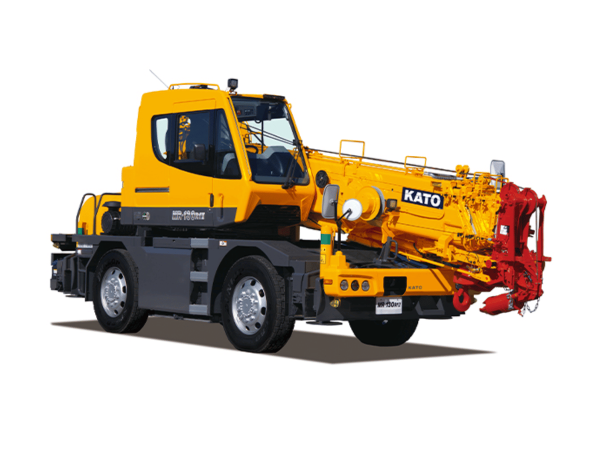
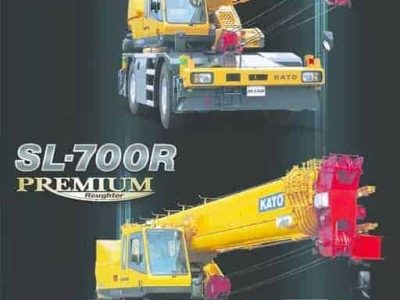
The Kato MR-130RfII represents the second-generation evolution of Kato’s highly successful Cityrange Superboom series. Marketed as the “Premium Jib” version, the crane was developed to deliver enhanced lifting performance and improved working flexibility through the addition of a hydraulically adjustable power jib. The model designation KRM-13H-F2 identifies it as a 13-ton rough terrain crane designed specifically for congested urban environments and projects where larger rough terrain cranes cannot easily operate.
At the heart of the crane is a six-section box-type hydraulic telescopic boom extending from 5.3 m to 24.0 m. The boom uses a synchronized telescoping arrangement where the second and third sections extend together, followed by the fourth, fifth, and sixth sections. This design provides excellent rigidity while maintaining smooth boom extension characteristics. The crane achieves a maximum rated lifting capacity of 13 tonnes at a 1.7 m working radius with the fully retracted 5.3 m boom. At longer boom lengths, capacities remain competitive, including 6.0 tonnes at a 4.0 m radius with the 9.04 m and 12.78 m boom lengths, 5.0 tonnes at a 4.5 m radius on the 16.52 m boom, 4.7 tonnes at a 4.0 m radius on the 20.26 m boom, and 3.2 tonnes at a 5.5 m radius with the fully extended 24.0 m boom.
One of the distinguishing features of the MR-130RfII is its hydraulically adjustable two-section power jib. The jib is available in lengths of 3.65 m and 5.6 m and can be offset hydraulically from 5° to 60°, allowing operators to position loads over rooftops, inside structures, or around obstacles. With the main boom fully extended and the 5.6 m power jib installed, the crane reaches a maximum lifting height of 30.4 m. Jib lifting capacities reach 1.6 tonnes on the shorter jib and 1.0 tonne on the longer jib, while a rooster sheave rated at 1.8 tonnes is provided for single-line lifting duties.
The lifting system consists of independent main and auxiliary winches driven by hydraulic motors through planetary gear reductions. Main line speed reaches 118 m/min, while the auxiliary winch achieves 106 m/min. The main hook speed is 14.75 m/min with eight-part reeving, while the auxiliary hook can achieve 106 m/min in single-line operation. A high-speed lowering mode is also available, providing a maximum lowering speed of approximately 160 m/min under no-load conditions. Boom elevation ranges from -7.5° to 82°, with full boom raising completed in only 29 seconds and full extension of the 18.7 m telescoping stroke requiring approximately 64 seconds. The crane’s slewing system operates at 2.4 rpm and has a compact tail swing radius of only 1.6 m, making it particularly suitable for restricted work sites.
The superstructure is supported by either a fully hydraulic H-type outrigger system or an X-type outrigger configuration depending on specification. Maximum outrigger spread is 4.75 m, with intermediate settings at 4.3 m, 3.7 m, and 2.7 m. The H-type configuration additionally offers a minimum outrigger spread of only 1.64 m, enabling crane operation in extremely confined areas where conventional outrigger deployment would not be possible.
Power is supplied by a Hino J05E-UM four-cylinder turbo diesel engine compliant with Japan’s 2014 special vehicle emission regulations. The 5.123-liter engine develops 129 kW (173 hp) at 2,500 rpm and produces a maximum torque of 540 Nm at 1,600 rpm. The carrier utilizes a selectable 4×2 or 4×4 drive system, paired with a torque converter transmission offering fully automatic or manual gear selection. Maximum travel speed reaches 49 km/h while gradeability is rated at 57%.
A major strength of the MR-130RfII is its maneuverability. The machine features three steering modes: front-wheel steering, rear-wheel steering, and independent four-wheel steering. This allows a minimum turning radius of only 3.92 m in four-wheel steering mode and 6.5 m in two-wheel steering mode, making the crane exceptionally capable in congested urban environments, factory sites, and infrastructure projects.
Safety and operational technology are centered around Kato’s ACS (Automatic Crane System), which incorporates overload prevention, voice alarms, automatic slewing stop functions, work area limiters, automatic outrigger width detection, anti-two-block systems, hydraulic safety valves, drum hold safety devices, and overheat monitoring. Standard equipment includes an external ACS display, external voice alarm unit, winch monitoring camera, LED work lights, electronic level indicator with automatic outrigger leveling assistance, crane operation recorder, and Bluetooth-enabled AM/FM audio system.
The compact carrier measures only 7,465 mm in overall length, 1,995 mm in width, and 2,870 mm in height, with a wheelbase of 2,750 mm. Gross vehicle weight is approximately 14,105 kg, placing the crane within the highly popular Japanese 13-ton rough terrain crane class. These compact dimensions, combined with advanced steering and lifting systems, have made the MR-130RfII a preferred machine for steel erection, HVAC installation, utility construction, plant maintenance, and general construction projects where space limitations are a major consideration.

Reviews
There are no reviews yet.